e-book etiketine sahip kayıtlar gösteriliyor. Tüm kayıtları göster

4 Haziran 2016 Cumartesi

Priamos'un ölümü


Öğrenmek istersin sanırım yazgısını Priamus'un da;
Görünce yeniden, düşman elinde ülkesini, yıkılan
Kapılarını konağının, odalarına girdiğini saldırganların,
Kuşanır bir daha kullanamayacağı pusatları boşuna,
Güşsüz yaşlı, asar kılıcını titreyen omuzuna,
Atılır düşmana, yürür ölümün üstüne korkusuz.

Konağın ortasında, açık, göğün altında, büyük
Sunak, sunağın yanında yaşlı defne, eğilmiş
Dallarıyla Penatları çevreleyen, örten, gölgeleyen.
Toplanmış orada kızlarıyla Hecuba, çevremiş sunağı,
Azgın, karanlık fırtınadan kaçan güvercinler gibi,
Sokulmuşlar birbirlerine, oturmuş, sarılmışlar tanrı
Yontucuklarına. Görünce Priamus'u, gençken taşıdığı pusatla
Donanmış, dedi ki Hecuba: "Ey mutsuz kocam, nedir bu
Çıldırdın mı? Nereye? Ne yaparsın kuşandığın pusatlarla?
Ne yardımın var ne savunman bu durumda, geçmiş
O günler, yaşasa yetmezdi gücü oğlun Hector'un bile,
Gel buraya. Ya sunak kurtarır hepimizi ya sen de ölürsün bizimle." 
Çekti kendine doğru kocasını,
Bunları söyleyince, götürüp oturttu kutsal yerde.

İşte Pyrrhus'un ekinden ölümden kurtulan Polites,
Priamus'un oğullarından biri, oklar, yavılar arasından,
Sıyrılan, uzun kemer gediklerinden , boş avlulardan
Geçen, yaralı, seğirtir ardından azgın Pyrrhus,
kudurgan, tutup eliyle saplamış ona kargısını.
Varınca babasının anasının yanına yıkıldı yere,
Kanlar boşalmış ağzından, ayrıldı yaşamdan.
Tutamadı kendini, ölümün eşiğinde duran Priamus,
Ne sesini kesebildi, ne öfkesini yenebildi, bağırdı:

"Ey gözü dönmüş, eli kanlı, azgın, kıyıcı
Ettiğinden bulasın tanrılar önünde, işlediğin suçlar
Görülürse göksellerce görürsün gününü, çekersin
Öldürdün oğlumu gözümün önünde, gösterdin bir babaya
Oğlunun kanını, sıçrattın yüzüne, alırsın şimdi
Uygun ödül. Böyle yapmadı, oğlu olduğunu
Söylediğin Akhilleus, düşmanı Priamus'a, böyle
Davranmadı, yakaran kişiye kıymadı, uydu tüzeye,
Gömülsün diye Hektor'un kansız ölüsünü bana gönderdi."


Bunları dedi yaşlı fırlattı oku güçsüz
Eliyle, çarpıp tunca tısladı etkisiz ok, asıldı
Kaldı kalkanın ortasında temren. Dedi ki Pyrrhus:

"Öyleyse ilet babam Akhilleus'a sakın unutma
Bu kötü başarımı, Neoptolamus'un ne denli sıkıştığını
Söylemeyi de. yeter artık, şimdi sen de ölüver,"

Söyledikten sonra bunları sürüklediği sunağa doğru
Titreyen, oğlunun kanları üzerinde kayan yaşlı
Adamı, sol eliyle tutup saçlarından sapladı sapına
Değin sağ eliyle parlayan kılıcı hızla böğrüne.
Böyle sonlandı Priamus'un yazgısı, İlium'un çöküşü,
Öldü görerek yalımlar içinde yanan Troya'yı,
Yıkılan Pergama'yı, nice ülkenin, Asya'nın egemeni.
Şimdi deniz kıyısında yatan, başı omuzlarından
Ayrılmış kim olduğu bilinmeyen ölü gövde...


AENEAS - VERGİLİUS
2:506-558


Eski Türk Ulus Adı ve Bulunduğu Eski Kaynak
___________________________________________

Tiras                İskandinav kaynaklarında Traklar ve Türkler
Tir-s, Turis                                 Hazar kaynaklarında Türkler
Tirsen                                                            Yunanca Etrüskler
Turski                                                          Latincede Etrüskler
Truse                                    Avrupa kaynaklarında Truvalılar
Trausi                                       Avrupa kaynaklarında Traklar
Turşa                                        Mısır kaynaklarında Truvalılar
Turuşka                                                     Sanskritçede Türkler
Tursili                                    Ermeni kaynaklarında Turanlılar
Tarh, Tark                 Çeşitli kaynaklarda Türkler ve Etrüskler
Turki, Turukki, Turukka               Sami kaynaklarında Türkler
Turyana, Turan, Troya, Truva   Çeşitli kaynaklarda Türkler ve Truvalılar


Türkiye topraklarına Türklerin ilk olarak Orta Çağ'dan başlayarak yerleştiğini ileri süren görüş ile 7. ve 15. yüzyıllar arasında yaşamış Avrupalı tarihçilerin verdikleri Truva'nın Türk yurdu olduğu bilgisi arasında açık çelişki ortaya çıkmaktadır. Truvalıların kökeniyle ilgili bu bilgiler gerçekte yalnız Truva'nın değil, Akdeniz Bölgesinin büyük bir kesiminde yaşamış ulusların tarihiyle ilgili yeni gerçekleri ortaya koymaktadır.

Bu gerçeklerin önemli bir sonucu, Yeni Çağ'dan önceki üçüncü binyılda Küçük Asya da denilen Anadolu'da Truva kentini kuran toplumla Yunanistan'ın, İtalya'nın ve komşu ülkelerin ilk ulusları olan Pelasgların, kısaca Traklar da denilen Trakyalıların ve Etrüsklerin aynı soydan olduklarının ortaya çıkmasıdır. Bu ulusların da türk kökenli oldukları, bir yandan Avrupa'nın eski tarih kaynaklarında görülmekte, öte yandan yapılan bilimsel  araştırmalarından anlaşılmaktadır.

Eski İskandinav kaynaklarında Truva'dan Avrupa'nın kuzeyine geldiği belirtilen ulusun hem Truvalılar hem de Türkler diye anılması, onların aynı ulus olduğunu belirten çok önemli bir kanıttır. Örneğin, "Yerin Tanımı" adlı coğrafi kaynakta Asya'dan (Anadolu) gelmiş Türklerin kuzey ülkelerine ulaştıkları yazılıdır. Aynı kaynakta bu ulusun önderinin Tor'un oğlu Odin olduğu da bildirilmektedir.

"Skioldinglerin (Skjoldinglerin) Kahramanlık Öyküsü" ve Snorri Sturluson'un "Küçük Edda" adlı yapıtı gibi 12.yüzyılda yazılmış başka kaynaklarda söylendiğine göreyse, Truva Hakanı Priam'ın ulusu Odin'in önderliğinde Asya'dan (Anadolu) Avrupa'nın kuzeyine göç etmişlerdir.

Truva'nın Türklerle olan ilişkisi daha 7.yüzyılda yazılmış Fredegar Günlüğünde (Kroniğinde) ve 12.yüzyılda yazılmış Gesta Francorum adlı yapıtta anlatılıyordu. Fredegar Günlüğüne göre, Truva Savaşı'ndan sonra ülkenin düşmesi sonucu Türkler ve Franklar bölgeden kaçmışlar, Franklar Panonya (Macaristan) ve Ren bölgelerine, Türkler ise Saka (İskit) yurtlarına yerleşmişlerdi.

Tarihçi Nicole Gilles Türklerin Truvalı Turkosların soyundan geldiğini konuyla ilgili çalışmasında anlatmaktadır. 12.yüzyılda yaşamış tarihçi Tyreli William da Türklerin Truvalı olduğunu ve onların ataları Turkosların Saka yurtlarına göçünü yazmaktadır.

14.yüzyılda yaşamış tarihçi Andrea Dandalo, Türklerin Truva Hakanı Priam gibi Turkos soyundan geldiğini bildirmekle birlikte, ayrıca Türklerin Kafkaslardan geldiğini de yazmıştır.

Dominik Papazı Florasanlı Antoninus da günlüğünde Türklerin Truvalı Turkoslarla aynı ulustan olduğunu dile getirmiştir. Aynı bilgileri Bracciolini, Poggio, İsidor, Ficcino gibi Avrupalı ve öteki tarihçiler de bildirmişlerdir.

Alman tarihçi Felix Fabri ise Truvalı Türklerin tarihini Priam'ın döneminden Truva'nın daha eski çağlarına, Truva Prensesi (Ecesi) Hesione'nin oğlu Tevkrin (Teucer-SB) dönemine değin götürmektedir. Felix'e göre, Truva'nın düşmesinden sonra Hektor'un oğlu Franko'nun yönetimi altındaki Truvalı göçmenler öncelikle Almanya'da eski Frankoniya çevresine gelmişler, birçoğu Ren Irmağını geçmiş ve bugün Fransa denilen ülkeye yerleşmişlerdi. Yine Felix'in yazdığına göre, Turkos'un yönetimindeki geri kalan kesim ise, Asya'daki Saka ülkesine yerleşmişti.

İspanyol tarihçi Pero (Pedro) Tafur 1437 yılında İstanbul'a geldiği sırada Bizanslılar (Doğu Roma-SB) arasında "Türkler Truva'nın öcünü alacaklar" sözünün dolaştığını yazmıştır.

Giovanni Mario Filelfo, Amyris adlı koşuk biçimli yapıtında 2.Mehmet'in yaşamını ve utkularını (zaferlerini) anlatırken, onun soyunun Truvalılarla yakınlığını öne çıkarıyor ve Sultanın Rumlar karşısındaki utkusunu doğruluğunu üstünlüğü oalrak niteliyor. Onun düşüncesine göre, Türkler İstanbul'u alarak eskiden Truva'yı ele geçiren Yunanlılardan öç almışlardır.

İstanbul'u alan Fatih Sultan Mehmet Truva'nın tarihini biliyordu. O, 1462 yılında Midilli Adası'nı alırken, Çanakkale'deki eski Truva kenti ören yerine gelerek kahramanların gömütlerini araştırmıştı. Truva ile ilgili bütün yazılanları bilen Fatih Sutlan Mehmet Truva ören yerinde başını aşağı eğerek aşağıdakileri söylemişti:

"Allah beni bu ilin ve ulusunun dostu olarak bugüne değin koruyup sakladı. Biz bu ilin düşmanlarını yendik ve onların yurtlarını aldık. Yunanlıların biz Asyalılara karşı yaptıkları kötülüklerin öcünü, aradan uzun süre geçmesine karşın onların torunlarından aldık."

Fatih Sultan Mehmet'in söylediğinden de anlaşıldığı gibi, o İstanbul'u almasını ele geçirme değil karşılık verme olarak görmüş ve eskiden Rumların ele geçirdiği bu yurdu geç de olsa kurtardığını dile getirmişti.

Eski Yunanlılar gerçekte yalnız Truva'yı değil, önceleri Pelasgiya (Pelasgia) denilen şimdiki Yunanistan'ı da ele geçirmişlerdi. Doriler denilen bu yayılmacıların şimdiki Yunan topraklarına MÖ.2.-1.bin yıllarında geldikleri tarihsel bir gerçekliktir.

Eski Yunanlı tarihçi Heredot, Yunanlılardan önce Ellada'da (Kuzey Yunanistan) Pelasgların yaşadığını ve ülkenin onların adıyla Pelasgia diye anıldığını yazmaktadır.

Eski Yunanlı tarihçi Ksenofon ise, eski Yunanlıların Ellada'ya gelmesinden söz eden bir öyküsünde, o sırada burada yabancı bir dilde konuşanların yaşadığını belirten aşağıdaki olayı anlatır.

"Yunanca konuşan on bin kişilik bir topluluk, Balkan Dağlarından Struma veya Vardar Dersini izleyip güneye doğru ilerleyerek kendileri için daha iyi bir yurt arıyorlardı. Onlar birden karşılarında kendilerinin ve atalarının hiç görmediği büyük bir su gördüler. Şaşkınlık içinde yerlilere bunun ne olduğunu sordular. Yerlilerse şaşkınlıkla onlara gördükleri suyun thalassa (deniz) olduğunu söylediler. Böylece, thalassa sözcüğü aynı zamanda Yunan diline de girmiş oldu."

Böylelikle thalassa sözcüğü, ülkenin önceki yerlilerinin dilinden alınıp eski Yunan diline aktarılarak oluşturulan büyük sözcük kümesine eklendi. Sözcüğün kökeni Tala'dır ve öteki Hint-Avrupa dillerinde deniz anlamına gelen böyle bir sözcük yoktur. Ancak deniz anlamına gelen aynı kökten türemiş Talay sözcüğü eski Türk ve Moğol dillerinde vardır.

Pelasg Ulusunun kökenine gelince, eski tarihçilerin Pelasgları Tirrenlere veya Tirsenlere (Etrüsklere) yakın sayması, onların Hint-Avrupa kökenli değil, tersine Truvalı Etrüsk soyundan olduğunu gösterir.

Eski Yunanlı tarihçi Dionysius Halicarnassus veya Halikarnaslı Dionysios, Tirrenlerin ve Pelasgların aynı ulus olduğunu yazmıştır. 5.yüzyılda yaşamış Yunanlı tarihçi Lesboslu (Midilli) Helanik (Hellanicus) ise Tirsenlerin önceleri Pelasglar diye anıldığını ve Yunanlıların yayılmasından sonra bir bölümünün İtalya'ya göç ettiğini yazmıştır.

Limni Adası'nda ortaya çıkarılan Pelasg yazıtı da Pelasg ile Tirsen veya Etrüsk dillerinin aynı dilin yalnız değişik söyleyişleri olduğunu gösterir.

Görüldüğü gibi, eski Yunanlı tarihçilerin verdikleri bilgiler ne Truva'nın ne de Yunanistan diye anılan ülkenin en eski dönemlerde Yunan toprakları olmadığını, Yunanistan'da Truvalılar ile aynı soydan olan Pelasgların, Tirsenlerin ve Trakların yaşadığını göstermektedir.

Yunanistan'a ilk yerleşen Pelasgların, Truvalıların, Trakların özel ad varlıklarında eski Türk adları bulunmuştur. Belirlenen bu adlar ile ayrıca eski Avrupa kaynaklarının verdikleri bilgiler, aynı kökenli Truva, Trak, Pelasg ve Etrüsk dillerinin konuşulduğu Anadolu, Yunanistan ve İtalya sınırları içinde Truvalıların kökeni sorununun, bölgesel olarak incelenmesi gerekmektedir.


Prof.Dr.Çingiz Garaşarlı, Azerbaycan
Truvalılar ve Etrüskler Türk İdiler
Kömen Yayınları


The first Indo-European tribes, settled in the Mediterranean basin during the second millennium B.C., inherited the highly developed culture of the early inhabitants of the region. The problem relating to the languages of the early Mediterranean peoples has remained unsolved, although this issue has been researched during the last 500 years. Key languages have been examined from all over the world: Aramaic, Hebrew, Greek, Latin, Hittite, Lydian, Coptic, Chaldean, Egyptian, Celtic, Gothic, Albanian, Basque, Abhaz, Old Norse and many others.

The Etruscan writings, the mythological names of Greece, Rome and Troy, the substratum in Old Greek, Latin and other ancient languages, preserved some information about the origin of the aboriginals require interpretation. In relation to the origin of the Mediterranean aboriginals there is a great discrepancy between antique traditions and the opinions of European linguists. According to the authors of antiquity, the Thracians, Pelasgians, Trojans and Etruscans were all kinsmen. 

Thracians and Trojans have a close relationship in the «Iliad». As K.Blegen writes, the Trojans were part of the Thracian tribes who came to Troy during 3000 to 2500 B.C. from Eastern Europe . The name Dardan, the legendary forefather of the Trojans, reveals the Dardanian origin of the Trojans. The Dardans were one of the biggest Thracian tribes. To Apollodoros, Dardan was the grandfather of Tros, the legendary founder of Troy.

As for the Etruscans, ancient traditions indicate that they are descendants of the Trojans, who came to Italy after the collapse of Troy. The collapse of Troy coincides with the time of the appearance of the Trojans (Tursha) together with other sea peoples in Egypt  – the 13th century B.C. Simultaneously they migrated to Italy. They were the same Tirsens, described by Herodotos, to have migrated to Italy from Asia Minor as a result of famine . These Tirsens, according to Dionisi Halikarnaski, a Greek historian, were the Pelasgians. According to him, Tirsens (or Tirrhenians) and Pelasgians were the same nation . This idea is shared by Helanik of Lesbos, a 5th century Greek historian, who informs us that the Tirsens were initially called Pelasgians and, after the Greek occupation in Greece, some of them went to Italy .

Thucydides, an old Greek historian, thought differently. To him, the Tirrhenians formed a greater ethnical union,the Pelasgians being only part of them . 

The idea of Etruscan - Pelasgian kinship in our times was supported by some linguists, who discovered a close relationship between the Etruscan writings and the writings found on the island of Lemnos which was once settled by the Pelasgians. They possess only some dialectal differences .

Thus, the Thracians, Trojans and Etruscans on the one hand and the Tirsens (Etruscans) and the Pelasgians on the other appear to be ethnically interrelated. However, some European linguists, not taking into account the traditions of antiquity, have tried to relate the Thraco – Pelasgians to the Indo-Europeans. Neglecting the information of D.Halikarnaski, Helanik de Lesbos and Thucydides about the Pelasgo - Tirsenian kinship, they isolated the Pelasgians from the Tirsens as Indo-Europeans, while the latter was considered to be of unknown origin. They also neglected the commonly known relationship between the Etruscan (Tirsenian) and Pelasgian writings, thereby excluding the Indo-European origins of the latter.

Contradiction is also revealed in relation to Thraco – Trojan languages. These two peoples, mentioned in the «Iliad» and in other sources of antiquity as being kinsmen, are referred to as originally different peoples – the Thracians as Indo-European, but the Trojans as non – Indo-European. 

Neither the information of old Scandinavian sources about the Turkic origin of the Thracians and the Trojans, nor the Turkic elements discovered in the Etruscan language, were given due attention by linguists. They associated these Turkisms with contacts between «Asian» Turks and the old inhabitants of Asia Minor, where the ancestors of the Etruscans had settled . Could there have been any Etruscan – Turkic contact if the first Turks are alleged by European researchers to have appeared in Asia Minor in the Middle Ages?

The ancestors of the Etruscans, known to have left Asia Minor in the first millennium B.C., could not possibly have had any contact with the Asian Turks of the Middle Centuries. The truth is that the Etruscans themselves were Turkic by origin like their Trojan ancestors, who are referred to as Turks in old Scandinavian sources.

The exclusion of the Turks from Mediterranean civilizations is connected with traditional theory, according to which the motherland of the Turks is Central Asia. However, this view is incompatible with the results of the Nostratics, which revealed the kinship of different language families of Eurasia and Africa. 

According to this branch of linguistics, at some time in the dim and distant past, mankind shared a single language. This became split into different dialects and changed over long periods of time. Fore Asia is considered the cradle for Nostratic languages (IndoEuropean, Semitic, Uralic, Turkic, Caucasian, etc.. This has been proved by the discovery of lexico-grammatical features common to these languages. For instance, the personal pronouns mon, ton, son («I», «you», «he») in the Mordva (Uralic) language and the possessive pronouns mon, ton, son («my», «your», «his») in French are evidently of the same origin . To them can be added the Turkic men, sen («I», «you»), Georgian me, shen («I», «you»), etc....

Turkic languages have an evident relationship with the Nostratic (Indo-European, Uralic, Semitic, etc.) languages.They cannot be isolated from the history of Western civilizations, in particular, from those of the Mediterranean basin. The theory about the Central Asian origins of the Turkic languages contradicts their distant relationship with the Indo – European, Semitic and other languages. Like other Nostratic peoples, the Turks have migrated to different parts of Eurasia. Only some of the Proto-Turks migrated to the East, whilst others, concretely those of Thraco-Trojan origin, could have initially settled somewhere between the Caucasus and the Mediterranean basin independently from the Asian Turks.

The English scientists I.Lloyd and G.Child maintained that the Turks, who settled in the basin of the Tigris and Euphrates in the 12th millennium B.C., took an active part in the creation of world civilization . One of these was the Etruscan civilization. 


The Greek and Italic languages of the Mediterranean basin are known to have been preceded by those of non – Indo-European origin, previously not identified by linguists. Indo-Europeans are considered to have arrived from Eastern Europe. The arrival of the first Hellenic people has been described by Xenophon so: 

«Some ten, or maybe fifteen centuries before the march of the Ten Thousand a band of Greek-speaking people made their way south out of the Balkan Mountains, down the Struma or Vardar valley in search of a more comfortable home. Suddenly they saw in front of them an immense amount of water, more water than they or their ancestors had ever seen before. In astonishment, they contrived to ask the natives what it was and the natives, rather puzzled, said, «why, thalassa, of course». 

So, «thalassa» it remained, after nearly all the other words in that language had perished . This story reveals that the pre-Hellenic people of Greece spoke quite a different language in which thalassa meant «sea». It was adopted into the Greek language. Thala, which is not observed in the Indo-European languages, is consonant with the Old Turkic talay («sea», «ocean») . The word talaz («wave», «waterspout»), in modern Turkish language, is of the same origin . It originates from early Turkic languages of Asia Minor. Despite Kitto’s statement thalassa (thala-ssa) was not the only native word left in Old Greek, native Pelasgians had left a whole group of their words, known as the pre-Greek substratum, covering both onomasticon and vocabulary. A significant part of them has been discovered to be Turkic by origin. 


Prof.Dr.Garasharly Chingiz, Azerbaijan
The Turkic Civilization Lost in the Mediterranean Basin

_________________________
_________________________

26 Şubat 2016 Cuma

Taştık, Yenisey, Kırgız, Hun Kurganları


The images of soldiers on planks crypt number 1 burial Teps III. 1, 3 - 7 strap; 2 - strip 6; 4, 7 - the bracket 3; 5 - 5 lath; 6 - 1 strap


Hun-Scythian-Turk in Tashtyk


1. Art post Scythian time that is, to the territory of Tuva Hun-Sarmatian period, It is of great interest for understanding the overall genetic development of the culture of the nomads of the steppe regions of the eastern zone. Chronologically, the specified period is between two important eras - Scythian and ancient Turkic, which gives special importance to the issues of cultural continuity. Art of this period little studied, represented mainly by the applied nature of the subject, and, as a rule, ceremonial purposes. All of them are inherent features of Scythian art.


2. In this connection, great interest two pairs of bone lining the middle of a complex bow, Point of interest in recent years in Central Tuva One (Fig. 1) is derived from the repository of the Kara-Dag, the other (Fig. 2) from the burial Aymyrlyg. Both pairs of single graves with characteristic Hun-Sarmatian time ritual burial and accompanying equipment. The burial of the Kara-Dag (Turkish; Black Mountain-SB) it accompanies clay pot type, has obvious similarities with ceramics Huns, known as the territory of Trans-Baikal, as well as in Mongolia.


3. On both pairs of pads, judging from the surviving fragments, depicted hunting scenes, made a fine line to be cut, the style of these images previously on the territory of Tuva is not known. The closest analogy to them, In our opinion, can be wooden plates of burial Teps III (Krasnoyarsk Territory), although it is worth to point out their nonequivalence. There we have a large multi-figure compositions, here the small scenes, but nevertheless it seems legitimate to talk about the common style of these images, point out in particular zashtrihovku body of horse and deer antlers interpretation Karadag image.


4. Considered lining relate to an earlier time than tepseyskie signs and apparently reflect an earlier form of development is now looming trends in fine art post Scythian time. There is reason to believe These findings are the beginning of a series of items with similar images. It is possible in the future to trace some of the trends in the evolution of art of ancient nomads of the Middle Ages.


Fig.1.The cemetery of the Kara-Dag. Fig. 2. Burial Aymyrlyg.
Bone lining composite bow from Central Tuva.


New monuments of the fine arts after the Scythian period of the Central Tuva.
// Problems of the Scythian-Siberian cultural and historical unity.
Kemerovo: 1979, pp 145-147.(google translate from Russia)


Teps III

Compact group at different times and different nature monuments located along the terrace above the floodplain strip, the length of which is 160, width of 30 m (Fig. 3). This grave and podgornovskogo tesinskogo stages Tagar culture, tombs, children's graves and pits with offerings Tashtyk memorial culture, the graves of the Kyrgyz-time. 


On the surface of the terraces were clearly visible two large Tashtyk crypt and one small, were on the most elevated points of the terrace and has a dominant position in the cemetery. Around them it has many graves in the form of circles or rings formed by outcrop rocks. Often, in the middle there was a slight decrease, sometimes free of stones - rings. On the periphery of such burial ring freely located at some distance from one another and are each separately visible, while in the central part are clustered, overlapping each other. At the periphery of each individual it has been opened tomb excavation, and around the crypts studied one large continuous excavation. When attempting to open some small grave excavations inevitably affects other tombs and pits with a memorial offerings, features on the surface of which were absent.


The southern part of the burial ground was flat. There were several vertically set slabs up to 1.5 m, and could see many of the top edges of the plates. Any order in the arrangement of plates could not be traced visually. Excavations also showed that some boards were pitted with memorial offerings Tashtyk time. Such plates, but in smaller quantities, and discovered elsewhere repository.


During the work in paragraph Teps III were discovered and studied memorials 7 different cultural and historical periods - from the Chalcolithic to early medieval times. Chronologically resulting material can be classified as follows:


1. Afanasyevskaya culture: a fragment of a stone beater found about 28 graves.
2. Kamennolozhsky stage Karasuk culture: fragments of pottery found during excavations of graves 9 and 11 Kyrgyz time.
3. Podgornovsky stage Tagar culture graves 13, 35, 38, 62 and a bronze awl, identified during the excavation of the grave 9 Askizsky culture (Figure 4 as well.).
4. Bidzhinsky stage Tagar culture: a fragment of a clay vessel, met during the excavation of the graves 22 and 23 Tashtyk culture (Figure 4b.).
5. Tesinsky stage Tagar culture graves 16, 24, 25, and a fragment of a clay vessel unearthed graves 9 Askizsky culture (Figure 4 as well.).
6. Tashtyk culture (tepseysky stage): two large and one small crypts; 38 graves (4, 8, 12, 17, 22-24, 26 - 29, 34, 37, 39-65); pits with a memorial offerings found during the excavation of the graves 14, 28, 32, 33 Kyrgyz time and in paragraphs A and B; Fragments of pottery encountered in the excavation of the tomb of the Kyrgyz 36 time (Figure 4b, c).
7. Kyrgyzskoe time grave 1-4, 6-12, 14, 15, 18, 19, 27, 28, 30-33, 36, 44, 50, 67 (Fig 4 in.).


In some cases, due to the failure of the material was difficult to decide, it refers to the grave Tashtyk culture or to the Kyrgyz-time. However, in all such cases, the decision was made, and the graves were distributed to the respective periods. If in due course it will be possible to detect and correct errors, material changes in our cultural and historical construction of this will not make as monuments considered too poor information.


Fig. 1. Archaeological neighborhood Teps before excavation (1968):
1 - general view of the southern part of (I, II, III ... - items T.I excavation, T.II, T.III ...): 2 - Teps III, pominalnik; 3 - Teps III, Kyrgyz children's grave 8.

The complex of archaeological monuments at Mount Teps on the Yenisei. / Novosibirsk, 1979, 167 p. google translate from Russia


Teps III. Drawing on a charred strip of Tashtypsky crypt.


Teps III. Drawing on a charred strip of Tasty Sky crypt.


Barely visible on the surface of the monuments of different types and different epochs are located on a narrow terrace above the floodplain Yenisei leaning against the steep mountainside Teps, on the rocks in a variety of which are ancient Turkic inscriptions and drawings. It worked three companies Krasnoyarsk expedition. Rannetagarsky squad investigated a series of mounds podgornovskogo stage and some other periods. Kamensky squad copied carved on the rocks pictures and inscriptions. Karasuk squad to focus on the excavation of burial Tashtyk culture and, moreover, examined a series of monuments from different eras. In general, in the area above the floodplain terraces length of 500 meters to explore the numerous graves of 11 consecutive periods, and on the edge of the meadow adjacent terraces - the remains of settlements of two epochs.


Excavations circular stone wall Afanasiev culture in paragraph VII Teps found two graves - collective and individual, usually a device burial facilities for burial rite and inventory: egg-shaped pots and decorative horny studs. New excavations in the given parking point Teps X. cultural layer lies at a depth of 2.5 m is almost directly on the gravels. Covering an area of ​​90 sq opened two centers and several fireplaces. Found typically Athanasian shards, bones of domestic animals (cow, sheep, horse), stone and iron is polished ax. Pockets are like in-depth into the ground bowl with a diameter of about 1 m, 20 cm deep, lined with stone tiles on the walls. Such lesions are associated with cooking is not on fire, but in the hot ashes with sand, which corresponds to the shape and ostrodonnaya vessels.


Four fences Karasuk culture in paragraph VIII Teps interesting stratigraphic observations. All of them are robbed, many years after burial (after complete decomposition of corpses), and then the mound was built saragashenskogo stage, put on top of a fence which disturbed the robbers cover the grave. So, robbery Karasuk graves produced in antiquity, in the XI-V centuries. BC.


Kurgan saragashenskogo stage (IV-III centuries BC.), The so-called vosmikamenny contained in the center of the two collective graves and around them several children. At 3 and 15 m from it found another two collective graves saragashenskogo stage, had no gravestone constructions. In one of them were buried the bones of three people - not the bodies and bones. The bones of an adult male are laid in the grave in anatomical order, but with a few mistakes. The bones of two children four and five years of age stacked in two piles. All three were killed by blows to the head and a bronze chisel tetrahedral tip. When a man found a pot and a bronze knife.


Graves tesinskogo stage (II-I centuries BC.) Met as the inlet to the mound saragashenskogo stage, and in the form of separate ground graves. One of the last discovered under the fence Tashtyk crypt and it is resting on a dirt Tashtyk grave. This is confirmed by a chronological sequence of steps Saragash - Tes - Tashtyk. Tomb in paragraph VII Teps interesting finding in her bronze buckles with a picture of the head of the Saiga, lace and other metal plates, iron dagger in a sheath covered in black varnish with a red stripe.


Chaatas Kyrgyz and Kyrgyz series of stone tombs in paragraphs Teps XI and III contain the usual stuff. Interesting burying warriors with osёdlannym horse and the grave, where one pit buried the ashes of burnt man in the other - the ashes of a horse. Fully excavated a small cemetery Teps II pre-Mongol times (XI-XII centuries. BC). His nine graves with ceramics and iron things light very poorly studied period on the Yenisei.


The most varied and gave the new material a complex of monuments in the cemetery Tashtyk culture Teps III. Crypt excavated large (50 square meters), which contained the burial of a few dozen people. Crypt burned. Besides the usual bronze and iron objects (buckles, paired heads of horses, chains, etc.), Ceramic, plaster byustovyh masks, it preserved bark purse wooden charred trough, barrel wine (?), Two large statues of deer, of the wooden boxes and capillaries, strips with images on them, and various other things. In a small crypt (16 square meters) were also plaster masks of different shapes pottery, bark tues, bronze buckle and head of horses and, in addition, a lot of sheep and cow heel astragalus (talus and calcaneus in the joint). About crypts excavated a series of children's graves with the same ceramic as in the tombs, sometimes with iron and horny things. Among the graves, and in a separate area to the south of the crypts excavated a large number of holes with a memorial offerings: One-pot and a few pieces of beef or lamb. Finally, on the edge of the meadow terrace investigated the cultural layer of the settlement.


Completely new was the discovery of a large crypt charred planks with preserved them multi-figure compositions. Trims up to 1 m, a width of 6-12 cm with a handle at one end, covered with subtle delicate drawings, cut the edge of the knife. On one side of the strap is usually depicted running deer, moose, bears, wolves and other animals, on the other - compositions on the theme, apparently, the heroic epic and historical novels. Shown horsemen and foot soldiers with bows and arrows, sometimes in combat armor. They run, shoot, race horses, fell wounded. Presents a picture of the battle, theft recovery, chase, battle on the boat and others, most of us are not yet understood. Surviving on planks figures are, of course, only the contours of the former here polychrome images. It is the oldest in Asia miniatures (II-VI cent. BC), stylistically quite peculiar. They left the company, did not have yet either public or written language, while all known ancient miniatures and murals of heroic themes were created in a class society, the State, with the development of writing and literature.


MP Grjaznov, MN Komarova
// AB 1968. M .: 1969. pp 176-179. google tr.from Russia


Fig. VIII. Sadaqa "early-type" in the monuments of the first half of I millennium:
1 - Niya, burial 8 [on: The Institute ..., 2000]; 2 - The cave artists [on: Le Coq, 1925]; 3 - Kumtura, mural fragment [by: Caves of the Thousand Buddhas ..., 2008]; 4 - Orlatsky repository [on: Nikonorov, Khudyakov, 1999]; 5 - Tongue-and-Sarvak approx. 200 g [on: Ghirshman, 1962]; 6 - relief fragment from the stele Afeni [on: Desyatchikov 1972].


Fig. VI. Tattoos on the mummy of a man Oglahtinskogo burial ground (4 m.), Infrared photography:
1 - on the back; 2 - on the chest; 3 - on the left hand; 4 - on the right hand [by: Kyzlasov, Pankov, 2004].


Fig. X. Quivers with protruding rear wall and frame-frames:
1 - Tashtyk engraving (Teps Sq 4, 6; Tasheba, 1 sq..); 2, 3 - curly frame quivers of M. Pereshchepino and Bochy [on: Zalesskaya et al, 1997;. Tóth, Horváth, 1992]; 4 - Kamtyttukem [on: Savin, Semenov, 1997]; 5 - Hocho, drawing with painting the IX. [By: Le Coq, 1925].


Fig. V. Realities of the first group of soldiers and comparable materials from Tashtyk monuments:
2-4, 7-8, 10 - Tashtyk engraving (Teps, Tasheba); 1 - model on (photo author); 5, 9 - tattoos [on: Kyzlasov, Pankov, 2004; Pankov, 2005]; 6 - cap [on: Pankov et al., 2010].
1, 5, 6, 9 - Oglahtinsky burial, m 4..


Fig. III. Warriors of the third group in Tashtyk miniatures:
1 - Teps, 2-3 - Tasheba


Fig. II. Warriors of the second group in Tashtyk miniatures:
1-7 - Teps, 8-9 - Tasheba.


Fig. I. The soldiers first group Tashtyk miniatures:
1-3 - Teps, 4-5 - Tasheba.


Fig. XIII. Images of Turks (haircut)
1-3 - with a funeral couch An Tse [on: Anjia Tomb ..., 2003]; 4 - funerary statuette of 550-577 years. [By: Stark, 2008]; 5 - Pile, painting of Maya Cave-III [by: Yatsenko, 2009]; 6 - on the sarcophagus Yu Hon [on: Yatsenko, 2009]; 7-9 - Altai, rock engraving [on: Kubarev, 2005]; 10 - Engraving fragment from the 20th Shilovsky repository [on: Bagautdinov et al., 1998]..
Source:
SV Pankov
// The ancient art in the mirror of archeology. On the 70th anniversary of the DG Savinova.
Not: Resimleri yeni sekmede açarak büyütebilirsiniz


Scythian-Turkish Warrior with Bow
and
Mamluk Turkish Bow on Vase


Eski Türk Kurganları - Orta Asya


Cups with Turkish inscriptions


Turkish inscriptions


Ancient Turkic Sayano-Altai VI-X centuries.
// Sverdlovsk: Ural State University. 1990. 223 p. ISBN 5-7525-0086-9

Multifunction tools, household items and appliances. 
For the ancient Turks Sayano-Altai peculiar preservation and further development of local traditions, as well as the invention of new techniques in the development of production tools, utensils and other household items. Made of metal, wood, bone, leather, clay and other raw materials. Set things in Turks tugyu very diverse. (google translate from Russia)


Uyghur Turkish inscription


Sogdian word in Turkic inscriptions, known as the Turkic words Sogdian inscriptions reflect the Turkic-Sogdian relationship, without giving more solid grounds for localization inscriptions.

Monuments Uighur culture in the Altai should, apparently, be considered monuments of the so-called Srostki culture named after a burial ground Srostki I in the foothills of the Altai. Earlier this culture were noted only Kyrgyz influence, since its appearance in the Altai long time belonged to the IX. Only after the dating of early graves Srostki end of the VIII century. based on the relative chronology of the coins and the opportunity to link the emergence of a new culture in the Altai region with access to the historic arena Uighurs (745-840 gg.). It was found that in the Altai foothills at that time there was some newly arrived tribe srostkintsev characterized by anthropological type and burial rites, spreading their culture and in the Altai Mountains in the population with the same anthropological type and the same rite of burial. In addition, srostkintsev foothills of a new type of belt completely decorated with hanging straps, belts as depicted in the paintings of Turfan in Indikutshari, including on the above picture with the image cut-cups. These direct data communication srostkintsev foothills of the Uighurs was listed as a reflection of Uighur influences. (google translate from Russia)

Shining bowl with the Yenisei
(The issue of Uighur monuments in the Sayano-Altai)
// Bronze and Iron Age in Siberia.
/ Materials on the history of Siberia. Ancient Siberia. Vol. 4. Novosibirsk, 1974, pp 177-183.


Ancient Turkic memorial complex/stone stele. 
c. 2 meters height, a few meters from the stele is the mound/kurgan.
Near Inya Village - Altai


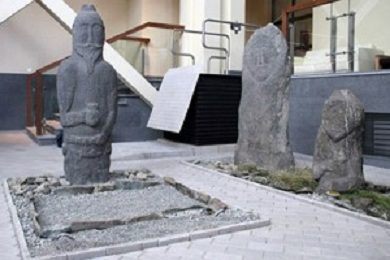
Antik-Türk dönemi, en az beşbin yıllık, yüksekliği 4 metreyi bulan, kutsal taş steller "Geyik Taşları".


Stone statue of a warrior-Tashbaba (Taşbaba)
Kurai steppe in the Altai
Culture Altai Turks
VII- VIII centuries
Russian museum in Gorno-Altaisk


Truva Kazılarından Bir Anı...


Schlieman’ın, 1871’de “şu anda tarla işleriyle uğraştıklarından Türk işçi bulunamadığına” değinerek. Hisarlık tepesinin kazısı için Yenişehir’den ve yakındaki diğer iki köyden 100 kadar Rum İşçi tuttuğuna dair yazdıklarını hatırladım.

“Rumlar, bölgenin en yoksulları dahil, saatte bin frank kazanacak olsalar bile bayram günü çalışmadıklarından, envai çeşit Rum bayramı nedeniyle” kazıların sık sık kesintiye uğramasından yakınıyordu.

Başka bir yerde, beş yüzyılı aşkın Türk egemenliğinden sonra, Rumların ulusal dillerini hiç bozulmadan koruyabilmelerinden duyduğu şaşkınlığı dile getirmişti.

John Freely
Troya Savaşı'ndan İstiklal Harbi’ne Anadolu'da Yunanlar 

Truva Hazinesi diye geçiyor
İskit Dönemi olabilir.


I recalled Schliemann writing that he hired 100 Greek workmen from Yenişehir and two other nearby villages to excavate the mound at Hisarlık in 1871, nothin that "Turkish workmen were not to be had, for they were at present occupied with field work". He complained that the work was often interrupted "owing to the various Greek festivals, for even the poorest Greek of this district would not work on a festival even if he could earn 1.000 francs in an hour".

Elsewhere he ramarked on his amazement that the Greeks, after more than five centuries of Turkish domination, still preserved their language intact.

Children of Achilles: The Greeks in Asia Minor Since the Days of Troy
John Freely


Truva hazinesi - Rusya'da


Altaylardaki kurgandan "triangle"
Turkish-Altai burial VI-VIII centuries
Kiselev
aynı kazıdan çıkan / from the same kurgan
Belt with Turkish inscription


Ve Truva Mühürleri


"Schliemann - Der Geheimnisvolle Schatz von Troja" Almanca Film fragmanı