tukri etiketine sahip kayıtlar gösteriliyor. Tüm kayıtları göster

9 Ağustos 2020 Pazar

Saka Türkü Buda ve Kuşanlar


Saka Türk boyundan olan "Bilge Öğretmen" Siddartha Gautama Buda (MÖ 623-543) bir Saka tiginidir. Hindistan'da Saka Türkleri "Shakas" ya da "Sakya" olarak geçer. Buda, Saka Türkleri tarafından Bur Kağan - Bur Han olarak adlandırılmış. Burhan/Bürhan sözünün Arapçadan geldiğini ve delil, güçlü kanıt, tanrısal aydınlık anlamına geldiğini savunanlar Bür/Bur hecesiyle Türkçede türetilmiş birçok özel isim olduğunu unutmaktadır ki Dede Korkut, Kaşgarlı, Eski Yazıtlar ve Uygur yazıtlarında geçtiğinin de farkında değildir; Örneğin, Babur/Babür, Bürgüt/Bürküt, Baybüre, Burçak, Burslan, Burulday, Burkay, Bürkek, Burhân, Burcu, Burla, Bürçü, Burguçan, Burçin... v.s. gibi, ya da Burta gibi Türk adları var ki birçoğu hâlâ Türk dünyasında kullanılıyor. Buda'nın anlamı da aydınlanmak demektir. Sorguluyoruz o zaman; O tarihte (MÖ 5.yy) Arapçanın o bölgede ne işi var? Ayrıca Moğolca'da da Burkan derler, ancak o da Türkçe kökenli; Bur Kan/Han - Bur Kağan gibi... Ve Türkçe olan Kağan sözünün de Hindistan'da Khan olarak kullanıldığı biliniyor. Bu arada Türkçenin Akadca ve onun torunu olan Arapça üzerinde etkisi olduğu da...


Budizm Kuşhanlar ile Orta Asya'ya yayılmıştır.
Sivri başlığı ile bir Kuşhan, Sakalardan geldiklerine en güzel kanıttır.


Filozof dedikleri Toxaris, Anacharsis ve Abaris gibi Şaman/Kam çıkaran Sakalar, Buda'yı da çıkarmıştır. Bir diğer filozof ise Ammonios Saka'dır (MS 2.yy). O da Mısır'a göçen Saka Türklerinden gelir. [Prof.Dr. Mehmet Bayrakdar, Yunanistan'da Saka Türkü Üç Filozof]


Birçok "bilimadamı" Sakaları-İskitleri "İranî" sayar, ancak gerçek hiç de öyle değildir! Hindistan'ın ilk başbakanı C.Nehru (1889-1964)'den aktaran Prof.Ağasıoğlu : "Doğu'ya giden Sakalar hakkında C.Nehru şöyle der :  - Sonra Saka akını başladı. Onlar sayıca çok idiler. Hindistan'ın kuzeybatı bölgelerine yayıldılar. Sakalar Türklerin büyük, göçen boylarındandı. Onları da öz yerinden başka bir büyük boy olan Kuşanlar çıkarmıştı - ". [Prof.Dr. Firudin Ağasıoğlu, Lidya Kralı Krez Azerbaycan'da]. 

Aynı şeyi Gandi de söylemiştir: "Hindistan bir anadır ve iki çocuğu vardır; Biri Hintliler, diğeri Türkler."


Kazakistan'dan Prof. Dr. Karjaubay Sarthocaoğlu da ; "Avrupa merkezli araştırmacıları Sakaları (İskitleri) İranlıların atası olarak nitelendiriyor, aslında onlar Türk halklarının atasıdır. Son yıllarda Avrupa merkezli araştırmacıların çalışmalarını inceleyenler, bunların çok fazla hata içerdiğini ve bilimsel dayanağı olmadığını kanıtladı. Tarihsel veriler, destan ve efsaneler, etno-kültürel kimlik, arkeolojik ve dil açısından, antik dönem Sakaların torunlarının Türkler olduğunu ortaya koymuştur" demektedir. [Karjaubay Sarthocaoğlu]


Batılılar, Hindistan'daki İskitlere "İndo-Scythian", yani Hint İskitleri demekte, ancak herhangi bir tarihçi eğer İskitleri/Sakaları İranî gösteriyorsa "İranî" denmesini dikkate almayacağız! Hindistan'ın kronolojisini anlatan ve Kaşmirli Kalhana'nın 12.yy'da yazdığı "Rajatarangini (Nehir Kralları)" adlı eserde, Kuşhanlara Turuşka (Turushka) denildiği, Turuşka sözünün de Türkler için söylendiği de bilinmektedir. Bu arada Kaşmirliler değer verdikleri bilginlerine yerel ad verirdi ki Kalhana adı da Sanskritçe değil yerel bir addır. [Prof. K.N.Dhar, Kalhana - The Chronicler] Bununla birlikte "Kavi Bilhana" adında da 11.yy'da yaşamış şairleri de bulunmaktadır. Buradaki Bilhana, yani Bil Han da tıpkı Sumerli Bilgemiş ya da Göktürk Hakanı Bilge Kağan'daki gibi Türkçedir.


Bilhana'nın hayatını anlatan 1948 yapımı filmin afişi


Aşağıdaki görselde Saka-Türk Kralı Azes (Scythian Azaz olarak da geçer)'e ait iki sikke.

Türk oturuşu ve Türk savaş geleneğine göre atının kuyruğu düğümlüdür. Azes'in bir elinde kuş var , ya Türk sanatında sıkça kullanılan avcı betimlemesi ya da ölüm, taşbabalardaki gibi ruhu kuş olup gitti, demek. Diğer elinde de devleti temsilen Kurt Ağzı dedikleri sancak bulunmakta. Kral Azes öldükten sonra Sakaların hakimiyeti bitmiş ve Kuşanların hakimiyeti başlamıştır ki MS 6.yy'a kadar devam eder. Devletin resmi dini olan Budizmi Orta Asya'ya adları bir kişi adından gelen Kuşanlar yaymıştır.

 Bu tamgalar Kırım-Tatar tamgalarıyla da benzerlik gösterir.

Pakistanlı bilginler bile Saka/İskitler ile Kuşhanların Türk kökenli olduğunu bildirilerinde sunmuştur.

"This was followed by the conquest of Sakas or Scythians and Kushans (120 BC - 200 AC). Scythian remains unearthed at Banbhore (the old port of Debal) indicate that they had advanced far to the south of Sind. Both Scythians and Kushans were of Turki origin and they conquest also..."

Sind a Historical Perspective By Dr Nabi Bakhsh Khan Baloch


Sömürge politikası güden Oxford bile itiraf eder: Kuşhanlar Türk kökenli.


Kısaca Buda Sakalardan gelir, Sakalar ve Budizmi yayan Kuşhanlar Türktür. Buda'nın "Three Jewels" dedikleri "Üç Hazine-Mücevher" betimlemesi Göktürk abecesindeki Ant sesini veren damgadır ki bugün çintemani olarak da biliniyor. Swastika olarak bildiğimiz ve Buda heykellerinde sıkça rastladığımız Oz damgası ise tüm Türk dünyasında tanrıyı temsil eder ki, Büyük Ayı'nın Kutup Yıldızı etrafındaki mevsimsel döngüsüdür. Kağan'ın tahta çıkmasını, tanrının yeryüzündeki görseli/temsili ya da tanrıyla bütünleşmek anlamına da gelir.


Semra Bayraktar (SB)


Türkçe - İngilizce karışık kaynaklar:


*** "Tanrılaştırılmış Buda gerçekte Aryan değil, Turani kökenlidir." [Forlong, Faiths of Man, Cilt 1]


*** "Hindistan'da Budizm Türkler geldikten sonra yayılır... Kendisi bir Saka prensi idi... Hintliler ona Türk Tanrısı derken, Türkler ona Tengri Burk-Han, yani Tanrı'nın Elçisi derdi. Bu sebeple her zaman mavi gözlerle betimlendi, çünkü Türkler de mavi gözlü idi..." [Murad Adji]

[ Buradaki mavi gözlü Türkler Kıpçak Türklerdir, ki Hindistan Kıpçak Türkleri tarafından yönetilmiştir. Sakaların arasında mavi göz, açık renk ten ve kızıl/sarı saç görülmekte. Çünkü Tarım Havzasında bulunan mumyalar bu özellikleri taşır. Bunların arasında da Türk var, ve en güzel kanıt ise 3500 yıllık pantolonun üzerindeki damgadır. Bu betimleme, pantolon bulunmadan önce de Türk kilim, halı ve örgüde kullanılıyordu. - SB]


İngilizcesi:

[Buddhism arose in Hindustan after the Turks had come there. Seekin the meaning of life, a certain man now known as Siddartha Gautama (Young prince of the Sakya people in what is now modern Nepal, born in the sixth century BC, known as the Buddha) came to the conclusion that Monotheism is impossible (apparently in a continuation of the spiritual dispute that originated in the Altai at that time)... The native Indians called Buddha Shakyamuni, which literally means 'Türkic God'. And the Turks called him Tanghri Burkhan, i.e. Tengri's Messenger. That's why he is sitll drawn with blue eyes, the same as all other Turks... In Nepal, near Rummindei, there is a column where the name of the founder of Buddhism is carved - the name of a human being from Shakya family who came from the North. The column was raised in the 3rd century BC. It marks the place where Buddha Shakyamuni, 'the sage from Shakya family' or the 'Turkic God' was born. The king Kanishka complemented the Buddha's image on coins with the incription 'Sakamano Boddho' and 'Bogo Boddho'. The first incription emphasized the belonging of Buddha to the Turks, and the second is translated as 'God Buddha'. That is to say that starting from the 1st century AD Buddha was identified with Tengri, which was logical for the Northern Hindustan and Middle East, which were absorbing the Altaic Culture." 

[Murad Adji]


*** BURKAN - BURK HAN - BUR HAN

Murad Adji'nin söylediklerini destekler.

"Burqantïn ö?i 'except Buddha (Burqan "Buddha')"

[Türkic Languages, Linguistics Institute, USSR Academy of Sciences, Old Türkic - Russian Dictionary (OTD), Science Publishing, Leningrad Branch, Leningrad, 1969, Editors V.M.Nadelyaev, D.M.Nasilov, E.R.Tenishev, A.M.Scherbak, Affixes and analytical constructions.]


*** "His actual name was Siddhartha, and in his family he was known as Gautama. He was born in 560 BC in a grove called Lumbini. His father, Suddhodana, was the king of the Sakya tribe, who ruled over Kapilavastu in Nepal. His mother Mahamaya died when he was only seven days old. The Sakyas were not Aryan, but of Turanian descent. Unquestionably it is amongst the Turanians where Buddhism found the most acceptances."

[Making of the Buddha, P K Chhetri, 2015]


*** "Mauryan Emperor Ashoka and others sent Buddhist preachers up to Central Asia and many of the tribes there became Buddhists. Turkic tribes like Sakas, Kushanas, when they settled on India's borders and inside it also adopted languages and religions of Hindustan.... After the collapse of Mauryan Empire in 3rd century BC, a number of Central Asian Turkic tribes, known as Sakas in India and Scythians in West, came to Hindustan and settled down there... Kushanas became Budhists and Kanishka spread this religion in Central Asia and elsewhere. Other major tribe which entered later in 6th Century AD were Huns, a branch of Hephthalis or white Huns, whose first king came to be known as Toramana in early 6th century and whose son Mihirakula was a patron of Shavism, a branch of Hinduism..." 

[Contribution of Turkic Languages in the Evolytion and Development of Hindustani Langauges, by K. Gajendra Singh, New Delhi,India, (1992-96 Ankara ve Azerbaycan'da büyükelçi, bugün Indo-Turkic Studies'in başkanı)]


*** " Anyhow, the early legends of Buddha's previous history seem to have been carried away to Cabul, as if he had lived there. This, again seems to favour the Turanian origin of the Sakyas as a race... Buddhism was not a purely indigenous religion of India, but derived from a fusion of Turanian and Aryan elements...."

[Samuel Beal, Abstract of Four Lectures on Buddhist Literature in China. (Doğu bilginiydi, Budizmin ilk kayıtlarını doğrudan Çin'den tercüme etmişti.]


*** "Troubled at the prospect that the Buddha's racial classification as Aryan might irrevocably align him with European civilization, Inoue* contended instead that the Buddha's tribe, the Sakyas, was actually a subgroup of the Scythians described in ancient Greek histories. These he linked to the Sai (Saka) tribe and the Yuezhi described in ancient Chinese records - meaning, he claimed, that the Buddha's people would be members not of the Aryan race, but of the Turanian. Conveniently, Inoue continued, the mixed race that had emerged on the Japanese archipelago in ancient times incorporated a large admixture of Turanian stock."

[Prof.Micah L. Auerback, A Storied Sage: Canon and Creation in the Making of a Japanese Buddha. kitabından . Inoue Tetsujirö (1855-1944) ise, Filozof  "To What Race Does the Buddha Belong? - Shaka wa ikanaru shuzoku nar ka - 1895]


*** "Scythian Mauas", "Scythian Azaz" olarak bahseden Sir Alexander Cunningham (The Bhilsa Topes: Or, Buddhist Monuments of Central India. Cunningham), Hindistan'da yapılan arkeolojik araştırmaların babası olarak bilinir. ancak o da İskitleri İranî dilli sayar, dikkat! (Hindistan ve Pakistan İskit/Sakalara Türk derken, bu "kibirli Batılılar" kendilerini tek uzman olarak görüp haklıymışcasına ve ısrarla İranî yapmakta! Ben en çok da, bizim bilginlerin bu batılılara biat etmelerine kızıyorum!) Bu çalışmadaki en güzel şey ise Budistlerin kutsal anıtlarının "KURGAN" benzeri olması ve TOPE olarak adlandırılmasıdır. Çünkü TOPE Türkçedir ve TEPE sözünün kendisidir. Pelasglarda da, Amerika Yerlilerinde (Alaska) de TEPE sözü görülür.


Fergusson'a göre bu TEPELER (TOPELER) en erken 1.yy ila 4.yy arasında tarihlendiriliyor.

TEPELER Buddha'yı anmak için inşa edilmiştir.

Kervan yolu boyunca da Buda için anıtlar yapılmış, heykeller dikilmiştir.

Kanişka'nın kendisi Budizmi seçmemiş olsa da halkı için Budizme büyük önem vermiştir.

Sikkelerin üzerindeki yazıtlarda çoğu Yunan abecesi kullanılmış olsa da dili "bilinmeyen bir dil" olarak sınıflandırılmış.

Bunu da söyleyen A.Cunningham'dır!

Bu "tanımlamak istemedikleri dil" tabi ki Türkçedir.

Kanişka (MS 120) sikkesi örneğinde gördüğümüz gibi

Solda: Elinde sancağı ile Kanişka bir sunu yaparken

Sağda: Büyük İskender'in gelişiyle etkilenen kültür Güneş Tanrısı Helios'u betimlemiş ki Buda da bir Güneş (Aydınlatan) olarak tanımlanır. Ancak bunu sadece "Yunan" kültürüne bağlamak da yanlış, çünkü Hakasya'da bulunan Okunev-Türk kültürü hem daha eski hem de Sakaların atalarına ait güneş sembolleri bulunmaktadır.

Yazıtta Yunan abecesi kullanılmış ancak BAŞİL (Basil-eus) yazdığı görülmektedir ki Türkçedir "Kralların Kralı" anlamına gelen "İlbaşların/beylerin İlbaşı" demektedir.

Early gold coin of Kanishka I with Greek language legend and Helios. (c. 120 AD). Obverse: Kanishka standing, clad in heavy Kushan coat and long boots, flames emanating from shoulders, holding a standard in his left hand, and making a sacrifice over an altar: ΒΑΣΙΛΕΥΣ ΒΑΣΙΛΕΩΝ ΚΑΝΗϷΚΟΥ Basileus Basileon Kanishkoy "[Coin] of Kanishka, king of kings". Reverse: Standing Helios, forming a benediction gesture with the right hand. ΗΛΙΟΣ Helios. Kanishka monogram (tamgha) to the left.

BASİL(-eus) is TURKİSH of ETYMOLOGY > BAŞ (head, leader) İL (country, land)

TAMGHA is TURKİSH of ETYMOLOGY >  TAMGA/DAMGA (mark, symbol)

Bölgede TEGİN/TİGİN (tagino), YABGU ve BAŞİL gibi Türkçe unvanlar kullanılmaktaydı.


"Kabulistan bölgesiyle Afganistan'ın güneydoğusunda YABGU unvanına sahip Kuşhan liderlerinden biri, iktidarı ele geçirerek kısa sürede büyük bir krallık haline gelen, küçük bir alan kurmuştu." - Dr.Eduard Rtveladze / Kazak Tv "Kushan Kingdom" video


Dr. Rtveladze'nin burada bahsettiği YABGU unvanı Kassit Türklerinde de görülür ki, bu da sözcüğün İrani olmadığını kanıtlar. Çünkü, MÖ 18.yy ila MÖ 12.yy arasında tarih sahnesinde yerini alan Kassitler döneminde İranî sayılan hiçbir topluluk bu topraklara ayak basmamıştır. İranî toplulukların bu bölgedeki tarihi MÖ 800'den önceye gitmez. YABGU unvanı Ak Hunlar, Hazarlar, Türk Kağanlığı (Göktürk) ve Oğuzlarda da görülmektedir. Yani, bazı akademisyenlerimiz bilgilerini güncellemek durumundadır. Örneğin Dr. Mehmet Tezcan'ın "Yabgu Unvanı" makalesinde "Türkçe menşeli olmayıp Sakalarla bağlantılı bir kelime" derken "İranî tesiri"ni olduğunu yazmaktadır ki yanlış ve eksiktir. Öncelikle; "Türkçe kökenli olmayıp Sakalarla" derken, yanlış yönlendirme yapmakta, çünkü Sakalar da Türkçe konuşmaktadır. İkincisi de Kassitlerle ilgilidir, İranîler henüz tarih sahnesine çıkmamıştır. Kassitler (Kaslar) Türktür ve Sakaların da atalarındandır.

[Dr. Mehmet Tezcan, Yabgu Unvanı ve Kullanımı (Kuşanlardan İlk Müslüman Türk Devletlerine Kadar), Atatürk Üniversitesi Türkiyat Araştırmaları Enstitüsü Dergisi, 2012, Cilt 0, Sayı 48, Sayfalar 305 - 342]


"At the beginning of our area one of the Kushan leaders, who had the title YABGU, somewhere in Kabulistan region, and in southeast of Afghanistan seach the power and established a small domain, which soon became a kingdom. Inscripitons on the coins depict his rights. At first they called him Zaoou, which means leader in Greek [*], and YABGU in Turkic, in İranian [*], because there are different views on the origin of word of YABGU. Then called him a King, and King of Kings. So the history of the great Kushan State began with this person. his name was Kujula Kadphises."

Dr.Eduard Rtveladze, Academician, Doctor of Historical Sciences, Scientific Director of the Project, Chairperson of Scientific Council of World Scientific Society for Study, Preservation and Popularization of Cultural Heritage of Uzbekistan.

[* ] Zaoou maybe a broken word of Yabgu, dialect maybe? Yabgu>Yauva>Zauva>Zaoou? Or of Heraus>Zaooy? But at first Yabgu is Turkish of etymology, also to be seen among Kassite Turks. So, it is not İranian! Because there was no İranian tribes at the time of Kassites (18th.12th BC) in Near East. Even among Hephthalites (Abdaly or White Hun-Turks) is the title YABGU to be seen, after Kushan-Turks. SB


*** The Kushan era marked an important stage in the history of Buddhism. This is explained by the fact that Sakas (in Greek sources known as Scythians) were directly related to the Shaky clan from the central part of northern India, in which the Buddha Shakyamuni was born (or Sakyamuni – literally translated as “the Sage of the Saka clan.”) Proof of this fact is the genetic testing of the direct descendants of this spiritual enlightener, conducted by Kazakh scientists during an expedition to Nepal. The processing and analysis of DNA test data were carried out by the Kazakh Company “Shejire DNA” and decoding was carried out in the USA, in the world-famous laboratory “Family Tree DNA.”


In addition, several indirect evidences were found to support this theory. These are artefacts where Sakas motifs can be traced. For example, the cult Buddhist Vajra object is reminiscent of the Adji sign denoting the deity Tengri.

Furthermore, while visiting Nepal, Bhutan and Sri Lanka, I found that some words have similar meanings with the Kazakh language. For example, there are such words as “aga,” “ata,” “ana,” “apa,” “koke,” “tate,” which over time are pronounced with slight phonetic changes and perceived slightly new meanings. It is noteworthy that the peoples of these countries speak different languages and have different cultures and histories. From this, it follows that the unifying factor of these states is Buddhism and these words entered their languages with the arrival of the first Buddhists. Thus, part of the inhabitants of modern India and neighbouring countries that were part of the Kushan Kingdom, have a gene of the Steppe people, and they also adopted some words from the Sakas, who were the ancestors to the Turkic people. In this regard, I would like to share one interesting episode of my life. While waiting at the airport for boarding a flight, I saw how a Japanese Buddhist monk was located next to me, who, as it turned out, had been in Kazakhstan. We had a rather lively conversation, in which we also touched upon Buddhist themes. During the conversation, I talked about the “Golden Man” – a descendant of the Saka leader, whose grave was found in 1970 near the Kazakh city of Issyk. All his clothes, weapons, crown and jewellery were made of gold. This burial dates from the V-IV century BC. I noted that to date 5 such golden people have been found. Thus, the territory of Kazakhstan is the valley of the burial of Sakas Kings. In this context, I expressed the opinion that he and the Buddha may be close relations belonging to the same member of royal families of the Sakas, as the Buddha also came from a royal family. On the other hand, my interlocutor, dispelling all my doubts, replied: “in fact, it would be so.”

[Bulat Sarsenbayev, King of the Kushan dynasty Kanishka, Astanatimes, 3 JUNE 2020]


*** Buda Saka boyundan gelir, ancak İskitleri İranî gösterir, dikkate almayınız!..

[Greek Buddha: Pyrrho's Encounter with Early Buddhism in Central Asia, by Christopher I. Beckwith]


SB


Budda is from Saka tribe, and Scythians/Sakas are not İranian, but Turkish tribe as the Kushans!.. This "İranian" deception must end !

Every culture matters, every culture deserve respect, but, twisting the history, falsifying with knowledge, who ever is doing, is wrong, and not acceptable! And don't say "don't give us a point of view of Turkish scholars", is just nonsensical! Who says that the Westerners are truthfully? We trust everyone who ever take pen in his/her hand, don't, because they do have the ability to lie according to their political views.  Because writing history, is partly based on the author's comments. So, we must read the history from both and from the third/fourt side. Stealing the heritage from another nation is committing a crime to that nation, humankind and history. Just like stealing the artifacts from a kurgan or ancient settlement.


Kushans are Turkish tribe. By the way, mostly use the word Turkic, but I don't, as I say before, again, Turkic is given name by the westerners, not us, ooo no... We do say Kazakh-Turk, Uzbek-Turk or Saka-Turk, (you get the idea), and not Kazakh-Turkic!


Every Turkish tribe knows that the Kushans are Turkish tribe, and not just the Turks from Türkiye, but also from Kazakhstan, Uzbekistan, Turkmenistan or Azerbaijan. Because, Kushans are also known as Avar-Turks, or White Hun-Turks (Abdaly, Hephthalites). and they were known in İndia as Turushka! And everyone knows that Turushka is an other name for Turk.


About the inscription "Basileus"... It is %100 Turkish! First, -eus is not Greek of origin, and second, Basil < Baş-il, and the meaning is Baş=Head ; il=Country, State = The Head of the Country, i.e. the Leader, so in westerner point a King. The Greek alphabet doesn't have ş (sch), so they wrote as Bas instead of Baş. On a coin of Scythian King Sariakos (180 BC) wrote Basi Sari =  Leader Sarı, Kağan Sarı or King Sarı (Sarı is also Turkish (blond or yellow in every Turkish dialect). I'm writing at this moment in English, am I an English now?... Just like claiming today "Greek Yoghurt", as if there were a "Greek Yoghurt"!.. Yoghurt is %100 Turkish word and invention! Advertisement and mass media is important ofcourse, you can fool everyone!... Everything around us became political! Damn!...


And please read this to..:

Prof.Dr. Mirfatyh Zakiev's about Kushans, Tochars and Sakas:


SB.


18 Ocak 2016 Pazartesi

Tarim Mummy in Socio-Ethnological Perspective


Early in 2014 came out a breaking news about old pants worn by a male mummy in the Tarim Basin.1 It was reported that in the Tarim Basin in China, in the Yanghai graveyard, archaeologists have uncovered a Tarim mummy.


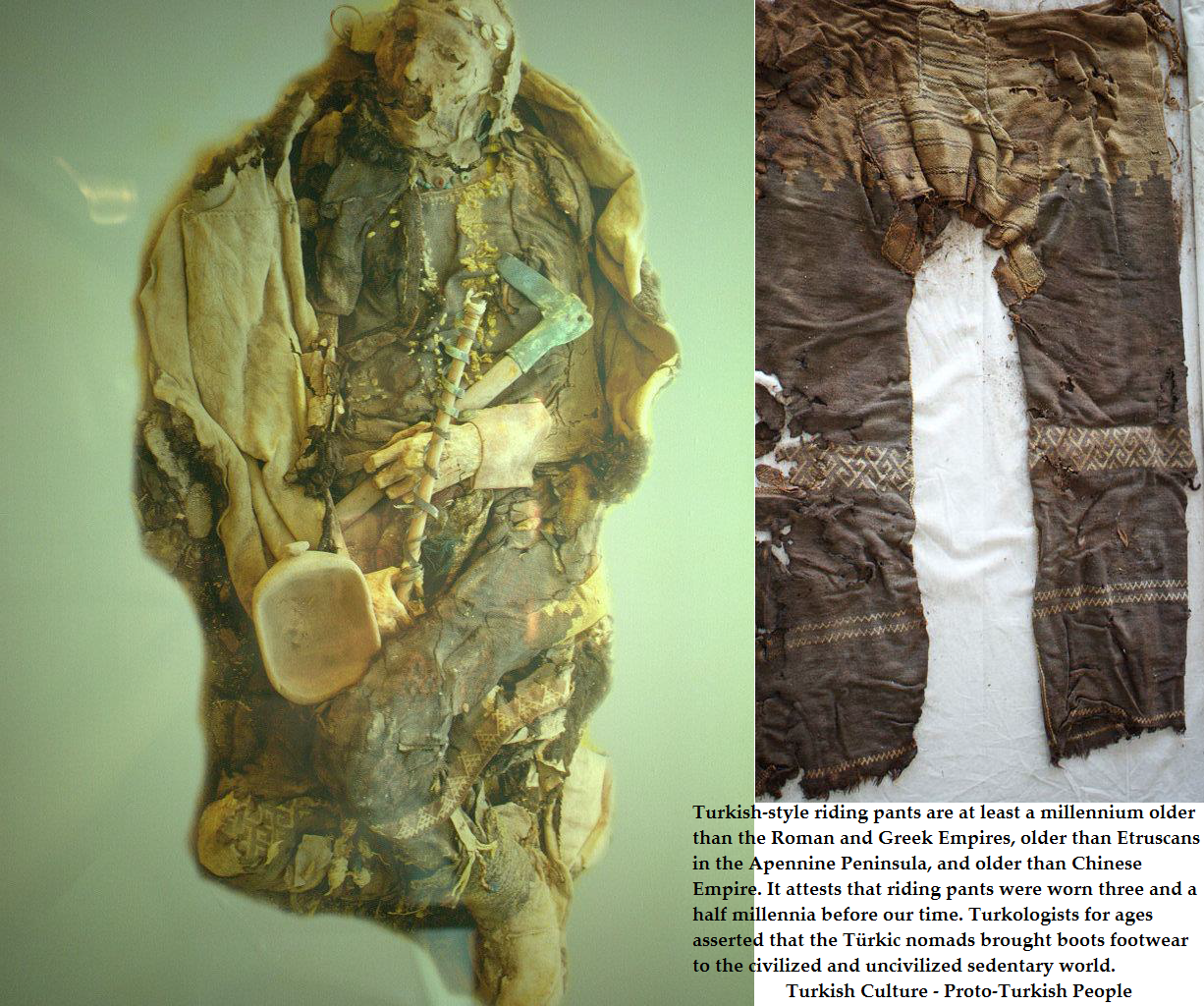
On closer inspection the substance of the news turned out to transcend far beyond the old pants, archeologists uncovered a material witness with traits that portray a whole epoch. It attests that people of the Zhou nomadic circle penetrated into Tarim Basin along with the future China. It attests that the Turkish-style riding pants are at least a millennium older than the Roman and Greek Empires, older than Etruscans in the Apennine Peninsula, and older than Chinese Empire. It attests that riding pants were worn three and a half millennia before our time. It alludes to the horse which the pants were riding on, and the whip that was to rush it. The find leads to the South Siberia, China, and Mesopotamia. It allows to date the uncovered artifacts as an undisturbed material complex, literally meet face-to-face with a descendent of the migratory waves, to see individual artifacts in their natural context. The pictures of the discovery flushed across news pages around the globe. Pants were reported as a centerfold of the news, but picture showed other unmentioned traits that also were as much the gems of the discovery.


The ancient man was completely dressed and wore a pair of riding bot boots, which are “extremely uncomfortable in walking”. Turkologists for ages asserted that the Türkic nomads brought boots footwear to the civilized and uncivilized sedentary world, only to be taken up with sneers and scorn. This uncouth old mummy puts to rest the sneers of prejudiced skeptic generations.


The mummy’s caftan coat illustrates the accuracy of the Chinese annals, it is lapelled to the left, in contrast with the Chinese robes lapelled to the right. 12 centuries later, for the Chinese of the Han period, the lapel to the left was a sign of barbarism and a reason for permanent consternation. Great efforts of the much later Celestial empires were futilely spent on attempts to re-educate millions of barbarians to switch to the real civilized fashion of lapel to the right. In the end, some of those millions joined Chinese people and turned into bona fide Chinese in right lapelled robes. Some of those Chinese retained their old ethnic name Hu for the Central Asian nomads, like Hu Jintao 胡锦涛.


The deceased was buried with his travel necessities. He was given provisions for the road, in pots and vessels, and carried a flask. He carried a whip and an axe, to be prepared in case of any travel surprises. He was ready for shine or rain. His predecessors of the Neolithic Age were sent off for reincarnation with whetstone as major tool. The advanced Bronze Age traveler instead of whetstone carried a state-of-the-art cast bronze axe.


A yip whip was needed to accompany the deceased to the Tengri for reincarnation. In the year 1400 BC, the Buddhism had not been invented yet. It would take another 800 years to come up with the Buddhism and its reincarnation etiology. By that time, kurgans, Tengriism, and reincarnation would have existed for about 6 millennia. Probably not in the same form as they came down to us, but the kurgans and the usual inventory of the travel necessities attest to the intended travel and reincarnation. The horse or horses of the Zhou traveler must have been interred in the immediate proximity of the deceased, otherwise he would not have grabbed a horsewhip to go along. The horse remains and its DNA escaped attention of the reporters, a complete picture of his mount and details of its burial are sorely missing. Those details could have suggested burial traditions similar to the ones of the later times. Although the Kurgan burial traditions generally are very monotonous, small details are different among different populations, they afford some degree of kinship lineage tracing.


The DNA of the Tarim people is highly charged politically and therefore it is a guarded Chinese state secret, largely known from years of sensationalized and highly demagogued reports on Caucasoid “Indo-European” blonds speaking “Tokharian” language (i.e. Kuchean, aka Kushana, a version of Meroitic Hindi, an Indian lingua franca or trade language in Central Asia used by diverse peoples living in an intense bilingual environment) on one side, and Chinese counter inculcation on the other side. The available genetic bits of information on the Tarim burials suggest Central Asian (read: Türkic) and Indian males and mostly local eastern ladies. A single pointed reference in the DNA studies was made to Uigurs, who used to control the Tarim Basin during historical times. A veil of confusion congenital to the population genetics blots the picture, leaving metallurgy to lead the field with precise, verifiable, and consistent data till the biological studies provide comparably sound results.


The blondishness of the Tarim horse nomads comes from the Ugro-Fennic stock described in the metallurgical, anthropological, and genetic tracing. Ironically, although the Ugro-Fennic blondishness is a rare oddity in Europe and in the Indo-European stock, it has been sold as an innate trait of the Indo-Europeans, and was sold as such for many years, probably starting with the European philosophers of the 19th century. Until challenged by new discoveries, the blondishness is specifically of either Ugro-Fennic or Melanesian origin. The T. Chikisheva's fundamental work on physical anthropology explains the process of amalgamation of the horse nomads with the Ugro-Fennic hunters very clearly.3 So does the E. Chernykh's tracking of metallurgy. 


These were the processes that produced a blond mummy of the Tarim nomad. In their drives to the east and west, the nomads could not escape bringing their traits to Europe and Far East. Hence, the blond Europeans, endemic in the Ugro-Fennic ancestral territories of the Eastern Europe, the blond Far Easterners, and the blond South Asians. Hence, the endemic confusion of the Ural-Altaic, Altaic, Macro-Altaic, Micro-Altaic, etc. linguistic classifications. The light hair and eyes may be exclusively female inheritance, independent of Y-DNA, it can be a natural consequence of the brunettes' eternal weakness for the blonde beauties. The Indian DNA does not have a chance to start a line of blond offsprings, that honor falls on the DNA of the Türkic nomadic pastoralists from the South-Western Siberia. Chinese annals of the latter days specifically mention which Türkic tribes in their neighborhood had light hair and eyes. Among them were Tele tribes, Usuns (the modern Dulats of Kazakhstan) and Enisei Kirgizes, the modern Khakasses and Kirgizes.


The most striking artefact in the Tarim mummy’s burial complex is the tubular socket ax, an implement so unique and diagnostic that it beats by far the 3,300-year aged model of the riding pants. The tubular socket ax is an oddity in the world of axes, it is known from the early period of the bronze casting, and only from the limited areas of the northern hills in the Mesopotamia, Altai and surrounding South Siberia, and the northern areas of what is China today. It is known from the tombstone sculptures routinely attributed to the Scythians (or Cimmerians), and dated accordingly to the post-9th cent. BC. That guesstimate dating surely needs verification by instrumented methods. The tubular socket axes belong to the Steppe Metallurgy named by E. Chernykh an East Asian Metallurgical Province.


In the metallurgical periodization, they belong to the third stage of the East - West sprawl in the 3rd-2nd mill. BC. The Middle Bronze Age metallurgical period of 1900-1200 BC includes the lifetime of the constituent archeological cultures, 3,300 – 2,300 BC for Pit Grave Culture, 2,500 - 1,500 BC for Afanasiev Culture, 1,900 – 1,200 BC for Timber Grave Culture, 1,800 – 1,200 BC for Andronov Culture, and 1,400 - 700 BC for Karasuk Culture. The early phase of the Eurasian Metallurgical Province, dated 28-22 centuries BC, is remarkable for the start of two swift counter-propagating waves of the pastoral peoples' migration from the west to the east and from the east to the west that left their unique tubular socket traces to the west in Mesopotamia, in South Siberia, and to the east in what today is the northern China.


The tubular socket ax was but a single component of the “Scythian complex” that also included other peculiar metallurgical and non-metallurgical objects, not necessarily interred with the deceased as attire or travel utensils. These distinct objects included symbolic bronze knifes that with time turned into round and square coins. The turtle shell notebooks are timed with the arrival of the Zhou people to the future China.


The unique traceable model of the ax allows to connect the Gut (Kut, Qut) horse nomads (Guties) in the west with the Zhou horse nomads in the east, and speculate that Guties stand either for Guzes, a genetic Türkic for “tribe” or Juzes a genetic Türkic for “union, tribal confederation”, and the name Zhous also stands for Juzes. The Juz still means “union” in Kazakhstan, and it is Üz (Юз) in Slavic, which has a form Soüz (Союз), like in the name USSR (СССР) where the first Cyrillic C stands for Souz (Союз). The Turkic word that stood first in the title of the country had survived the Stalin's ethnic pogroms and deportations not because of the kindness of the ruling thugs, but because of their blatant ignorance and the absence of substitute synonyms in the Russian lexis.


In the context of the attribution, the name Guties does not literally or specifically mean the Gut or Guti tribe. In the nomadic world across Eurasia, no tribe or subdivision possessed suzerainty, out of necessity every tribe had to align with other tribes into a tribal union for its own survival. Historical records retain the name of the union (e.g. On Ok, a union of ten tribes, or Oguz, lit. “Tribal (Ok) Union (Üz)”), and chroniclers are rarely aware of all its members, at best they know of the largest, or closest, or somehow most salient of the neighbors’ tribes. It is not known if the name Guties was a name of a union, a part of a union, or an individual tribe. 


Likelier than not, the name Guties was a generic name applied to the tribal confederation, like the names Saka, Scythians, Alans, Tatars, Oguzes, Goths, etc. Chroniclers almost always noted that besides a common name, the described tribe has many individual tribes with their own names. The name Guties came to the front because the Akkadian scribes called the nomadic rulers of the Akkad and Sumer Guties (Gutium with Semitic pl. ending); but the name of one Gutian ruler Elulumeš (El (land, country, tribe) + Lulu (tribal name) + -meš (attributive suffix)) points to his origin from the tribe Lulu (Lulubu), hence he was a Gutian and a Lulubian at the same time (Cf. Chinese American or African-American, etc.). In the context of the attribution, then, Gutian stands for all and every nomadic tribe of the Mesopotamia of that particular time. From the Akkadian records, they are known as Kassites, Lulu (Lulubians), Subars (Subartu), and Turuks.


The reference to Zhous also does not literally or specifically mean a tribe of Zhou. Rather, like the Chinese terms Hu and Juns (pinyin Rong), it was a generic term for nomadic intruders. It took Chinese more than another millennium to learn and cite the names of the individual nomadic tribes. This treatment was repeated everywhere, the ruling and neighboring nomads had generic appellations of Saka or Scythians and Guties in the Middle East, Huns in Europe, India, and China, Tatars or Mongols across Northern Eurasia, etc. None of those appellations reflected tribal composition of the nomadic rulers. The Zhou was a nomadic tribal conglomerate that happened to play a most decisive and long-lasting role in the emergence and consolidation of China, the Tarim mummy is spatially and temporally closest to the nomadic Zhous, and it is ethnologically linked with them by the common origin attested by the unique axe artifact.


The first signs of the Eurasian inception of the “steppe belt” appeared in the 5th mill. BC, at the very beginning of the Early Metal or the Copper Age. By the end of the 2nd mill. BC the “steppe belt” had established form that in main features endured for the next three millennia. The initial stages of the pastoral economy and emergence of metallurgy led to two global consequences, the spread of mobile pastoralism across Eurasia in one gigantic Steppe Belt extending for 8,000 km and notable for its uniform distinct culture without explicit prototypes, and the spread of metallurgy along the Steppe Belt. That was the time of the beginning of the nomadic waves of Kurganians that largely wrote and defined Eurasia. The kernel of the nomadic movement were people who left behind monuments where archaeologists recognize the so-called Sintashta or Abashevo-Sintashta and Petrov cultures. Populations of the communities disdained agriculture, animal husbandry was central to their daily lives. The copper ore deposits east of the Urals and in Kazakhstan attest that metal mining industry was successfully developing there. In the development of metallurgy, theirs was a stage, the Eurasian Metallurgical Province, it bore the seeds for the East Asian Metallurgical Province.


In the archeology, the eastern “wave” is known as the Seima-Turbino transcultural phenomenon (after two famous cemeteries: Seima and Turbino). The warlike nomadic populations rapidly moved westward in parallel, but to the north from the oncoming wave of the Abashevo-Sintashta tribes, primarily along the southern strip of the Eurasian forest zone. 35-40 centuries later by the same path heading eastward would as swiftly move small Cossack detachments, the restless and undisciplined mercenaries of the incipient Russian state. Cossacks were Türkic mercenaries of various tribal ethnicity, generally defined by their ancestral location: Yaik Cossacks, Don Cossacks, Terek Cossacks, etc. Cossacks were hired for a determined season, or a determined campaign or task.


Fig. 7 Phase in formation of the Eurasian Metallurgical Province. Two counter-propagating waves in the spread of the cultural formations. Asterisks denote tombs and sanctuaries, points and oval shapes denote isolated finds of metal of the Seima-Turbino appearance. Mesopotamia Taurus and Zagros mountains, at the end of the 3rd mill. BC occupied by Guties and their kindred tribes, lays outside of the study area. Schematic illustration after Fig. 7 in Chernykh E.N., 2008.


Eastward from the Urals, kurgan cemeteries almost disappeared: the ancient ritual of constructing massive grave mounds was on the ebb, attesting to more egalitarian communities. Archaeologists discovered many villages of that community, but as a rule the settlements were tiny. The Sintashta/Abashevo/Petrov culture display typical traits of peaceful colonization and amalgamation. The fragmented aboriginal foot hunter population continued their traditional non-producing economy, with large tracts of forest needed for the sustenance of each family; that limited the size of the villages exploiting natural resources within their immediate vicinity. The newcomers brought along their producing animal husbandry economy that did not compete with the aboriginal economy. They engaged aborigines into metal production as suppliers of the ore and charcoal, and possibly of the ingots. On the social level, amalgamation went on as inter-ethnic marital unions. In the lingo of physical anthropology, the nomads of the western part of the steppe belt are termed Southern Eurasian Anthropological Formation; these are the people called Kurgans within the Indo-European linguistic Urheimat hypothesis. That hypothesis, developed before major advances in DNA sequencing and statistics, confused the westward migration of the Kurgan nomads (4th-3rd mill. BC) with the much later southeastern migration of the non-Kurgan European farmers, later known in the South-Central Asia as Indo-Aryans (2nd mill. BC). The northern foot hunters are termed Northern Eurasian Anthropological Formation, they occupied the northern belt of Eurasia from the White Sea to the Baraba steppes, and archeologically are termed Pit–Comb Ware Cultures.


They are largely identified with the Fennic linguistic group. The initial stages of the pastoral economy and emergence of metallurgy led to two global consequences, the spread of mobile pastoralism across Eurasia in one gigantic Steppe Belt extending for 8,000 km and notable for its uniform distinct culture without explicit prototypes, and the spread of metallurgy along the Steppe Belt. The cattlemen warriors of the Steppe Belt in a tide and ebb fashion penetrated deep into the settled farming societies to the south, creating throughout its vast extent the regions with interspersed coexistence of contrasting types of cultures.


Like the Pilgrims vs. Amerindians, like the conquistadors vs. Mesoamericans, and like any other colonial expansion, the nomadic newcomers are relatively few, and barely visible archeologically; but their visibility may be relatively high if their archeological culture is very distinct, and if the visibility of the aboriginal archeological backdrop is even less prominent. Their offsprings soon become physically indistinguishable from the aboriginal population, except for their continued economic and social traditions, reflected in disappearing kurgan cemeteries. The economic and marital compacts may continue indefinitely, until a new upheaval changes the scenery.


The initial stages of the pastoral economy and emergence of metallurgy led to two global consequences, the spread of mobile pastoralism across Eurasia in one gigantic Steppe Belt extending for 8,000 km and notable for its uniform distinct culture without explicit prototypes, and the spread of metallurgy along the Steppe Belt. The cattlemen warriors of the Steppe Belt in a tide and ebb fashion penetrated deep into the settled farming societies to the south, creating throughout its vast extent regions with interspersed coexistence of various types of cultures. The initial nomadic “wave” spread the technology of productive pastoralism across the Steppe Belt. The second nomadic “wave” (or the eastern impulse) very quickly came to a very developed type of metallurgy in the vast area of the Sayano-Altai mountain system. The relatively primitive metallurgical centers of the preceding period went through a sudden burst of high-tech production of thin-walled bronze castings of fine and at times unique forms of weapons. There were cast spearheads, kelt axes, curved knives with sculpted images of various animals and even humans (Fig. 8). The vast majority of these objects were found in cenotaph graves, where archaeologists have found no human remains. The width of the distribution area of these unusual antiquities is amazing: from the Western and even Central China, to the Eastern Baltic, i.e., more than 6,000 km. But in this enormous territory were found surprisingly small number of these metal objects, not more than six hundred.


Fig. 8. Some forms of the Seima-Turbino type metal products Illustration after Fig. 8 in Chernykh E.N., 2008.


The provenance of the unique tubular socket axes, which followed the practice of tubular-socketed arrowheads and spear blades, sheds light on the origin of the East Asian Metallurgical Province. The tubular socket technique serves as a diagnostic tool for tracing origin of the populations. Such tubular socket axes were found in Mesopotamia, in the Altai, and in the Northern China. In the Mesopotamia, they are attributed to the nomadic horse cattlemen Guties (Guzes, maybe Juzes from Juz “union, tribal confederation”), and hence the nomadic tribes of Lulu, Kassites, Turuks (Türk), Subaru (Subars), Komans (Kumans), and Kangars; in China they are associated with the nomadic horse cattlemen Zhou (Jous, from Juz “union, tribal confederation”) and Juns (pinyin Rongs, probably standing for Huns); in the Altai they are associated with metal production of the East Asian Metallurgical Province.


That was a birth of another great metallurgical province, which is called East Asian Metallurgical Province. Compared with the Eurasian Metallurgical Province it had a much more complex structure.


In the second half of the 2nd mill. BC the nomadic pastoralists of the East Asian Metallurgical Province dramatically changed orientation of their expansion. Their vector went mainly in the southeast direction (Fig. 9), toward the rich agricultural centers of the Shang (Yin) state in the south of the Huanhe (Yellow River) basin in China. The steppe extracts, whose culture archaeologists call Karasuk, inherited many weapons forms from the prior Seima-Turbino phenomenon, first of all casting the so-called single-edged curved knives with decorated handles (Fig. 8). These forms of weapons, or rather their imitations, spread throughout the territory of the Shang principality. Apparently, from that time originated the great confrontation between the steppe pastoral warriors and the ancient and medieval Chinese civilizations.


Figure 9. Major impact directions of the cultural unions belonging to the northwestern (Sayan - Altai) centers of the East Asian Metallurgical Province during the final development of the Eurasian “steppe belt” The western leg of the eastward migration passes the Tarim Basin, carrying the left lapelled caftans, oldest riding pants, riding boots, tubular socket axes, horsewhips, ceramic flasks, kaury (cowrie, cowry) shell diadems, dress buttons, etc.


Metallurgical investigation of the Tarim mummy’s axe would provide another trace to the origins of the Tarim ancient nomadic people. The trail may lead as far as the Altai or Sayan mountains, where ore and charcoal were available. The trail of the East Asian Metallurgical Province runs through the Tarim basin and ends in China (Fig. 3.25, 3.36, 3.39, illustrations after Loeuwe M., Shaughnessy E.L., eds., 1999).


Reports about discovery of the Tarim mummy revealed that archaeologists in China have uncovered in the Yanghai graveyard in the Tarim Basin the world's oldest pants, age ca. 3.3 thousand years. It is the most ancient pair of pants ever found on earth. Their tailoring involved no cutting: the pant sections were shaped on a loom in the final size. Trousers was sewn together from three pieces of brown-colored wool cloth, one piece for each leg and an insert for the crotch. Finished pants included side slits, strings for fastening at the waist and woven designs on the legs. They are decorated with embroidery. Experts believe that the pants belonged to one of the “Asian nomads”. The find confirms that the “Asian nomads” sewed special clothing to ride on horseback.


The scientists were struck by another observation. Reconstruction showed that the wide crotch part of the ancient pants was hanging by folds, exactly in a fashion of the Türkic pants one still can see in Turkey. One of the Wagner colleagues tried the pants sewn after the pattern of the oldest pants, and concluded that they were “extremely uncomfortable when walking”. M. Wagner commented: “While walking, the internal parts of the legs, the crotch and the lower abdomen are not subjected to a long period of friction. The problem of friction becomes acute only when riders have to spend a lot of time on horseback.” The Turkish and Azeri men (**), however, apparently have no problems wearing the modern version of the similarly patterned riding trousers as a daily attire.


The discovery attests that the horse riding existed in the Tarim Basin three and a half thousand years ago. Over the ages, Central Asia passed through cyclical periods of aridification and humidification, driving out and attracting nomadic pastoralists. 3,500 years ago, during a humid period, the Tarim Basin must have offered attractive pastures to the nomadic ranchers.


No written sources exist for the pre-historical period of South Siberia and Northern China. Archeology and paleoanthropology shed uneven light on their societies and peoples; the name of the Zhou people appeared in the early Chinese records in connection with the Shang period of Yin state. In contrast, Mesopotamia was endowed with a pioneering writing system and extensive body of historical and mundane records preceding migration of the Indo-Arian farmers to the Iranian Plateau. The Gutian history is known in broad terms from the Mesopotamian records. Gutians belonged to a cluster of horse nomadic tribes occupying eastern Taurus and Zagros mountains from about 3000 BC under peculiar tribal names rendered as Turuks (Turukkos), Lulu (Lullubians), Kassites, and Subartu; the names that can be rendered Komans and Kangars also figure in the Mesopotamian cuneiform records. Dating of records and geography for the nomadic tribes is spotty. Gutians were a powerful tribe that took over the rule of Sumer and Akkad for about a century. For the agricultural population and cities, the Gutian period (ca. 2154 – 2112 BC in short chronology, 124 years on the outside) was a disaster, cities and irrigation were ruined, fields were used for pastures.


A most frequently used title of the Gutian rulers is read as Yargan, which in Türkic corresponds to the title “Judge”, a member of a “tribunal”, and may be translated as “Tribune” (spelled yarğa:n in Clauson EDT, 1971, p. 963). That position and title were perpetuated in the Bible's Book of Judges, in the Roman Republic, and in the legend of the Round Table of the King Arthur with its Earl tribunes. The republican system does not fit well into the paradigm of the kings and monarchies expounded by the 20th cent. scholars of the Middle East, the title raised substantial scientific puzzlement and stray guesses. The title Yarğa:n was already not new when it came to the attention of the Akkadian scribes, it lasted during the Gutian rule of the Akkkad and Sumer, and it outlived the Akkkadian Empire by more than 3000 years. G. Clauson cites the name-titles Inançu Apa Yarğan Tarxan (8th c. AD) and Boyla Kutluğ Yarğan Suci (9th c. AD) in Türkü and Uigur records, and Greek records have a regent Organa for Bu-Yurgan (7th c. AD).


In these cases, the element Yarğan corresponds to the post of “judge, tribune” rather than “commander”, that is attested by the component Yarğan Suci meaning “Judge - Army Commander”, and the title Earl (a form of Yarğan) at the Round Table. The etymology of the position Yarğan ascends to the word yarğu: “splitter, tribunal, lawsuit, legal decision” denoting a legal tribunal at the head of the tribal administration, “i.e. an instrument for splitting facts and discovering the truth” from the verb yar- “to split, cleave”. Two more words relate to the post and add functional description: yarlığ is a “command (from superior to inferior)), edict”, it has civil and military applications, and yarğu:n is a “destroyer, ruiner”, a derivative of the verb yar- with clear war-time application. These terms are consistent with the verbs cited by K. Balkan, yarlïqa-, yarlïɣga- “to order, to command”.


The phonetic and semantic consistency demonstrates a peculiar linguistic longevity across a period of four millennia, and the immense geographical spread from China to British Isles.


Since the term judge alludes to justice, the interpretation of the notion is an equivalent to the expression “XYZ the Just”. The title Yarğan is loaded, it describes the republican system of the Guties' tribal organization, their tribal Council, and the position of the presiding Judge at the council; it asserts that in the 3rd mill. BC, the Guties had the organization and military power to take over and rule the troubled Akkadian Empire. That is a model replicated in numerous cases, from the Türkic and Mongol empires to the Round Table of the King Arthur and the institution of the modern parliament. At least some words and concepts introduced by the ruling Guties had to be internalized (Cf. Gutium, the Semitic form) and eternized within the inheritor languages, including Babylonian and later Persian.


The body of Gutian-related records is not large, consisting of mostly onomasticon and morphological elements. None of the neighborhood contemporary languages of the 24th c. BC come linguistically close to the Gutian, so the parallels must be sought elsewhere. It is generally agreed that onomastics is irrelevant in ethnological attributions (Cf. not all Alexanders are Greek, not all Joshuas are Hebrew); that is one of the main objections to the V. Abaev’s Scytho-Iranian Theory (Cf. Dremin G. , 2006). The title-names do not fall into the category of the names because generally they are semantic designations peculiar to individual languages (Cf. title “King”, “Judge” in the European languages: Pol. krol; Lat. rex, regis; Hu. kiraly; Gmn. König; etc. vs. sędziavs; iudex; bíró; Richter, etc. respectively). The ethnical examination of the Gutian names as personal names, on the model of the European names, would be credible only with a questionable assumption that in the majority they are not borrowings but specifically Gutian native names. In contrast, the ethnical examination of the Gutian names as titles (title-names) is credible, since the assumption is that in majority they are not borrowings but peculiar Gutian native titles, and can be empirically validated by systemic concordance with the titles and morphology of a candidate language.


The thesis that the Gutian language is related to the Türkic linguistic family was first proposed by B. Landsberger, a chair of Sumerology at the Ankara University, in 1937.16 B. Landsberger illustrated his thesis with specific examples of the Gutian lexicon and morphological elements. The Gutians came to the fore again in the late 20th century. P. Dolukhanov, 1994, with a reference to the Assyrologist I. M. Diakonoff, posited that Gutians were distant relatives of the today's Dagestanies, in today’s lingo called Kumyks; J.Derakhshani, 1998, asserted that the Gutians were a Turanian tribe Tukri. 


The modern Kumyks are descendants from the agglomerate of the Türkic tribes of the Masguts (Alans), Kayis (Kaitags), Huns (aka Savirs/Suvars), Khazars (Barsils), and Oguzes. The B. Landsberger’s thesis was analyzed by K. Balkan, 2000, with a detailed inventory and examination of the available Gutian material. K. Balkan turned to the Old Turkic to interpret Gutian titles and morphological elements, building on and adding more examples and morphological elements to the brief B.Landsberger’s list (El Ulumuş, Yarlagan, Tirigan, Şarlak, etc.), and advancing B. Landsberger’s resemblances to direct correspondences, like the name Ia-ar-la-ga-an-de of the founder of the Gutian dynasty with the ending –de, which turned to be the Old Turkic locative noun suffix -da/-de (-da/-dä), “of judges”, “of tribunal”, and the like. The K. Balkan’s work was seconded by E. Memiş, 2000.


The archaic Türkic origin of the nomadic Guties and their constituent nomadic tribes is consistent and corroborates archeological, ethnological, historical, biological, and ethnical details associated with the nomadic mummy from the Tarim Basin. The Tarim Basin mummy from the Yanghai graveyard opened another porthole to the events of the 2nd mill. BC that shaped histories of the Eurasian peoples from one end of the continent to another. It is unavoidable that the Yanghai discovery will generate a wealth of scientific material illuminating many aspects of the ancient life. In broad terms, the historical outline has solidified, and it is likely that the new discovery will fall into the established scheme of things, adding, for example, another tested specimen to the database in excess of 120 thousand artifacts (as of 2008) in the study headed by E.N. Chernykh.


Unlike the wool of the pants, which could come from the same breed of the sheep a continent apart, the chemical composition of the peculiar axe can pinpoint the exact source of the ore, tracing geography of its ultimate source to a specific point. A certain community of Neolithic migrants traversed Eurasia from Kazakhstan to the Eastern Europe, bringing with them a peculiar animal husbandry producing economy, a peculiar etiology attested by kurgan burials, and a peculiar egalitarian social system, learned of metallurgy in the Northern Balkans, and in reciprocal migrations spread that practice back to their homeland. Unlike the sedentary societies, the social system based on voluntary principle was the only viable social system in the mobile and fluid pastoral world. Along the way, the cattlemen learned to live symbiotically, for mutual benefit, with populations scattered along their spread.


The seeds of metallurgy blossomed into new techniques and beneficial products, and again the reciprocal migrations of the mobile cattlemen spread it far and wide, seeding new amalgamated nations and new civilizations. A high mobility of the pastoralists gave them an upper hand in dealing with the sedentary foot hunter and agricultural societies, it kept enriching both the mobile and the sedentary peoples for the next 3 millennia, well into the Middle Ages. And now, in the 3rd millennium AD, the traces of the technological and social evolution spearheaded by the peculiar mobile pastoralists, are still pulsating in the spread of egalitarianism, parliamentarism, and technical innovations connected with use of metals in the modern world.


KISAMOV, Norm
JOURNAL OF EURASIAN STUDIES
Volume VII., Issue 2. / April — June 2015


(**) There is no "AZERİ" Azeri word is fabricated by Russians. Azeri's are %100 Turkish people. And they preferred "Azerbaijani Turks".


* Subartu/Subar is one of the oldest Turkish people who lived in Southeast Turkey in 3000 BC. 
Also the name father of "Siberia".


ve

B.Landsberger, söz konusu tebliğinde Gut dilinden kalan bozulmamış bazı kelimeleri vererek , 
Türkçe ile karşılaştırır. Şöyle ki:
1.Yarlagan = Haber veren olabilir. Orhun kitabelerinde yargan'ı hatırlatır.
2.Tirigan = yardım eden manasına gelir ve Uygurca Tiriga mükemmel kelimesini hatırlatır. 
3.Şarlak yahut Çarlak = Birçok lehçelerde kanatlı ve memeli hayvan adıdır. 
Anadolu'da bugün küçük çağlayanlara da (şelalelere) şarlak adını verirler.
4.Laşirap yahut lasirap = Kral listelerinde takriben MÖ.2000'de yazılıp , nakledilen isimlerde şöyledir:
* El-ulumeş = memleketini büyütmüş, büyüten anlamına gelebilir.
*İnima-bakış = Çeşitli manalara gelebilir.
*Nikillakap
*Warlagaba
*Yarla
*Yarlaganda
*Tiriga
*İnguşu yahut İnkişu
*İgeşaus
*İbate yahut İbatı
Görülüyor ki Gutium kral isimleri , Türkçe ile manalandırılabiliyor.


Sanat insanların ve sosyalgrupların fiziki-sosyal dünyayı algılama ve yorumlama tarzıdır. Başka tabirle sanat duygu ve aklın ürünü olan gelenektir. Gelenekler ise mitolojik ve tarihte kökleri olan yaşama sürecini ifade eder. Sosyal bilimler yapıları gereğe siyasal düşüncelerle yakından ilgilidir. Mesela bir araştırmacı ne kadar bilim için bilim yapsa da onun bulgularını birileri istediği takdirde rahatlıkla siyasallaştırabilir. 

Çünkü tek tip eser okuyanlar, sadece okuduklarını gerçek sanıp, haberdar olmadıkları ya da sahip oldukları bilgilerin dışındaki farklı görüşlerle ilmi bilgilerin siyasallaşmasına sebep olabilirler. Mesela Bender, bir bilginin siyasallaşması konusunda önemli iddialarda bulunarak şöyle der:

“Tanınmış halı bilginleri de halı ve kilim dokumacılığının Kürtler tarafından icat edildiğini, İranlılarla Türklerin bu sanatı sonradan Kürtlerden öğrendiklerini öne sürmektedirler… Halı ve kilimin vatanı Zağros yöresidir…Kürt halıları geometrik desenli halılar ve çiçek-bitki desenli halılar olarak iki büyük grupta toplanır.”

Bender’in bu görüşü, konu hakkında ilmî çalışmalar yapanlarca doğrulanmamaktadır. Çünkü halı, kim ve benzeri dokumalarda kullanılan geometrik, yani simetrik örneklerin Türklere, çiçek ve bitki, yani asimetrik örneklerin ise 
Farslara ait olduğu konunun uzmanlarınca kabul edilmektedir.

Pazırık Kurganı’ndaki buluntularda at üzerindeki askerin pantolon giydiği, (Hint-Avrupalıların pantolonu M.S. V. asırdan itibaren giymeye başlamışlardır.) halıdaki geometrik damgalar ile atın koşum şeklinin Hint-Avrupalı hakların kullandıklarıyla ilgisiz olduğu yapılan basit bir araştırma ve karşılaştırmayla dahi anlaşılır.

İskit’lere ait olduğu söylenen arkeoloji ve etnografya eserleri üzerindeki damga ve süslemelerin 
Türklerin otantik damga ve süslemeleriyle örtüşmektedir.

Görsel kaynaklar üzerindeki damgaların, nasıl ve hangi şartlarda Doğu Türkistan’dan yola çıkarak, Altaylar’da, Damal’da, Çamlıhemşin’de, Isparta’da, Balıkesir’de ve benzeri Türk kültür coğrafyasında görülmelerini izah etmek zorundadırlar.

Sonuç olarak, bu damgalar Türk tarihin bilinen kadim dönemlerinden günümüze kadar gelmişler ve taşıdıkları anlamlarla tarihe şahitlik etmişlerdir. Çünkü onlar başka halkların geleneksel, yani otantik kültürlerinde yoktur.


"Tarihin Bilinen İlk Pantolonundan Türkiye’ye Gelen Damga"
Mustafa Aksoy / devamı
Türk Dünyası Tarih Kültür Dergisi, Sayı 346, 2015


Aksoy, pantolonun üzerindeki damgaların Anadolu’da özellikle kilim ve çorapların üzerindeki motiflerle aynı olduğunu tespit etti. 3 bin 500 yıllık damganın Rize’nin Hemşin ilçesindeki yöresel el dokuması çorapların üzerinde de yer alması, Ermeni Diasporası'nın yıllardır Hemşin ile ilgili ortaya attığı asılsız iddiaları bir kez daha çürüttü. ... link


Son araştırmalarla Hintavrupa diye bir ırkın / dilin olmadığı görüşü yaygınlaşıyor, yoktur zaten. Thomas Young 1813 yılında, Hint Avrupa terminolojisini "icad" etmiştir. Hint Avrupalılar İran'a MÖ.800 de gelmiştir, ne kadar zorlasalarda daha önceki tarihe gitmez. 


Turkish Culture - Proto-Turkish People