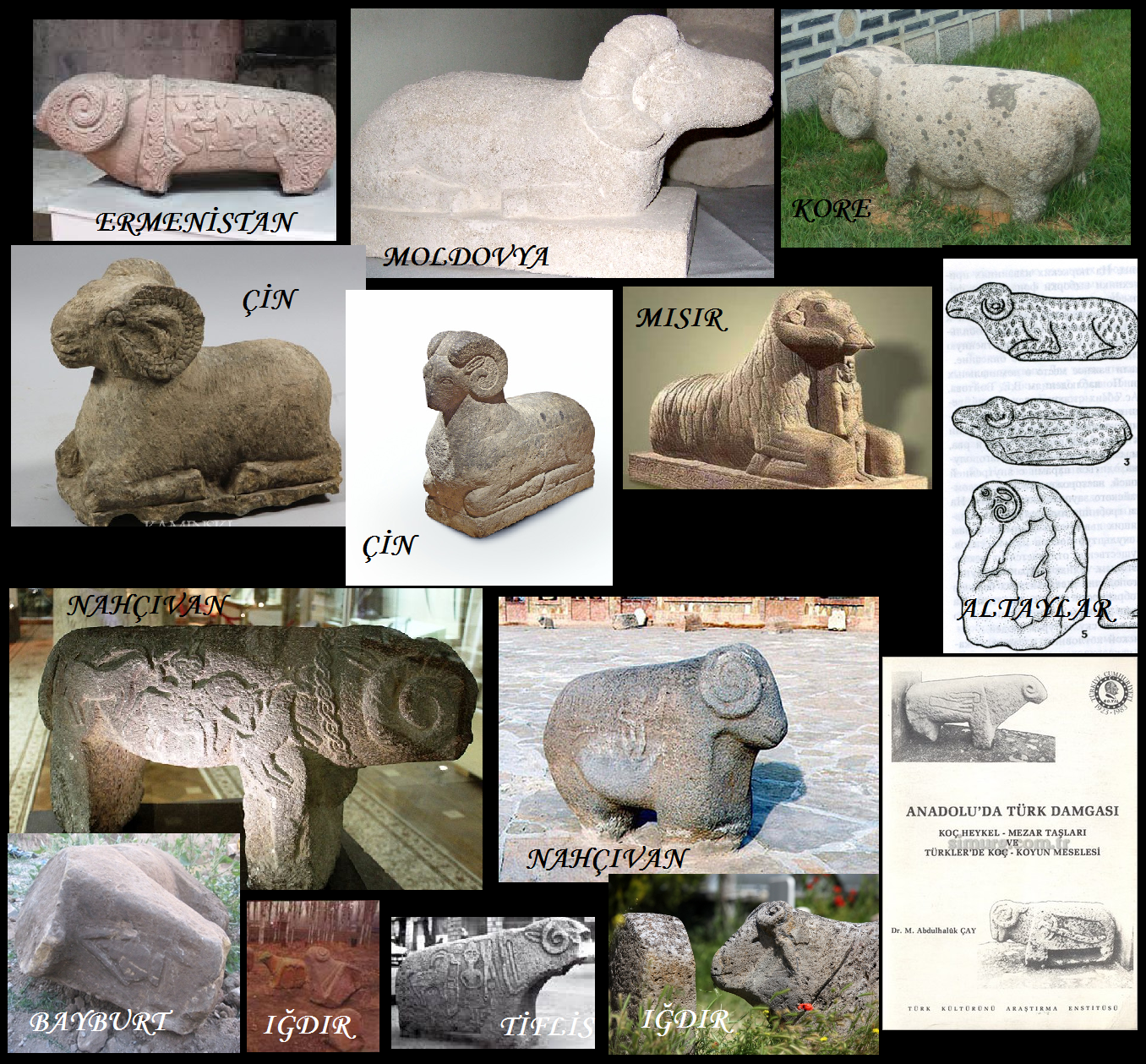
18.Hanedan dönemi - MÖ.1400-1300 / Mısır. (Walters Museum)
...Bundan başka Mısır kral/allahlarına verilen eski isimler DEMİRCİ manasına olarak tercüme edilmiştir. Bunlar hem muharip hem maden sanatlarını yapan insanlardı....
Bugün muhakkaktır ki, ilk Mısır ahalisi milattan 5000 sene eveline doğru Asya'dan gelmiş olan beyaz ırktır; bu ırk Nil vadisinde yerleşti. Kabileler halinde kümeler teşkil etti. Herbir kümenin reisi, dini ve kanunları vardı.
Bu malumattan ve Türk tarihine methalde Türklerin umumi muhaceretlerine dair verilen tafsilatın ihtiva ettiği delillerden Mısır deltasına yerleşerek ilk Mısır medeniyerini kuranların Türkler olduğu anlaşılır.....
...Nil vadisinin delta kısmını ilk işgal edenler , Orta Asya'dan muhtelif yollarla ve birbiri ardısıra gelmiş olan Türk kabileleridir.....
*
Mısır; silindir mühür, tuğlalarla inşaat tekniğini, birçok sanatsal ögeyi ve özellikle de Birinci Hanedanın başlarında (y.MÖ.3000) birdenbire, hiçbir öncülü olmaksızın beliriveren yazıyı SUMER'den aldı.
Firavun tanrı olarak kabul edildiğinde veya giderek tanrıya dönüştüğünde....
Mezopotamya'da kralın yalnızca tanrının temsilcisi olduğunu.....bilelim.
Priamit Metinleri : MÖ.2500-2300
Lahit Metinleri : MÖ.2300-2000
Ölüler Kitabı : MÖ.1500 den sonra
Orta Krallık, aşağı yukarı hepsi 12.Hanedandan gelme bir dizi mükemmel hükümdar tarafından yönetildi. Onların egemenliğinde Mısır bir ekonomik büyüme ve uluslararası büyük saygınlık dönemi yaşadı. Firavunların taç giyme törenleri sırasında seçtikleri isimler, onların insanlara ve tanrılara karşı adaletle davranma isteğini yansıtmaktadır.
Hermopolis'te tapılan sekiz tanrıdan biri olan Amon 12. Hanedan döneminde Amon-Re adıyla en üstün tanrı konumuna yükseldi. (Hanedanın kurucusunun adı Amennemhet "Amon en başta" idi). "Gizli" tanrı tam anlamıyla "görünür" tanrı olan güneşle özdeşleştirildi. Amon "güneşleştirilme" sayesinde İmparatorluk'un evrensel tanrısı oldu.
Bu imparatorluk - aslında bu adı almaya layık tek dönem - çelişkili gözükse de 12.Hanedanın sona erişinden sonra patlak veren ikinci bir krizin gecikmiş ama kaçınılmaz sonucuydu. Hyksosların MÖ.1674'teki istilasına kadar çok sayıda hükümdar hızla birbirini izledi.
Devleti Hyksos saldırısında daha iki kuşak önce parçalanmasının nedenleri bilinmiyor. Ama her ne olursa olsun Mısırlılar, at, savaş arabası, zırh ve gelişmiş yaylar kullanan bu korkutucu savaşçıların saldırısına zaten uzun süre dayanamazlardı. Hyksosların tarihi yeterince bilinmiyor, ama Mısır'a doğru ilerlemelerinin MÖ.17.yüzyılda Yakındoğu'yu sarsan göçlerin bir sonucu olduğuna kuşku yok.
(Bilinen isimlerin çoğu Sami kökenlidir, ama Hurri kökenli isimlere de rastlanmıştır. O çağa ait hiçbir Mısır belgesinde Hyksoslardan söz edilmemektedir. Müstahkem şehirleri Tanis'in adı 19.Hanedan dönemine ait bir metinde ve aynı döneme doğru yazılmış bir halk masalında geçmektedir. Tahmin edilebileceği gibi, fatihler - Mısırlıların gözünde "barbarlar"- Kaos'un simgesi yılan Apophis'le özdeşleştirilmişti.)
Mircea Eliade
Dinsel İnançlar Tarihi,cilt 1

A granite statue of Amon in the form of a Ram
Protecting King Taharqa, was made in the 25th dynasty of ancient Egypt, 690-664 BC.
The British Museum
KOÇ HEYKELLER TÜRK KÜLTÜRÜNDE GÖRÜLÜR
*
EGYPT
....The original civilising race came apparently from Asia, before the age of the Pyramids.....
.....(the carved slates, supposed to be as old as the 1st dynasty, represent hunting scenes, and wars with negroes ; and the writer regards them as showing invaders from Asia Minor; for they are armed with the double axe of Karians and Kretans, found also on Hittite monuments, and at Behistun as well as in Etruria as used by Turanians....)
....The people of Lukopolis (wolf town) propitiated the wolf that tore their sheep; other shepherds adored the bull and the ram.....
....5th dynasty , at Memphis (or at Elephanta) say 3950 to 3700 BC. The Turin copy of the Ritual belonged to this age, with various proverbial treatises. The skulls are long, like those of modern Egyptian peasants, whereas those of the first four dynasties are round, suggesting a Turanian race.....
....14th dynasty at Xois (Sakha) :say 2400 to 2000 BC. The Turanian fondness for confederacies of tribes instead of kingdoms (seen also among Hittites and Etruskans).....
....The Hyksos called themselves Min , coming from a country east of Syria and near Assyria. They appear therefore to have been Minni, or Minyas from near Lake Van: and the Minyans of this region (Matiene or Mitanni) in the 15th century BC. spoke a Turanian language, being apparently of the same stock with the Kassites of Babylon and the Hittites, which agrees with the worship of Sutekh. (Between the 12th and 18th dynasties also, foreign pottery like that found in Palestine, Kappadokia and on the shores of the Eagean Sea, appears in Egypt and is marked with emblems of the "Asianic syllabary" which was used by Hittites, Karians, Kretans and Kuprians......
...Thus for three generations, Semitic and Turanian influence began to reassert itself in Egypt....
...The Kassites were then ruling in Babylon and the whole Turanian power, from Asia Minor and Syria to Mesopotamia.....
....Kadesh and Karkemish are named with the Masu (Mysians) , Pidasa (Pedasos) Leka (Lycians or Ligyes) Dardani (Dardanos) and others. (The Kassites were then ruling in Babylon, and the whole Turanian power, from Asia Minor and Syria to Mesopotamia- perhaps aided by Aryans (see Rameses III,below)- was leagued against Egypt-ED)....
....Rameses II was a great builder, and constructed the Ramesseum at Thebes, and the beautiful rock temples of Abu Simbel. He completed the Hall of Columns at KArnak; and from its bas reliefs we learn much as to his conquest of Kadesh and other cities. He died in old age, and his mummu presents a very stiking countenance more Asiatic than Egyptian, with a powerful aquiline nose.....
.....(Among the names of tribes allied to the Libyans we find Akausha (supposed to be Achaeans) Tursba or Tulsha (people of Tros, Thrace or Tlos) Shartana (Sardians) and others "of the lands of the sea"....
_____________/____________
This acoors with the westward drift of races in the earliest times and historic race of the Egyptians to the Lower Nile, for from its origin Egypt was rather Asiatic than African....(page 94)
We have seen indications that the mixture and even fusion of races, so characteristic of the Chaldaean country had extended itself in the tideway of migration through Mesopotamia, Syria, Canaan and even into the Delta. We shall not be surprised to find if so be, even a Turanian element in Egypt when we treat of the "shepherd-kings"....(page 104)
This is a most important contrast and would lead to the conclusion that the pristine Turanian religion of Chaldaea, in respect at least of the worship of elemental spirits ,had not formed any portion of the complicated system which grew up in Egypt....(page 118)
The best picture we can produce must be tessellated with fragments from the most various sources. We have already brought many together and arranged them in a rough outline. We have seen the western migration of different races, Turanian, Hamitci, Semitic ; have traced the line of their smouldering camp-fires from the Persian Gulf to the eastern branches of the Nile, the names of their stations, the titles of their gods, the records of their conquests and, last of all, their very presence with living tradition on their lips from point, along their old time-honoured highway....(page 131)
The name Hyksos, by which they were known to the Egyptian priestly historian Manetho is generally believed to be compounded of Shasu, the usual word for the Arab hordes, and hyk king ; and may have been a mere nickname used after their expulsion. But the Egyptians call them in their records Menti (Syrians), Sati ,the roving Asiatics armed with bows, or by a word of hatred or contempt. Manetho, says they wre of ignoble race, "some say Arabians ;" and also uses the term Phoenicians for the earlier monarchs. Africanus calls them Phoenicians.
It is clear enough from what quarter they came. As we have seen, the few sculptures yet discovered show a type, most strongly-marked common to all the royal heads. Mr.Lenormant has suggested more than once that this may display a Turanian element ; "a race which is not even purely Semitic, and must be pretty strongly mixed with those Truanian elements which science reveals to-day as having borne so large a part in the population of Chaldaea and Babylonia".... (page 143)
The subject of marriage in Egypt has been treated by Prof.Ebers. The wife held a very honourable place in the oldest times, as the monuments clearly show. This agrees well with the Pharaoh's view of the matter, which indeed was quite as characteristic of the old Turanian people of Chaldaea and also guided the conduct of Abimelech king of Gerar....(page 154)
The word used in Genesis xii, for the officers of Pharaoh's court, is the correct Egyptian title (Sar), which is in fact common to the Turanian and Semitic Babylonia, Egyptian and Hebrew languages...(page 155)
Studies on the times of Abraham - Henry George Tomkins,
Member of the Society of Biblical Archaeology
Akrep Kral MENES..Firavunların ilki..(M.Ö. 3100)
Manas, yani Akrep Gözlü Er
Manas Kırgızların Destanında anlatılan
Kahraman Arketipi
Campbell'ın dediği gibi,
"Mitolojilerin Ne Zaman Oluştuğunu Ancak Tanrı Bilir"
"Firavunların gözlerine çektikleri sürmeler, çekik göze öykünmelerinden dolayıdır."
aktaran Nuray Bilgili
Mavi gözler :
Tanrı gökyüzünde yaşar, gökyüzü mavidir, mavi koruyucudur.
"Mavi Gözlü ve Sarışın Türkler"
The Early Neolithic Offering Tumuli from Sacred Mountain
in Nabta (Western Desert of Egypt)...
On this all area 224 tumuli were noted ...
 |
| SAQQARA - SAKKARA (SAKA?!) |
The earliest burials of nobles can be traced back to the
First Dynasty, at the north side of the Saqqara plateau.
During this time, the royal burial ground was at Abydos.
The first royal burials at Saqqara, comprising underground galleries, date to the Second Dynasty
Fig 1. First-Third Dynasty cemetery on the plateau edge of North Saqqara (after Lehner 1997).
The Mastaba of Sabu (Tomb 3111, c. 3100-3000 BC) was excavated by Walter B. Emery on January, 10th of 1936 at the plateau edge of North Saqqara, approximately 1.7 km north of Djoser's Step Pyramid (Fig. 1). Sabu was a high official or administrator of a town or province possibly called "Star of the family of Horus" during the reign of the First Dynasty Kings Udima (Den) and Enezib (Anedjib) (Emery 1949).
General Description of Tomb 3111
The superstructure of Tomb 3111 was surrounded by a palace facade made of mud brick, which exhibited the deeply recessed, niched walls indicative of Sabu's high social status (Fig. 2). Early 1st Dynasty mastaba facades were originally plastered and the recessed panels painted yellow to imitate wood, and the broadest forward faces painted in a variety of square, cross, and lozenge patterns to imitate woven reed-mats. This may have represented the wood frame and woven reed-mats structures of Predynastic shrines that became characteristic of archaic Upper and Lower Egypt (Lehner 1997). In the south corner of the superstructure was located a platform of roughly dressed limestone blocks. Emery (1949) suggests that this is likely a temporary structure possibly used during the funerary ceremony of Sabu. The interior of the mastaba consisted of a seven roomed substructure located in a pit cut to a depth of 2.55 m into the gravel substrate and limestone bedrock (Fig. 2). The rooms were separated by mud brick walls. The mud bricks were made of a dark black earth mixed with straw and averaged about 0.26 by 0.12 by 0.07 meters in size.

Fig 2. Tomb 3111 (after Emery 1949).
Room A was found intact and exhibited walls with traces of mud plaster and a roof made of wooden planks. The room was filled with 96 pottery vessels, some of which had domed and conical seals bearing the names of King Den and Sabu.
Room B was similar in design to room A. The room contained many articulated ox bones and the remains of what was originally large pieces of meat in proximity to 5 pottery bowls.
Room C exhibited walls with traces of mud plaster and a roof made of wooden planks supported by a socketed wooden beam positioned on the east and west facing walls. The room contained 71 pottery vessels, some of which had conical seals, but none bore names or impressions.
Room D was similar in design to room C. The room was found to be almost empty, containing only a few fragments of stone vessels and pottery.
Room E was the burial chamber. The brick walls were covered in mud plaster, which also exhibited traces of white stucco. The roof of wood planks was supported by three wooden beams socketed into the east and west facing walls. The burial chamber contained the remains of Sabu, which was the first time a noble of the First Dynasty was found in the position that it was originally placed at the time of burial. His body was positioned on its right side in a slightly flexed position with the head in a northerly direction (Fig. 3). The tomb was ransacked at some time it its history, but still exhibited some semblance to the original placement of objects. These objects consisted of copper and flint implements, 77 pottery vessels, ivory boxes, bones of 2 oxen, arrows, and stone vessels.

Fig 3. Burial chamber of Sabu (after Emery 1949).
Most of the 48 stone vessels in the burial chamber were found broken and represented 20 different types of stone vessel forms. The material used for these vessels consisted of travertine (39), metasiltstone (7), and volcanic tuff (2). One of the stone vessels was the elaborately designed metasiltstone ornamental tri-lobe bowl (Fig. 4) which was originally found crushed and scattered around the center of the tomb. The flint implements consisted of many small knives (85) and a few triangular scrappers (5).
Room F and G are similar in design to rooms A and B. Room F contained pottery fragments and a number of sealings bearing the name of King Anedjib. Room G contained scattered fragments of stone vessels and pottery.The Ornamental Tri-lobed "schist" Bowl
The ornamental tri-lobed bowl has a maximum diameter of 61 cm and a maximum height of 10 cm (Emery 1949). Since originally found crushed it has been restored, and is now on display in the Cairo Museum (JE71295, Fig. 4).

Fig. 4. Ornamental bowl from the 1st Dynasty tomb of Sabu (Tomb 3111). (d. 61 cm, Cairo Museum, Photograph by Jon Bodsworth The Egypt Archive)
The vessel consists of a flat, round-bottomed bowl with 3 thinly carved, curved lobes orientated at 120 degrees around the periphery. Very flat and wide bowls are known from the 1st to 3rd Dynasties, but none have been found from the Predynastic Period (El-Khouli 1978). The lobes are separated from the rim by 3 biconvex-shaped perforations . The center of the vessel contains a thinly carved tube approximately 10 cm in diameter . When viewed edge on the vessel's flat bowl shape does not show perfect symmetry .
In the past, some Egyptologists have use the term "schist" to describe this artifact (Emery 1949, Aldred 1981); others have identified the object as a slate (Smith 1981). The term schist was not being used in a modern geologic context (i.e. a medium- to coarse-grained foliated metamorphic rock), but was being used to describe a metasedimentary rock called a metasiltstone. This rock is essentially the sedimentary rock siltstone that has been very weakly metamorphosed. It still retains its clastic sedimentary texture and has no visible schistosity. Metasiltstone is similar to slate, but is more coarse-grained and has no fissisity or slaty cleavage, making it a solid rock that does not easily fracture along discreet planes when struck. The weak metamorphism of siltstone indurates the rock and increases the cohesiveness of the mineral grains (i.e. rock hardness), making the rock less susceptible to fracture during carving. This allows for fine detail and intricate shapes to be carved into vessels, statues, palettes, and other such objects. Metasiltstone as a material for vessel manufacturing came into use during the middle Predynastic and was used extensively during the Early Dynastic Period (Aston 1994). Besides the tri-lobed bowl there are a number of intricately carved metasiltstone objects known from the Early Dynastic, such as a very ornate toilet tray (Fig. 8), flower-shaped vessels (e.g. 1st Dynasty, UC37063 (Note: identified as greywacke but more likely metasiltstone, metagreywacke was not used until the Old Kingdom and not for vessels (Nicholson & Shaw 2000))), vessels shaped as leaves (e.g. 1st-2nd Dynasty, UC35653), vessels shaped to imitate basket-work (e.g. 1st-2nd Dynasty, UC35654), vessels shaped as hieroglyphic symbols (e.g. 1st Dynasty, libation dish), and even used to imitate metal vessels (e.g. a stone vessel with simulated rivet-heads (Lauer 1976, pl. 109). Many of these sophisticated and creative designs are unique to the Early Dynastic Period, showing a high degree of experimentation in artistic expression during this time.
Possible Usage for Tri-lobed Bowl
Emery (1972) suggests that the artifact may have been carved in the imitation of a metal vessel's form, with a center hole that was originally designed to fit on a pedestal. Possible competition between metal and stone vessel artisans may have been one of the reasons for the development of artistic expression in ornamental stone vessel forms during the Early Dynastic Period (El-Khouli 1978). William Kay (Link) has suggested that the vessel was a ritualistic tri-flamed oil lamp, in which bundles of rushes, immersed in oil, acted as the wicks. These bundles of rushes were held in place by the lobes, and the vessel was suspended on a pedestal inserted through the center. Whether it was actually used for this purpose is uncertain. The fragile nature of such an intricately carved stone object greatly limits is practical usage and suggests a purely ornamental function, being of a religious or other such ritualistic purpose.
Although it has been suggested the vessel was meant to be held on a pedestal, the center tube may also have been used as a stand for holding another vessel or object. Smith (1981) has suggested that the center tube was a container. Tubes of rock were used by the ancient Egyptians to hold round-bottomed vessels, and there are many examples of these throughout the dynastic Egypt, including from the Early Dynastic Period (El-Khouli 1978).
The tomb of Sabu and the tri-lobed "schist" bowl
SB.
________________________