zırh etiketine sahip kayıtlar gösteriliyor. Tüm kayıtları göster

12 Mart 2024 Salı

Turova Savaşından Bir Sahne


Turova Savaşı'ndan bir sahne, der arkeologlar, ancak detay vermezler.

Endişeli baba ve annenin Kral Pirim ile Eke/Ece Aba, savaşa hazırlanan kişinin de Baş Komutan Eke Tur (Hektor) olma ihtimali var. 

Eke Tur'a bacak zırhları (dizçekler) takılmakta. Olba/Silifke, MS 2.yy

Olba'nın "Yeğen" Türker (Teucer)'in soyundan gelenler tarafından kurulduğu söylenir.


Truva Savaşı'ndan benzer bir sahneyi bu duvar perdeliğinde de görüyoruz, 1470-90 / Tournai (Metropolitan Müzesi)
Eke Tur savaş meydanına inmek için hazırlanırken endişelenler (dönememe ihtimaline karşı veda edenler);
Babası ve annesi, eşi Andromake ve çocukları, kızkardeşi ve gelinleri Elene.


OKÇU

Beyaz keçeden başlığı, Grek tarzı tuniği ve bacaklarındaki zırhı ile bir İskit-Türk Okçusu

(Attik, MÖ 550-540, Metropolitan müzesi)


ZIRHLAR

Özel bir kolleksiyonun parçası olan bacak zırhları İskit-Türklerine ait. Bulunduğu yer tam olarak belirtilmemiş olsa da

"Sibirya"da bulunduğu söylenir ki çok geniş bir coğrafya.

Bu alplerimiz Demir Kurtlar olarak anılıyordu. (MÖ 7.-5. yy)


SB

20 Şubat 2021 Cumartesi

Şövalyelilik Kültüründe Türk Etkisi


Bir Şövalye - 13.yy sonları 14.yy başları, bakırla karışık altın plaket. Bulunduğu yer Batı Avrupa / Metropolitan Müzesi.

Ve Pazırık kurganından çıkartılan At Başlığı - MÖ 4.yy / Hermitage Müzesi


"Avrupa'da büyük destanlarla romanların, aşklarla şiirlerin doğduğu dönem Şövalyelik Çağı'dır. Yaklaşık olarak 500'lerde Kral Arthur ve Nibelung destanlarıyla başlar, ancak bu destanlar da eski motiflerle işlenmiş tarihi olaylara dayanır ki bunlar "Bozkır Binicilerinin" uzun soluklu epik geleneklerine kadar geriye gider. Sanatta çok önemli bir yer tutan Şövalye kültüründe karşılaştığımız şiir, destan, roman, duvar halıları ile hanedanlık armalarında da eski göçebe geleneği kendini hissettirmektedir. Gotlar bile silah ile ekipmanlar da dahil at kültürünü komşuları "barbar göçebeler"den almıştır. " - Helmut Nickel, Metropolitan Müzesi

Met müzesi "muhtemelen İngiliz" dese de, "Türk" sanatından etkilendiği görülmekte. Sanatta zırhlı süvari ve zırhlı at örnekleri Avrupa'dan önce İskit (Altın Elbiseli gibi), Hun, Göktürk (Demir Kurtlar, 8.yy), Avar, Hazar, hatta süreklilik açısından Selçuklu'da Osmanlı'da (sipahiler) bile görülmekteydi. 13.yy'da Pazırık kurganları henüz açığa çıkartılmadığına göre, bu "giydirme geleneğini" "muhtemelen İngiliz" olan kimden almış olabilir? Çünkü atı Pazırık'taki gibi "geyik boynuzlarıyla" süslenmiş. Atın üzerindeki örtünün altından çıkan düğümlü kuyruğu da gözden kaçmıyor. Hatta plaketteki şövalye "muhtemelen İngiliz" bile olmayabilir...

Helmut Nickel'in bahsettiği "Bozkır Binicileri"nin kim olduğunu söylememe gerek yok sanırım. Ancak, Helmut Nickel İskitleri "en iyi süvariler" olarak tanımlasa da "Pers" olduklarını söyler ki yanlıştır. Met müzesi gibi diğer bütün Batı müzeleri de (British müzesi de İskit sergisi sırasında sürekli İranî vurgusu yapmıştır!) İskitleri, kaynaklar tersini söylese de, ısrarla İranî olarak tanıtmaktadırlar! Bu tavır "bilim insanıyım" diyenlere yakışmıyor. Bu etik olmayan davranış "büyüklük-kompleksli-efendilik duyguları" ile önyargılarından kaynaklanır! Hatta aralarında para ve kürsü için bilime sahtekarlık bulaştıranlar da bulunmaktadır!

[Scythians are not "İranian", these "Steppe Riders" are Turks ! To the museums, don't misinform the people! - SB].

Kral Arthur ve Nibelung Destanları da "Türk" destan ve boylarına dayanır. Nibelungen Destanı'ndaki Etzel Atilla'dır. MS 6.yy'da Germen dedikleri toplulukların bırakın edebi eserlerinin varlığını, alfabeleri, yazıtları, hatta soy şecereleri bile yoktu ki yasalarını bile krallarının emriyle yaşlıların "hafızalarından" Latince okuma-yazma bilen katiplere yazdırmışlardı. Kral Arthur'un kılıcı Excalibur İskitlerin-Hunların "kutsal kılıç" efsanesine dayanıyordu ki kılıcın adı bile Türk boyu olan ve Karadeniz bölgesinde hüküm sürmüş, MÖ 15.yy'dan beri yazıtlarda bahsedilen (ki öncesi de var!) Kaşkalardan (Chalub) gelmekteydi (link). Kral Arthur'un en yakın arkadaşı olarak tanıtılan Lancelot'un adında bile Türk vardı: Lancelot < Alan of Lot = Lot gölünden bir Alan-Türkü. Batılı bir araştırmacı diyordu bunu ve destanı da Nart Destanı'na dayandırıyordu ki Nart destanı da Karaçay-Malkar/Balkar Türklerine aitti (link). Ancak bu Batılı araştırmacı hepsini "İranî" olarak gösteriyordu!

Yani, batıda savaşçılıklarıyla ün salmış olan İskitler, Hunlar, Avarlar, Hazarlar, Kumanlar gibi Türk toplulukları da dikkate alınırsa net bir şekilde ;  Avrupalıların "Şövalyelilik Kültürü"nde "Bozkırın Efendileri" olan Türklerin etkisi vardı ; diyebiliriz.


Semra Bayraktar (SB)

Fighting scene of two pike men riding horses,
Early Middle Ages, Chaganka (Kara-Oyuk)/Altai Mountains

Turks - Tamgaly/Kazakhstan


İskit/Saka - Türk Bronz Plaka, MÖ 7.yy-5.yy

Yakın zamanda kuzeydoğu Çin'deki bir kurganda bu tip zırh parçaları bulunduğundan dolayı savaşçılar tarafından kullanılan kol/bacak korumalığı olduğu varsayılıyor. (link)


Güney Sibirya Şövalyeleri Türkler

"Demir Kurtlar" Türk Savaşçılar / Temsili

"Iron Wolves" Turkish Warriors


Basından;

Türk Kağanlığı dönemi (8.yy) asker zırhının kopyası Putin'e hediye edilmek için, gümüş, deri, keçe ve Şahin tüyleri kullanılarak yapılmış.

"Büyük Türk Kağanlığı önderliğinde, göçebe imparatorluğunun merkezi 6.yy'da Altay'dı. Bu devlet savaş sanatı bakımından çok güçlüydü. Ordusunun temel çarpışan gücü, atları bile zırhlandırılmış, ağır mızraklar ve ağır silahlı zırhlı süvarileriydi. Onlara "Buri" ya da "Demir Kurtlar" deniliyordu. Aslında onlar 'Güney Sibirya Şövalyeleri'ydi. Dövüş sanatı alanındaki fikirleri birçok komşuları tarafından kabul edildi ve daha sonra Doğu Avrupa şövalyeleri tarafından kullanıldı." (Siberiantimes,2014) (15 Mart 2017-link)


* ZIRH < TUMAR

"Türkçede muska, nazarlık ve tılsım kelimelerinin günümüzde Türk lehçelerinde karşılığı “tumar” olarak geçiyor. Muska ve tılsım için “zırh”, “zırhlı” tabiri de kullanılıyor. Bu durumda zırhın karşılığı “tumar” oluyor."


Prof.Dr. İlhami Durmuş

Kazakistan'da Sakalar, Asya Araştırmaları Dergisi, Cilt 3, Sayı 2.


Saka Türkü Buda / Saka Turk Buddha

"Scythians or Sakans and Kushans were of Turki origin"

Dr.Nabi Bakhsh Khan Baloch


Not:

FB adresimTw adresim

Hatti-Turan (link) adlı arkadaş instagramda #semrabayraktar olarak birçok paylaşımımı aktarmış.

Buradan kendisine teşekkür ederim.


28 Kasım 2015 Cumartesi

Scythian Period Deer Stone and Bronze Plaque


fig 1-2-3
Bronze plaque with zoomorphic images. After: Treasures 1998, p. 68, Fig.62). 
Figs. 2 & 3, details of upper and lower parts of bronze plaque in Fig. 1


Geyik Taşlarındaki Bazı Resimlerin Yorumlanması Üzerine
Sergei S. Miniaev

Geyik taşları, Tunç Çağı ve İskit dönemlerine ait Avrasya bozkırlarındaki anıtlar arasında belirli bir türdür. Bunlar, bazen antropomorfik, ancak çoğunlukla zoomorfik tasvirlere sahip, farklı boyutlarda taş stellerdir. Bunlar arasında, uzun, dallı boynuzlu, dörtnala koşan geyiklerin stilize figürleri baskındır. Bu tür anıtlar, tarihlerini ve bulundukları toprakların kapsamını belirleyen birçok bilim insanı tarafından sıklıkla incelenmişlerdir (Volkov 1981; Chlenova 1984; Khudiakov 1987; Savinov 1994; Varenov 1998). Tüm uzmanlar, geyik taşlarını savaşçıların sembolik temsilleri, üzerlerindeki tasvirleri ise savaşçıların kıyafetlerindeki dövmeler veya deri aplikeler olarak yorumlamışlardır. Hem müze koleksiyonlarından hem de son yıllardaki kazılardan elde edilen bir dizi bronz objenin analizi, bu tür tasvirlerin yorumlanması için başka bir seçenek daha önermektedir.

Öncelikle özel bir koleksiyondan alınmış bir bronz plakaya bakalım (Resim 1). Bu plakanın keşfedilme koşulları bilinmemektedir, ancak tasvirlerin tarzı onu İskit-Sibirya kültürleriyle ilişkilendirmektedir. Şekli yaklaşık olarak yamuk şeklindedir, 31,5 x 8,5 cm boyutlarındadır ve yaklaşık 0,5 cm kalınlığındadır; alt kenarı yuvarlak, üst ve daha geniş kenarı ise kabaca üçgen şeklindedir.

Plakanın ön yüzünde birkaç süsleme bölgesi bulunur: bunlardan üçü geometrik kompozisyonlara, ikisi ise zoomorfik konulara sahiptir. Geometrik kompozisyonlar, üç sırası plakanın ortasında, bir sırası alt ve üst kenarlarda olmak üzere volütlerden oluşur. Plakanın üst kısmındaki zoomorfik nesne, iki geyik ve iki öküz figürü içerir; bu çiftler, simetrik olarak yan yana (sırt sırta) dizilmiştir (Şekil 2). Plakanın alt kısmında (Şekil 3) iki sıra halinde (ancak neredeyse tam simetri içinde) yırtıcı hayvan sahneleri yer alır: her sırada bir kedi yırtıcı hayvan bulunur ve bunun altında bir toynaklı hayvanın (at veya kulan) başı tasvir edilmiştir. Kedinin arkasında bir sıra halinde uzun gagalı üç yırtıcı hayvan bulunur. Plakanın uzun kenarları boyunca ve alt kenarı boyunca, birbirinden yaklaşık eşit uzaklıkta, her biri 3-4 cm çapında 37 delik bulunur.

Bu deliklerin varlığı, katalog açıklamasının yazarlarını, plakanın deriye tutturulmuş bir at koşum takımı süsü (muhtemelen bir alınlık) olduğuna karar vermeye yöneltmiştir (Treasures 1998, s. 68). Ancak, bu amaç bu kadar çok delik gerektirmezdi. Dolayısıyla, söz konusu plaka için farklı bir işlev önermek mümkündür. Savunma amaçlı bir silahın parçası olabilir ve ayrı bir kol plakası olarak hizmet etmiş veya (deri kayışlar veya kirişler yardımıyla) benzer bir veya daha fazla plakayla birleştirilerek koruyucu bir giysi oluşturmuş olabilir. Söz konusu plakadaki geyik ve diğer hayvan tasvirlerinin, geyik taşlarındaki tasvirlerle benzerliği oldukça açıktır (Şekil 4). Dolayısıyla, bu taş savaşçı heykellerine oyulmuş tasvirlerin, yalnızca kıyafetlerdeki dövmeleri veya deri aplikeleri değil, aynı zamanda bronz zırhlardaki zoomorfik kompozisyonları da taklit ettiği öne sürülebilir.

İskit döneminde Avrasya bozkırlarındaki halkların bu tür bronz zırhları kullandığı iyi bilinmektedir. Arkeolojik anıtlarda, bu zırhların parçaları esas olarak üretim ve kullanım gelenekleri Tunç Çağı'na kadar uzanan bronz miğferlerle temsil edilmektedir (Komissarov 1987; Varenov 1989). Bozkır kuşağının doğu kesiminde uzun süre İskit dönemine ait bu tür miğferler yalnızca tesadüfi buluntularla biliniyordu ve yağmalanmış mezarlarda tek tek buluntular da mevcuttu (Erdenebaatar ve Khudiakov 2000; Khudiakov ve Erdene-Ochir 2010; Varenov 1994; bozkır kuşağının doğu bölgesindeki buluntular için bkz. Kang 2009). Son yıllarda Çin'in kuzeydoğusunda yapılan kazılar, yalnızca silah koleksiyonunu doldurmakla kalmamış, aynı zamanda ilk kez yerinde zırh parçalarının buluntularını da kaydetmiştir.

Özellikle, 1985 yılında İç Moğolistan, Ningcheng İlçesi'ndeki Xiaoheishigou bölgesinde kazılan 2 numaralı mezarda (85 NDKhA I M2) durum böyledir (Resim 5). Bir önceki yüzyılın sonlarında yapılan kazılarda, kültürel katmanlara ve konut yapılarına oyulmuş birkaç düzine mezar bulunmuştur. Ayrıca, çeşitli tahrip edilmiş mezarlardan kaynaklandığı anlaşılan temsili bir bronz eser koleksiyonu da oluşturulmuştur. Çalışmanın yapıldığı yıla denk gelen bu koleksiyonlara (belirli bir mezarın mezar envanterini oluşturmayan) geçici olarak "mezar 8501", "mezar 9601" vb. isimler verilmiştir (Xiaoheishigou 2009).

Toplam altı bronz miğfer, beşi kompleksin dışında, biri ise 85 NDXA I M2 numaralı mezarda olmak üzere alanda bulunmuştur. Bu gömü, dikey duvarları olan sığ bir çukurda ahşap bir tabuttaydı. Erkek bedeni sağ tarafına yatırılmış, başı güneydoğuya dönük ve uzuvları uzatılmış halde yatıyordu; ancak ayak kemikleri eksikti. Ölen kişinin başında, tepesinde dikdörtgen bir halka bulunan bronz bir miğfer vardı. Envanterde bronz silahlar (mızraklar [Şekil 6.1,2], hançerler [6: 9–12, 14–16], sivrilen bıçaklı ve trapez dipli bir hançer baltası [6:3], dip kısmında topuz bulunan dikdörtgen şekilli yuvalı bir balta [6:7] ve iki bıçaklı ok uçları [6:17–23]), bıçaklar, bızlar, küçük bir içi boş balta [6:13], bronz halkalar [6:24, 27, 28], beş boncuk sırası gibi oluşturulmuş kemer süsleri [6:26, 29] ve iki çift hayvan başından şekillendirilmiş kare bir plaka [6:25] vardı.

Ölen kişinin başının üzerinde, üzerinde bir açıklık (muhtemelen küçük bir balta) [6:8] ve hayvan boynuzundan yapılmış bir çivi [6:5] bulunan kama biçimli bir taş obje vardı. Özellikle, ölen kişinin ön kolunun yakınında bulunan iki bronz levha ilgi çekiciydi [Res. 5, okla gösterilmiştir; 6:4,6; 7:1,2]. Boyutları yaklaşık olarak aynı olmasına rağmen, kazı raporunda (mezarın ölçüleri de dahil olmak üzere) bunların belirlenmesi kesin değildir: Mezar çiziminde (Xiaoheishigou 2009, Res. 237) ölçek, uzunluklarının yaklaşık 45 cm olduğunu gösterirken, envanteri tasvir eden resimde ölçek, levhaların yaklaşık 11 cm uzunluğunda olduğunu göstermektedir (Aynı eser, Res. 238).

Buluntuların açıklamasında, bir levhanın uzunluğu 22,1 cm, diğerinin ise 11,4 cm olarak belirlenmiştir (Aynı eser, s. 298). Açıklamada verilen mezarın boyutlarına (285 x 100 cm) bakılarak, diyagramdaki ölçek düzeltilmeli (1 m'den 0,5 m'ye) ve böylece plakaların muhtemel uzunluğu 22 cm olmalıdır. Plakalardan biri, uzun kenarları yuvarlatılmış düzensiz bir yamuk şeklindedir; diğerinin alt kısmı dikdörtgen şeklindedir ve üst kısmı yamuk şeklinde daralmaktadır. Plakaların kesiti üçgendir; arka yüzünde üst kısımda iki, alt kısımda ise bir halka bulunmaktadır.

Kazı raporunun yazarları, söz konusu nesneleri at alınlıkları olarak tanımlamaktadır; bu pek de haklı görünmemektedir: 85 NDXA I M2 mezar envanterinde at koşum takımı parçalarıyla ilişkilendirilebilecek hiçbir nesne bulunmamaktadır (diğer mezarlarda ise bu tür nesneler bulunmuştur). Plakaların ön kollar yakınındaki yerindeki konumu ve bunları sabitlemek için kullanılan halkalar göz önüne alındığında, bu plakaların kol plakası olarak kullanılmış olabileceği ve miğferle birlikte kullanıcıyı keskin silah darbelerinden korumak için kullanılmış olabileceği öne sürülebilir.

Şekli ve işlevi bakımından benzer olanlar, tesadüfi buluntular arasında yer alan ve alandan bilinen plakalardır (geçici numaraları "M8501" ve "M9601" olan eser koleksiyonu) (Şekil 7:3,4). Bunlardan birinin uzunluğu 24 cm, diğerinin uzunluğu ise 20 cm'dir. Plakaların üst kısmı, üst kenarı yuvarlatılmış bir yamuk (No. M8501) şeklindedir; alt kısmı ise içbükey, uzun kenarlı düzensiz bir yamuk şeklinde daralmaktadır. Plakaların ön yüzünde, üst kısmın ortasında iki çıkıntı bulunur; M8501 plakasının altında ayrıca küçük bir eşkenar dörtgen biçimli çıkıntı bulunmaktadır (muhtemelen, bu detaylar bir araya getirildiğinde bir maskeyi temsil etmektedir). Her iki plakanın arka yüzündeki kısa kenarlardan tutturma amaçlı küçük halkalar çıkmaktadır.

Açıkça 85 NDXA I M2 mezarı ve Xiaoheishigou sahasındaki diğer mezarların çoğu, İskit dünyasının Uzak Doğu uzantısının bir parçasıdır (Miniaev 1991). Bunu, hem İskit dönemine ait mezarlarda bulunan hem de geyik taşlarında tasvir edilen birçok nesnenin (hançerler, hançer başlı baltalar, baltalar, dizgin kılavuzları) bulunduğu mezar envanteri ve birçok eserdeki tasvirlerin "İskit-Sibirya" tarzında olması kanıtlamaktadır (Şekil 8).

Bu mezarların, bu alanın ait olduğu Yukarı Xiajiadan kültürüyle bağlantısı hâlâ tartışmalıdır. Tıpkı bu kültürün özelliklerini tanımlayan Xiajiadian'da olduğu gibi, Xiaoheishigou alanının katmanı ve onunla bağlantılı, envanteri olmayan yuvarlak çukurlardaki mezarlar, genellikle taş sandukalarda, daha az sıklıkla ahşap tabutlarda veya taş sandukaların içine yerleştirilmiş tabutlarda, envanteri olan İskit görünümündeki mezarlarla kesişmiştir. Dolayısıyla, "Yukarı Xiajiadian kültürü" olgusunun, terminolojik ve kronolojik karışıklığı önlemek için daha ayrıntılı bir analize ihtiyaç duyduğu açıktır (Miniaev 1985, s. 78; 1991, s. 173).

Aksine, gerçek "Üst Xiajiadian kültürü"nün (hem yerleşim yerleri hem de envanteri olmayan çukurlardaki gömüler), İskit envanterli sandık veya ahşap tabutlara gömülme kültürüyle bağlantısı olmayan ayrı bir kültürü temsil etmesi muhtemeldir. Üst Xiajiadian'ın günümüzde kabul gören kronolojisi - MÖ 1000-600 (Regional 2003), burada tartışılan gömülerin stratigrafisi ve Xiaoheishigou'daki "yerleştirilmiş" gömülerden elde edilen buluntuların çoğunun İç Asya'daki İskit kültürleriyle olan benzerlikleri göz önüne alındığında, bu tür gömülerin olası tarihi İlkbahar ve Sonbahar döneminin ikinci yarısı ile Savaşan Devletler döneminin başlangıcı, yaklaşık MÖ 7.-5. yüzyıllardır.


***
On the Interpretation of Certain Images on Deer Stones
Sergei S. Miniaev

Deer stones are one specific type among the monuments of the Eurasian steppes from the Bronze Age and Scythian periods. They are stone steles of varying dimensions, sometimes with anthropomorphic but primarily with zoomorphic representations, among which dominate stylized figures of of galloping deer with long branching horns. Such monuments have frequently been the subject of study by many scholars, who have established their date and the range of territory over which they are found (Volkov 1981; Chlenova 1984; Khudiakov 1987; Savinov 1994; Varenov 1998). All the specialists have interpreted deer stones as symbolic representations of warriors and the depictions on them as tattoos or leather appliqués on warriors’ clothing. Analysis of a number of bronze objects both from museum collections and from excavations of recent years suggests yet another variant for the interpretation of such representations.

Let us look first of all at a bronze plaque from a private collection (Fig. 1). The circumstances of the discovery of this plaque are unknown, but the style of the depictions connect it with Scytho-Siberian cultures. Its shape is approximately trapezoidal, it measures 31.5 x 8.5 cm, and is about 0.5 cm thick; its lower edge is rounded, while the upper and wider edge has roughly a triangular shape. 

On the face side of the plaque are several ornamental zones: three of them have geometric compositions and two zoomorphic subjects. The geometric compositions consist of volutes, three rows of which are in the center of the plaque and one row each on the lower and upper edges. The zoomorphic subject in the upper part of the plaque contains two figures of deer and two figures of oxen, these pairs symmetrically arranged in addorsed (back-to-back) poses (Fig. 2). On the lower part of the plaque (Fig. 3) in two rows (but practically in direct symmetry) are scenes of predation: in each row is a feline predator, under which is depicted the head of an ungulate (a horse or kulan). Behind the feline in a row stand three raptors with long beaks. Along the long edges of the plaque and along the lower border, approximately equidistant from each other, are 37 holes, each with a diameter of 3–4 cm. 

The presence of these holes led the authors of the catalog description to decide that the plaque was decoration for horse harness (probably they had in mind a browband) attached to leather (Treasures 1998, p. 68). However, that purpose would not have required such a large number of holes. So it is possible to propose a different function for the given plaque. It could be part of defensive armament and have served either as separate arm plates or (with the help of leather straps or sinews) have been combined with an analogous plaque or plaques to form a protective suit. The similarity of the depictions of the deer and other animals on the given plaque with those on the deer stones is quite obvious (Fig. 4). Therefore, one can propose that the depictions, carved on these stone statues of warriors, imitate not only tatooing or leather appliqués on clothes but as well zoomorphic compositions on bronze armor.

The use of such bronze armor by the peoples of the Eurasian steppes in Scythian times is well established. In archaeological monuments its parts are represented principally by bronze helmets whose traditions of manufacture and use date from the Bronze Age (Komissarov 1987; Varenov 1989). For a long time such helmets of the Scythian period in the eastern part of the steppe belt were known only from chance finds, and in individual instances were found in plundered graves (Erdenebaatar and Khudiakov 2000; Khudiakov and Erdene-Ochir 2010; Varenov 1994; for a collection of finds in the eastern region of the steppe belt see Kang 2009). Excavations of recent years in northeastern China not only have filled out the collection of armaments but for the first time possibly have recorded finds of armor parts in situ.

fig 4: The Ivolga deer stone. After: Okladnikov 1954.
Fig. 5. Plan and section of grave 85 NDXA I M2 at Xiaoheishigou. After: Xiaoheishigou 2009, Fig. 237


In particular, this is the case in grave No. 2 excavated in 1985 (85 NDKhA I M2) at the site of Xiaoheishigou in Ningcheng County, Inner Mongolia (Fig. 5). At the end of the previous century excavations of the site found several dozen burials, which had been cut into the cultural layers and domestic structures. Moreover, a representative collection of bronze artefacts was made, ones originating it seems in various destroyed burials. Corresponding to the year in which the work was carried out, these collections (which did not constitute the burial inventory of a specific tomb) were given the provisional names “grave 8501,” “grave 9601” etc. (Xiaoheishigou 2009).

In toto six bronze helmets were found at the site, five of them outside the complex and one in grave no. 85 NDXA I M2. That burial was in a wooden coffin in a shallow pit with vertical walls. The male body lay on its right side, head to the southeast with extended limbs, but the foot bones were missing. On the head of the deceased was a bronze helmet with a rectangular loop at the top. The inventory included bronze weapons (spears [Fig. 6.1,2], daggers [6: 9–12, 14–16], a dagger axe with tapering blade and trapezoidal butt [6:3], a socketed axe of rectangular shape with a knob on the butt [6:7], and two-bladed arrowheads [6:17–23]), knives, awls, a small hollow axe [6:13], bronze grommets [6:24, 27, 28], belt decorations formed like a row of five beads [6:26, 29], and a square plaque shaped from two pairs of animal heads [6:25].

Fig 6:Inventory of grave 85 NDXA I M2 at Xiaoheishigou. After: Xiaoheishigou 2009, Fig. 238.


Above the head of the deceased was a wedge-shaped stone object with an opening (possibly a small axe) [6:8] and a spike made from animal horn [6:5]. Of particular interest were two bronze plaques found in the vicinity of the forearm of the deceased [Figs. 5, indicated by arrow; 6:4,6; 7:1,2]. They have approximately the same size, whose determination (as also that of the measurements of the grave) in the excavation report is imprecise: on the drawing of the burial (Xiaoheishigou 2009, Fig. 237) the scale suggests that their length is about 45 cm, whereas in the figure depicting the inventory, the scale suggests the plaques have a length of about 11 cm (Ibid., Fig. 238).

The description of the finds assigns one plaque a length of 22.1 cm, the other 11.4 cm (Ibid., p. 298). Judging from the size of the grave given in the description (285 x 100 cm) the scale on the diagram should be corrected (from 1 m to 0.5 m) and thus the probable length of the plaques is 22 cm. One of the plaques has the shape of an irregular trapezoid with rounded long edges; the lower part of the other is in the shape of a rectangle with the upper part narrowing in the shape of a trapezoid. The cross-section of the plaques is triangular; on the reverse side are two loops in the upper part and one in the lower.

The authors of the excavation report describe the given objects as horse browbands, which hardly seems justified: in the inventory of burial 85 NDXA I M2 are no objects which can be connected with pieces of horse harness (whereas in other burials such are found). Taking into account the position of the plaques in situ in the vicinity of the forearms and the loops for securing them, one can suggest that such plaques could have been used as arm plates and, along with the helmet, served to defend the wearer from blows of sharp weapons.

Similar in shape and possibly analogous in function are the plaques known from the site that were among the chance finds (the collection of artefacts with the provisional numbers “M8501” and “M9601”) (Fig. 7:3,4). The length of one of them is 24 cm, the other 20 cm. The upper part of the plaques has the shape of a trapezoid, No. M8501 with rounded upper edge; the lower part narrows in the shape of an irregular trapezoid with concave longer sides. On the face side of the plaques in the center of the upper part are two projections; under them on plaque M8501 is also a small rhomboid-shaped projection (possibly, taken together these details represent a mask). Small loops for fastening project from the short sides on the reverse of both plaques.

Fig. 7. 1, 2. 
Bronze plaques from grave 85 NDXA I M2 (depicted also in Fig. 6: 4, 6). 3. Bronze plaque from “grave M8501.” 4. Bronze plaque from “grave M9601”. 
After: Xiaoheishigou 2009, Figs. 238; 330:2,10.


Clearly grave 85 NDXA I M2 and the majority of the other burials at the Xiaoheishigou site are part of the Far Eastern extension of the Scythian world (Miniaev 1991). Attesting to this is the inventory of the graves, where there are many objects both found in burials of the Scythian period and depicted on deer stones (daggers, dagger-headed axes, axes, rein guides), and the depictions on a number of the artefacts are in the “Scytho-Siberian” style (Fig. 8).

Fig. 8. Bronze objects collected at Xiaoheishigou from “grave M8061” and “grave M8501” respectively. After: Xiaoheishigou 2009.


The connection of these burials with the Upper Xiajiadan culture (to which this site is attributed) as yet remains controversial. Just as at Xiajiadian, which has defined the features of this culture, the stratum of the Xiaoheishigou site and the burials in round pits connected with it that have no inventory were cut through by burials with inventory of Scythian appearance, often in stone cists, less commonly in wooden coffins or coffins placed inside a stone cist. Thus it is clear that the phenomenon of the “culture the Upper Xiajiadian” is in need of more detailed analysis in order to avoid terminological and chronological confusion (Miniaev 1985, p. 78; 1991, p. 173)

Rather it is probable that the real “culture of the Upper Xiajiadian” (both settlements and burials in pits without inventory) represents a separate culture which is not connected with the culture of burials in cists or wooden coffins with Scythian inventory. Taking into account the currently accepted chronology of the Upper Xiajiadian — 1000–600 BCE (Regional 2003), the stratigraphy of the burials discussed here, and analogies of the majority of finds from the “inserted” burials at Xiaoheishigou to Scythian cultures of Inner Asia, the probable date of such burials is the second half of the Spring and Autumn period to beginning of the Warring States period, approximately the 7th–5th centuries BCE.


Sergei Miniaev -pdf
The Silk Road Vol 11 - 2013
is a senior scholar at the Institute of the History of Material Culture in the Russian Academy of Sciences, St. Petersburg. He is one of the leading specialists on the archaeology of the Xiongnu, having directed major excavations in Transbaikalia.

Note: This article previously appeared in Russian as “K interpretatsii nekotorykh izobrazhenii na olennykh kamniakh,” in: Kul’tury stepnoi Evrazii i ikh vzaimodeistvie s drevnimi tsivilizatsiiami: Materialy mezhdunarodnoi nauchnoi konferentsii, posviashchennoi 110-letiiu so dnia rozhdeniia vydaiushchegosia rossiiskogo arkheologa Mikhaila Petrovicha Griaznova, Kn. 1 (SPb.: IIMK RAN; Periferiia, 2012), pp. 262–67.


and


Example Pazyryk burial - burial mound excavated 
Turkish woman Ak-Alakha (Siberian Ice Maiden)


1990 to 1995 Southern Altai detachment of the North-Asian complex expedition of the Siberian Branch of the Russian Academy of Sciences conducted research on a high plateau Ukok, located in the border zone with China, Mongolia and Kazakhstan. During excavations in one of the mounds burial Ak-Alakha was found unique burial Turkish woman.... As in other Pazyryk graves in the northern part of the burial pit at the bottom it was laid six horses killed by a blow combat coinage in the parietal part of the skull. They lay in two tiers in a narrow (about 65 cm) space between the wall and the wall of the pit log. Preserved wool, braided tails, wooden jewelry harness, parts of saddles and felt cover.... Open to Ukok burial belongs to the free and noble Turkish woman. Pazyryk mounds almost never single, and ancestral burial grounds make up, but the mound, which was buried a young woman stood alone. Only much later, not earlier than VII century BC. e., near the Turkish soldier was buried. Even if we assume that the woman was the head of the family, her mound was to be the beginning or the center of the family chain. It can be assumed that a single burial of a young woman Pazyryk indicates celibacy peculiar shaman and other holders of secret knowledge. Celibacy emphasizes their independence and exclusivity.


On the left shoulder shows a fantastic animal in the animal style: a deer with the beak of a griffin, deer and ibex horns. Horn are decorated with stylized heads of griffins; a similar tip is placed on the back of the animal, which is shown with "Twisted" body. Later in the same pose depicted a sheep with his head thrown back; at his feet - serried jaws of a spotted leopard with a long curly tail. Under the leopard is a fantastic beast, the image of the head of which has not been preserved; his claws, a long striped tail tiger trunk lying deer and grow back from the head of a griffin. On his wrist is clearly visible deer head with large branched antlers. Almost all of these are real and fantastic animals are already known from the drawings on the body of a man from the Second Pazyryk mound. According to the authoritative opinion of Lotman, in the unwritten culture, "focused not on the multiplication of the number of texts, and on repeated their reproduction, the role of written characters perform mnemonic", which include samples and Pazyryk tattoos. With recurring images of real and fantastic animals the human body applied a kind of "text", a sacred record important information.


Tattoos in archaic and traditional societies involved, usually women. In addition, since ancient times traced another trend - tattooed women themselves often become.


The lives of many archaic societies tattoo occupied a significant place and was quite common, most often associated with the rite of initiation (and boys and girls). But note that the seven mummies found in the rich "frozen" graves, the tattoo was present at only two - a man and a woman. So, not all noble Pazyryk were indelible pictures on the body. But quite unexpectedly, the tattoo was found on the VI Molodin Ukok on ordinary warrior mummies Pazyryks. It was a picture of a fantastic animal figures - deer with gryphon's beak, as if thrown over the right shoulder to the chest and back.


That could mean tattooed Pazyryk society? Probably the same as in all traditional or ancient cultures. First of all, it could indicate the place occupied in society a specific person. These indelible marks can be distinguished warriors, priests, tribal chiefs, heads of other categories of the population. The point is in the "text": the kinds of real and imaginary animals, their number, the location of the drawings on the body. Tattooed woman's hand with Ukoka - a sign of her social status, but, unfortunately, does not answer the question of which one. According to archaeological materials difficult to identify the burial of the clergy, the priests. There is some evidence to suggest that the young woman buried tribesmen with such a pronounced respect, different kind of a special gift. This is not necessarily to be considered its shaman or priestess. In the ritual practice of the Sayano-Altai is known, for example, at least 30 names of various specialists - holders of secret knowledge that have always existed along with the shaman as his necessary background. The young woman could be a healer, storyteller, fortune teller. But it is unlikely we will ever know about it ...


Altai.go


10 Mayıs 2014 Cumartesi

İNGİLİZ YARIŞ ATLARININ ATASI TÜRK ATI


İNGİLİZ YARIŞ ATLARININ ATASI TÜRK ATI
ARAP ATI YOKTUR, ARAPLAŞTIRILMIŞ TÜRK ATI VARDIR.


QUOTE FROM AN EARLY HISTORY OF HORSEMANSHIP
PROF.A.AZZAROLI, 1985

"This story may be closed with the Arab. Strictly speakingi this breed is outside the limtis originally intended, because its history begins in the late Middle Ages, but this is one of the most ancient and noble breeds that have survived and it would be unfair not to mention it.

" The Arabs started breeding horses rather late in Mahomet's time they still had a very small number of them. The Arab of course belongs to the oriental, hot-blooded group, but its real fatherland is NOT ARABIA but TURKESTAN, and the race was bred an fixed in its present character in Egypt, by people who had come from CENTRAL ASIA.

The TURKISH ORIGIN of this breed is also attested by its name : The Arabic word to designate any horse in general is "faras" or "husan", but a horse of noble blood is called with a TURKISH WORD "ATIK".

"The history of the Arab was reconstructed by Jankovich as follows. Breeding of noble horses on a large scale was started in Egypt by a man of TURKISH ORIGIN, Sultan El Nasser El-Mansour, who reigned for fifty years, from 1291 to 1341.

he spent enormous sums purchasing horses of noble breeds, breeding them, organising races and all sorts of games. His love did not end with horses; he liked camels (dromedaries) as well, particularly racing breeds. At the time of his death his stables numbered 4.500 horses and 5.000 camels.

El Nasser strove to extend love for horses among his subjects and took particular care in breeding, but discarded the horses from Barka, favoured by his father, and imported horses that were called ARABS.

The name however was inaccurate, owing to a rather free use of geographical terms in the chronicles of this time: because the horses imported by El Nasser were bred in Syria by two NOMADİC TRİBES, the Beni Fadl and the Muhanna, who had come to he Middle East from TURKESTAN about three centuries earlier."

"Being primarily interested in breeding problems , El Nasser established reuglar stud books. They are now extremely interesting documents as they give evidence that the most valued arab strains, the Baya, the Siglawi, the Hamdani, The Habdan, all also collectively called Kehailan, descend from El Nasser's studs."


THE TURK HORSE

Turk horses imported into Britain are often incorrectly described as ARABS. The horse breeds of the OTTOMAN Empire listed below represent only some of the major breeds of horse found in TURKEY of which there still are (although in everdecreasing numbers) a great many subbreeds, and subdivisions.

The OTTOMAN Empire produced fabulous horses of great variety, of which Arabs formed one part, but the vast majority of military horses used by the OTTOMAN TURKS were of TURKIK ORIGIN.

They were distinguished from Arab horses in the seventeenth century by the Duke of Newcastle in his book MEthode et Invention Nouvelle et Dresser Les Chevaux, in which he clearly describes THE TURKS as standing "high, though of unequal shape, being remarkably beautiful active, with plenty of power...." and distinct from an Arab.

Miles states that "The Byerley TURK was a TOORKMAN HORSE."

The Ghazis, who had Eastern Turkik roots, had a powerful influence on the whole Ottoman Empire, and the Ghazis rode their own TURKIK, Steppe-bred Horses. Everything else they regarded as inferior.


OSMANLI/TÜRK 15.yy


PAZIRIK TÜRK/İSKİT KURGANLARINDAKİ AT KOŞUMLARI


HORSE BREEDS OF THE OTTOMAN EMPIRE

ANATOLIAN Ancient breed. Exceptionally hardy; good endurance qualities. Possess a high percentage of Turkoman and Armenian blood.

AYVACIK MIDILLIAN no data

CANIK Historically assumed to have been bred around Trabzon on the Black Sea.

CUKUROVA Cilician horse thought to have been imported by Soloman. Height 4.92-5.05 ft. and weight 880-1100 lb.; said to be larger than the Anatolian. Old Çukurova type. Breed almost wiped out following World War I.

GEMLIK West coast of Turkey, around Bursa.

GERMIYAN Ancient Turkish breed, preceding the KARAMAN

KAPADOKYA Ancient Turkish breed; throught to be one of the precursors of what is termed an Arab horse.

KARAMAN Most widely-disctributed Ottoman horse; described as a Turk, having Turkoman blood. Bred all over the Ottoman Empire, from Europe and the Balkans to Eastern Anatolia, their traditional homeland. They were much favored in timariot systems. 4.92-5.25 ft.

KARAÇABEY Refined during the eighteenth century.

KASTAMONU No detailed data available.

KURDISH Thought to have been Arab-size.

MALAKAN Composite of Bityug (heavy trotter) and other native Russian breeds, (also influence by Steppe Horses) From northeastern Turkey, now probably extinct.

RUMELI Karaman/Germiyan breed.

UZUNYAYLA Akhal Tekke/Turkoman strain, usually bay.


HORSE COLORS

Al Red ; expected to be untalented.
Demirkır ; Iron-colored, sometimes with white and brown. Considered sacred.
Doru ; Between red and bay. Good for tough missions.
Kır ; Gray, also good for tough missions.
Kula ; Between red and light brown, thought to be unlucky
Yağız ; Between balck and red , considered naughty.


Chronology of the Byerley TURK in Ireland

1689
Shipped from Hoylake
Unloaded in Belfast Lough
The march south
Arrival in Dundalk
The march to Lisburn

1690
Start of march to Downpatrick
The race at Flying horse Road


SELÇUK SULTANI ALAEDDİN KEYKUBAT - ANTALYA
KNOT ON HORSETAIL - TURKISH CULTURE
 ATLARIN KUYRUKLARI - LİNK


THE TURKS AND HORSES

*A sipahi was a feudel cavalryman who had been granted a timar, a piece of land, in return for military service rendered to the Sultan. Additionally, by the mid 1600s, an elite professional dragoon was drawn from the nobility - the hassa- in the direct pay of the Sultan. Talented horses that were brought to Istanbul from the provinces were gifted to members of the hassa , who were frequently related to the Sultan.

By far the greates number of horses that went to war wree bred by the tımarlı sipahi. In return for holding this land and enjoying its fruits, in the event of war, a tımarlı sipahi had to supply horses and men, and the richer he was, the more he was expected to supply. The hassa sipahi were the richest and were expected to supply large numbers of horses and men. No tımarlı nor hassa sipahi owned the land they occupied : it was land upon which the incumbent lived and from which he drew his income, and upon which the rayah, the country people- the common cattle, as they were called- worked. All sipahi trained their own horses and would not have ventured onto the battlefield on a horse that was either unshooled or did not know the sound of gunfire.

The hassa horses wore diamonds, rubies and emeralds. Their reins were made from silk-embriodered nappa leather, their saddles from the softest hide, their shabracs of felt embroidered in silver and gold. The martingales were tassled with gold, inlaid with precious stones, and silk-lined so as not to mark the horse.

The Turks did not have dress armor; they went to war in all their finery. Examples of it may be viewed in the Topkapı Palace in Istanbul ; also in Vienna and Krakow.

*The Turkish clans of western Siberia, notably the Kıpchaks, owned in excess of two million horses. Of the Uigar Turkik clan, there was a contemporary saying that the number of horses only God knows"

* The Ghazis were an elite group of chivalric warriors who took a sacred oath that bound them to an overlord. They obeyed a futuwwa, a mystical code that was developed in the tenth and eleventh centuries and adopted by guilds and corporations in the Islamic world. Most Ghazis were Turks. They came from the east and not from the south. The horses they brought with them were eastern, and not southern, horses: the Ghazi horses were the early Turkoman horses that became the root stock of horses that were bred for any by great Ottoman military machine.


* The Lore of Whorls
Whorls of possitive Influence

The World of the Prophet: or the The Prophet's Thumbprint. On the sides of the horse's neck. The master will live and die a good Muslim.

The Line of the Sultan : along the lenght of the neck following the windpipe. The horse has the power to avert bad luck.

The Whorl of the Spurs: on the flank. If inclined upward, means safety in battle, if inclined downward riches.

The Whorl of the Breast: The rider's tent will be filled with booty.

The Whorl of the Girth : The tribe's herds and flocks will increase.

Whorl between the Ears: or the Crown-piece of the Bridle. Denotes swiftness in races.

Whorls of Negative Influence

The Whorl above the Eyebrow : The master will die of a blow to the head.

The Whorl of the Coffin: Close to the witners with a downward inclination toward the shoulder. The rider will die in this horse's saddle.

The Whorl of Lamentations : Found on the cheeks; means debts and ruin; labors will nor bear fruit.

The Whorl of Theft: Found on the fetlocks. The horse will be stolen.

The Whorl on One Side of the Tail : Brings trouble, misery and famine.

The Whorl on the Inside of the Buttocks : Means that wives, children and livestock will all be lost.


AT BAŞI ZIRHI / OSMANLI/TÜRK


AT BAŞI ZIRHI / OSMANLI/TÜRK


* From the 1400s, the Janissaries formed a crack regiment of infantry, originally staffed by youths conscripted from Christian families in the Balkans under a system known as devşirme.

Disipline for Janissaries was strict. Paul Rycaut, author and diplomat, English consul in Turkey (1667-1678), recorded that "wine is frunk on pain of death ; the camps are quiet and orderly, no abuses are committed on the people by the March of their army; all is bought and paid with money....there are no Complaints by mothers of the Rape of Virgindaughters, no Violence or robberies offered on the inhabitants ; all which order tends to the succes of the aries, and Enlargement of their Empire."


YENİÇERİ AŞÇILARI / ASKERİ MÜZE İSTANBUL


JANNISSAIRES / YENİÇERİLER


ATATÜRK IN JANNISSARIES CLOTHES


* Ogier Ghiselin de Busbecq, the Flemish Ambassador to the Ottoman Empire for the Holy Roman Emperor wrote :

"There is no animal accustomed to humans like Turkish horses. They recognise their masters and the grooms that look after them, immediately. When they train their horses, they treat them gently. When I travelled through the Pontus region and Bithynia into Cappadocia, I saw the peasants giving close attention to their horses. They treated them palyfully ; they took their horses into their homes, nearly invited them to dinner, caressed and loved them. They love their colts like their children. There are necklaces around their necks, which are written with charms against the Evil Eye. People are afraid of the Evil Eye. Those who look after animals also treat them gently. They win their hearts. They do not hit them with sticks when they lose their tempers. As a result, the horses are friendly to humans. There is a vast difference between the way in which we treat our horses and the Turks treat theirs. Our grooms believe that if they do not shout at their horses and hit them that they will do nothing. Because of this when the grooms enter the stable the horses are trembling already with fear, hating them.

The Turks like to train them so that they will kneel down on a single command to let their masters mount easily. The horses are trained so that they pick up a stick or rug, lifting it above their heads, giving them to their masters. Silver rings are attached to the noses of talented horses as a token of their training. I saw horses that remain motionless if their rider falls."

* The Royal Privy Stables were one of the most important institutionas of the Ottoman goverment. During the sixteenth and seventeenth centuries, quartered in billets above the horses in the Privy Stables were the Sultan's seyises or grooms (twenty-six in number) , saddlers , farriers, wagons, water carriers (for horses), muleteers, cameleteers, and donkey drovers. Over three hundred saddlers and three hundred farriers were employed directly by the palace. In all, 3.341 officials grooms , saddlers, horse masters, trainers and horse doctors were engaged by the Sublime Porte.

*Chanfrons are protective faceplates that were used for horses during fifteenth through seventeenth centuries. Both the Askeri Museum in Istanbul and the Stibberts Musuem in Florence hold large collections of chanfrons. 

These items have survived intact because they are made of copper and plated in gold. Each chanfron was made to fit an invidual horse. All of the chanfrons in the Askeri Museum in Istanbul were made to fit horses with either straight faces or with slightly convex faces. There appear to be none made to fit horses with the spoon, or dished, faces characteristic of Arab horses.

Chanfrons to fit dishedfaced horses may be found in the Stibberts Museum in Florence, which houses collections of Mameluke armor from Egypt. ( Mameluke-Memlük = meaning "property" or "owned slave" of the king; is an Arabic designation for slaves. The most enduring Mamluk realm was the military caste in medieval Egypt that rose from the ranks of slave soldiers who were mainly Cumans-Kipchaks of Turkic, Circassian and Georgian of origin.-SB)

This would be consistent with the use of Arab horses. The chanfrons in Stibberts were made to fit faces considerably smaller than the Ottoman chanfrons in Istanbul, which measure from 23 to 28 in., so they would fit horses ranging from 15.3 hh to 17.2 hh.

* Mehmet IV's hunting expeditions were notorious. He hunted all his life on a massive scale, some of his expeditions involving fifteen judical districts, the services of thirty thousand men, and in one case the deaths of thirty people.

* The Royal grooms, the seyises, were maintained under the scrutinizing eye of the baş imrahor, who was responsible for the selection of the best quality horses and brought them from all across the Empire for hunting, for the selection of the best quality horses and brought them from all across the Empire for hunting, for training, for horse games - which included CİRİT, TOP, ÇEVGAN - and for war. His staff managed the great state studs.

*The At Meydanı arena can still be seen today in front of Sultan Ahmed, The Blue Mosque in Istanbul. It was originally built as a arena for chariot racing in Roman times. Today the column of Theodosius, the Obelisk, and the Spiral Column remain. The four horses of the quadriga overlooked this arena from Roman times until the twelfth century, when they were plundered by Crusaders, taken to Venice, and set on the portico of St. Mark's Cathedral. (They are now in a museum, and replicas stand on St.Mark's.)

* The original stables consisted of seventeen separate buildings along the outer palace walls and along the store of the Marmara. They housed more than a thousand horses, reserved for state occasions and pastured in the meadows of Kağıthane on the Golden Horne. (Haliç)

Horse tack treasury was kept in great chests eight foot long and four foot wide in the case of the baş imrahor. This was kept outside the palace at his headquarters in Vefa near Saraçhane.

The Turks horses went to battle in all their finery, and their finery was dazzling. Wonderful examples of Ottoman armory can be seen at the Topkapı Museum (Armory) and Askeri Museum in Istanbul.


ZİNCİRLİ ZIRH - OSMANLI/TÜRK 17.yy - ASKERİ MÜZE İSTANBUL


SWORD WITH SYMBOLS OF 4 DIRECTION (Ok / Oğ / Oğuz Tamga)
AND WOLF TURKISH CULTURE
The Military Museum - İstanbul


* Occupying a powerful strategic position over Ottoman Hungary, Györ was a fortress held by the Hapsburg İmperial forces. It was to be the principal focus of the Turkish attack.

* Here is one yewitness account of the Sultan and his bodyguard leaving Istanbul on October 10,1682 (with thanks to the Bodleian Library for their permission to reproduce this) :

"a sight so expos'd to view the greatest riches of the Empire, consisting in Jewels of inestimable value, Horses, Clothes and furniture. The manificence whereof is not to be expressed in writing, unless it was possible to shew you Horses Furniture (harness) covered over with Diamonds, Rubies and Emeralds ; and the Horses themselves more remarkable than their furniture: they proceeded in order: 


TOLGA/MİĞFER 15.-16.yy OSMANLI/TÜRK
TOPKAPI SARAYI


TOLGA/MİĞFER OSMANLI/TÜRK 15.-16.YY


Ottoman Turk Empire armor belonging to Sultan Mustafa III (1717–1774)
Tolga/miğfer (helmet), zirah (mail shirt), mail trousers, kolluk/bazu band (vambrace/arm guards), shamshir (sabre), decorated with gold and encrusted with jewels, 18th century
 Imperial Treasury of Topkapı Palace, Istanbul


First, A Body of horseman Armed Cap-a-pe with their bows, Quivers, swords and lances;

Next the Bashaws, each with his retinue of led horses, handsome pages with Coats of Mail richly drest: Ad next, all the Caddees, or Justices, wth Turbants at least a yard in diameter, with their attendants :After them proceeded the Chiaufs of the Viziers who bring people to justices before him, with prodigious long turbants, but not so big as the Caddees, and with them their followers: To them succeeded the Emirs, or Kindred of Mahomet, all with Green Heads to distinguish them: next came the Vizier's chia (Nor Secretary) with a vast and rich retinue of led Horses, pages and Agas ; next came the Great treasurer, or Defterdar, with a greater (number of) Attendants of like nature;

Then appeated a great number of Horses richly trapped, and led by very fine pages, and followed by many persons of quality, Attendants on the Two, which immediately succeeded on most stately Horses, with rich furniture, being the mosaip, or Favourite, (who married the Grand Signiors Daughter) and Kara Kiah, the greatest officier in the Empire, next the Vizier, called Chamcham, who were attended by a vast number of pages, on foot and on Horseback :

Then past the two Cadalesches or Lord Chief Justices, then the Vizier's Guard covered over with the skins of Lyons, Bears, Tygers and Leopards and every one differently habited : next came the Sic Horse-Tails; carried before the Vizier by Eighteen Men, on poles of ten yeards long; then Fifty of the Vizier's Pages on foot on each side the way, between whom Rode Himself, and the Mufty : After him all his Agas and Great Officers of his Household, with a number of pages ; Next several of the Grand Signiors, Eunuchs ; and after them a Kızlar Aga or black Eunuch, with Attendants equal to the Viziers ; He was succeeded by bawling Holy Men;

Lean ill favoured, praying all the way for the Signiour's Life, and the Propogation of their Law; These were followed by two of the greatest camels to be found in the Empire; the first of which carried the Cloathes of Mahomet, which he wore in his Life time; the latter carried the Alcoran as it was delivered by Mahomet to his Successors : Which Beasts, when they die, the Turks perswade themselves go to heaven.

After camels, and before the Grand Signior, Rode Soliman Chia (Friend of our Nation) Master of the Horse to the Grand Signiours, and his Favourite , but mortal enemy to the Vizier; after him rode the Grand Signior on a Milk White Horse, covered with unvaluable jewels, attended by pages drest alike with caps of Masly-Gold; 

Their Habit Cloth of Gold; reaching down below their knees, girded with a girdle of three inches broad, covered as thick with diamonds and other jewels as they could be fet together. After these rode the Prince in a plain habit, and on an ordinary Horse, followed by about four hundred, all the Grand Signiors Pages, Armed with Caps and Coats of Mail, Gauntlets, Swords and targets, each with a Quiver of Gilt arrows on his right side and bow on his left; the Case of which and the Quiver of some, was set.....


more to read:link

The Byerley Turk: The Incredible Story of the World's First Thoroughbred 
by Jeremy James


STIRRUPS PAIR - 17th-18th centuries
Ottoman/Turk

Iron, gold, silver and turquoise

Pair of stirrups of rectangular shape, in iron, with inlayed drawings in gold and silver, enriched with the application of turquoise gemstones.

These pieces are part of the production of the Turkish Ottoman Empire .

Jorge Caravan Collection


KILIÇ / SWORD - TURK/OTTOMAN
Sword : 19th century; Blade: circa 1576 – 1625
TÜRKİYE

Steel, gold, silver, rhinoceros horn, wood, shagreen leather, iron
Full length; 94, 5 cm; blade length: 80 cm

The Kılıç is a type of Turkish sword, equivalent to the European sabre, originating in the late 15th century, in the Ottoman Empire where it had a prominent role in horse fighting.

It is characterized by the large size of the blade, which is narrow and single edged, slightly curved, with a pronounced double edged tip. Both sides are filled with cartouches and reserves with inscriptions and vegetal elements, engraved and encrusted in gold.

The hilt, in the characteristic shape of a pistol handgrip, is sculpted out of rhinoceros horn and displays a cruciform hand-guard, made of engraved and chiselled silver with geometric and vegetable motifs.

The scabbard, made of wood, is covered in shagreen leather, sewn with silver thread. Silver mounts, stamped with the Tughra or official monogram of the ruler, probably the Sultan Abdull Meijid (1839-1861). Iron tip, decorated in gold with a depiction of an anchor in its extremity.

Jorge Caravan Collection


YATAĞAN SWORD - 1814-15
TÜRKİYE

Damascene steel, buffalo horn, gold
Full length: 73.2 cm; blade length: 57 cm.

Yatagan with single-edged slightly curved blade, decorated with extensive gold damascening in the form of large panels of floral design issuing a series of palmettes and including, on one side, a talismanic numerical grid, and on the other lines of naskh.

Inscribed with the owner's name, Tatarcia Husayn Agha, and makers name, i'amal Sheikh 'Ali Efendi.

The chappe has further similar damascening, the ox horn hilt being of typical form with split flaring pommel and set with four stones backed with small rosette finials. The cross guard has a further damascened inscription.

Jorge Caravan Collection


KAYI BOYU TAMGALI AT BAŞI ZIRHI 16.yy OSMANLI/TÜRK

" Kayı teorisi Osmanlı hanedanını yüceltmek için ortaya atılmış bir teoriden ibarettir. Timur'un oğlu Şahruh, İkinci Murat zamanında kendisine bir hil'at (Hükümdarların takdir için bir kimseye verdikleri cübbe) gönderip bunu giymesini, kendi egemenliğini tanımasını istemiştir. Zira Timur ve oğulları kendilerini Oğuzhan neslinden sayarlar.

Büyük hanlığın kendilerine ait olduğunu iddia ederler. İşte bu iddia karşısında II. Murad kendi bağımsızlığını göstermek üzere Oğuzname destanını kullanmış ve Osman Bey'in Oğuzhan'ın neslinden olduğu iddiasını benimsemiştir.

Kayı menşei iddiası, Timuroğulları'nın Oğuzhan'dan geldikleri iddiasına karşı siyasi bir iddiadır. Bu bir kurgudur. Fatih zamanında şehzadelere Oğuz, Korkut adlarını vermişler ve topların üzerine Kayı damgasını koymaya başlamışlardır. Kayı teorisi Osmanlı hanedanını yüceltmek için ortaya atılmış bir teoriden ibarettir. Bunu 40 yıl önce de yazmıştım. " ...Halil İnalcık.


OSMANLI/TÜRK ZIRH

SULTAN V.MURAT KILICI - 1876
Saltanatı : 30 Mayıs 1876- 31 Ağustos 1876 (3 ay 1 gün)  - (D:1840 - Ö:1904)


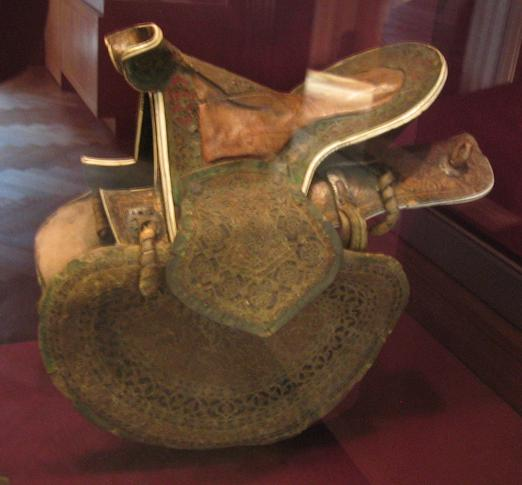
EYER OSMANLI/TÜRK 16.YY


HANÇER - TÜRK 1732-1733


ATBAŞI ZIRH OSMANLI/TÜRK 16.YY


ATBAŞI ZIRH OSMANLI/TÜRK 16.YY


OSMANLI/TÜRK TOLGA/MİĞFER 15.YY - KALKAN 19.YY


KHANJAR DAGGER - 17th Century
INDIA

Wootz Steel.
North Indian Khanjar dagger. The hilt is of chiseled steel, with fully-modeled ram’s head pommel. The knucklebow issues from a makara’s mouth and terminates in a horse’s head, while the guard is chiseled with elephant’s heads in relief.

The broad, curved double-edged blade forged of fine silver wootz damascus steel, bears two deep fullers and a pronounced median ridge, developing into a thick armor-piercing tip.

Jorge Caravan Collection

link


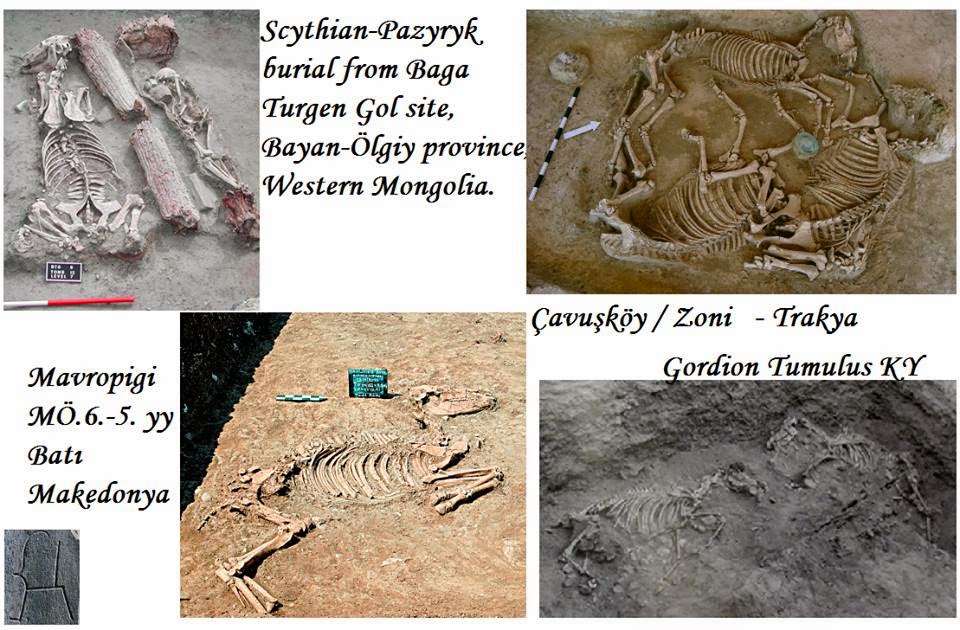
At ile gömü Türk Kültürü


____________


Türkçesi de var: link

İNGİLİZ YARIŞ ATLARININ ATASI TÜRK ATI
Jeremy James


Bir İmparatorluk… Bir at… Bir seyis... Üç kent… 
Viyana, Buda, İstanbul…

1683'te Osmanlı'nın Viyana'yı kuşatmasıyla başlayan bir tarih sahnesi. Sahnenin önünde varlığını atıyla bütünleştirmiş ‘Gazi' yemini eden evlad-ı fâtihan bir Seyis ve kökleri Orta Asya'ya Atilla'ya ve Cengiz Han'a uzanan Türkmen soyundan bir Karaman atı Azaraks (Ateşin Oğlu). Kökleri gibi yaşamları da aynı olan bu iki varlığın yazgıları da bir.

Osmanlı'nın İkinci Viyana Kuşatması'nda oradalar. Bozgunu yaşıyorlar. Ardından Hıristiyan orduları Buda Kalesi'ni kuşattığında (1686) ise yine birlikteler. 'Buda düşerse İstanbul da düşer' diyorlar ve diğer Gazi'lerle birlikte kaleyi kahramanca savunuyorlar.

Ancak tarihin kırılma noktasında Osmanlı'nın yazgısını değiştiremiyor ve Buda Kalesi'yle birlikte onlar da bir İngiliz birliğine esir düşüyorlar. 

İstanbul, Viyana, Buda derken kader onları bu sefer Londra'ya sürüklüyor. Aristokrat Albay Robert Byerley hem Azaraks'ı hem de Seyis'i satın alıyor ve sahipleniyor. Bundan böyle Azaraks'ın adı İngiltere'de Byerley Turk olarak anılacaktır.  Atın şöhreti bütün İngiltere'ye yayılmıştır. Hem aygır hem yarış atı olarak fırtınalar estiren kahramanımızın şeceresi bugün günümüze kadar hâlâ devam ediyor.

Tarihsel gerçekliğin içine oturtulmuş nefes kesen, sürükleyici bir kurgu. Bilinmeyen şaşırtıcı bir gerçek. Ayrıntılarda saklı kalmış tarihsel bir roman.


TÜRKLER


Truva'ya neden AT şeklinde tuzak kuruldu biliyor musunuz? - LİNK


İSKİTLERDEN TÜRKLERE AT KÜLTÜRÜ VE KIMIZ - LİNK


TULPAR ; PEGASUS'UN ATASI - LİNK


PANTALON ; BİR TÜRK İCADI - LİNK