mourning etiketine sahip kayıtlar gösteriliyor. Tüm kayıtları göster

17 Mayıs 2015 Pazar

The Turks in the Seventh Century


 "At that time we must remember, there was hardly such a thing as a town in Anglo-Saxon England...." H.G.Wells


"It becomes fairly evident that in the fifth and sixth centuries A.D. not merely Persia, but the regions that are now Turkestan and Afghanistan were far more advanced in civilization than were the French and English of that time. The obscurity of the history of these regions has been lifted in the last two decades, and a very considerable literature written in languages of the Turkish group has been discovered. These extant manuscripts date from the seventh century onward." - page 628

"Yuan Chwang’s account of Samarkand is of a large and prosperous city, “a great commercial entrepôt, the country about it very fertile, abounding in trees and flowers and yielding many fine horses. Its inhabitants were skilful craftsmen, smart and energetic.” At that time we must remember there was hardly such a thing as a town in Anglo-Saxon England." - page 646


Buddhist named Yuan Chwang started out from Singan, Tai-tsung’s capital, upon a great journey to India. He was away sixteen years, he returned in 645, and he wrote an account of his travels which is treasured as a Chinese classic. One or two points about his experiences are to be noted here because they contribute to our general review of the state of the world in the seventh century A.D.

Yuan Chwang was as eager for marvels and as credulous as Herodotus, and without the latter writer’s fine sense of history; he could never pass a monument or ruin without learning some fabulous story about it; Chinese ideas of the dignity of literature perhaps prevented him from telling us much detail of how he travelled, who were his attendants, how he was lodged, or what he ate and how he paid his expenses—details precious to the historian; nevertheless, he gives us a series of illuminating flashes upon China, Central Asia, and India in the period now under consideration.

His journey was an enormous one. He went and came back by way of the Pamirs. He went by the northern route, crossing the desert of Gobi, passing along the southern slopes of the Thien Shan, skirting the great deep blue lake of Issik Kul, and so to Tashkend and Samarkand, and then more or less in the footsteps of Alexander the Great southward to the Khyber Pass and Peshawur. He returned by the southern route, crossing the Pamirs from Afghanistan to Kashgar, and so along the line of retreat the Yueh Chi had followed in the reverse direction seven centuries before, and by Yarkand, along the slopes of the Kuen Lun to rejoin his former route near the desert end of the Great Wall. Each route involved some hard mountaineering. His journeyings in India are untraceable; he was there fourteen years, and he went all over the peninsula from Nepal to Ceylon.

At that time there was an imperial edict forbidding foreign travel, so that Yuan Chwang started from Singan like an escaping criminal. There was a pursuit to prevent him carrying out his project. How he bought a lean red-coloured horse that knew the desert paths from a strange grey-beard, how he dodged a frontier guard-house with the help of a “foreign person” who made him a bridge of brushwood lower down the river, how he crossed the desert guided by the bones of men and cattle, how he saw a mirage, and how twice he narrowly escaped being shot by arrows when he was getting water near the watch-towers on the desert track, the reader will find in the Life. He lost his way in the desert of Gobi, and for four nights and five days he had no water; when he was in the mountains among the glaciers, twelve of his party were frozen to death. All this is in the Life; he tells little of it in his own account of his travels.

He shows us the Turks, this new development of the Hun tradition, in possession not only of what is now Turkestan, but all along the northern route. He mentions many cities and considerable cultivation. He is entertained by various rulers, allies of or more or less nominally tributaries to China, and among others by the Khan of the Turks, a magnificent person in green satin, with his long hair tied with silk.

“The gold embroidery of this grand tent shone with a dazzling splendour; the ministers of the presence in attendance sat on mats in long rows on either side all dressed in magnificent brocade robes, while the rest of the retinue on duty stood behind. You saw that although it was a case of a frontier ruler, yet there was an air of distinction and elegance. The Khan came out from his tent about thirty paces to meet Yuan Chwang, who, after a courteous greeting, entered the tent.... After a short interval envoys from China and Kao-chang were admitted and presented their despatches and credentials, which the Khan perused. He was much elated, and caused the envoys to be seated; then he ordered wine and music for himself and them and grape-syrup for the pilgrim. Hereupon all pledged each other, and the filling and draining of the winecups made a din and bustle, while the mingled music of various instruments rose loud: although the airs were the popular strains of foreigners, yet they pleased the senses and exhilarated the mental faculties. 

After a little, piles of roasted beef and mutton were served for the others, and lawful food, such as cakes, milk, candy, honey, and grapes, for the pilgrim. After the entertainment, grape-syrup was again served, and the Khan invited Yuan Chwang to improve the occasion, whereupon the pilgrim expounded the doctrines of the ‘ten virtues,’ compassion for animal life, and the paramitas and emancipation. The Khan, raising his hands, bowed, and gladly believed and accepted the teaching.”

Yuan Chwang’s account of Samarkand is of a large and prosperous city, “a great commercial entrepôt, the country about it very fertile, abounding in trees and flowers and yielding many fine horses. Its inhabitants were skilful craftsmen, smart and energetic.”


from: 
H.G.Wells - THE OUTLINE OF HISTORY, book vı,1920
"On Yuan Chwang's Travels in India, 629-645 A.D." (B.602, D.664)


629-645. Xuan Zang (Hsuan-tsang). Chinese Buddhist monk and translator traveling across the Tarim basin via the northern route, Turfan, Kucha, Tashkent, Samarkand, Bactria, then over the Kindu Kush to India. Returned via the southern route. He spent his remaining life translating sutras into Chinese. .His travel and story became fantastic legends which were used in plays and novels, such as Wu Ch'eng-en's famous novel in the 16th century, Journey to the West. more to read:


NOTE:

"At the time when the Orkhon Monuments were erected, French and German nation was not formed." - Prof.Dr. Ahmet Taşağıl (Turcologist, historian)


Thus we can also add English nation to that, because Anglo-Saxons has emigrated to England in the 5th c AD....and they had interactions in culture and blood with the Turks. That's why we see many Turkish words in English, and some cultural artifacts, customs and traditions.


SB


* * *


"Şunu hatırlatalım ki o tarihler itibarıyla, böylesi uygarlaşmış kentlere Anglo-Sakson İngiltere'sinden 
rastlamak mümkün değildir." H.G.Wells


H.G.Wells, Yuan Chwang adlı Budist gezginin *MS.45 yılında Hindistan'a uzanan gezisindeki izlenimlerinden hareketle şöyle bir saptamada bulunur;

"Gezici bizlere sadece Türkistan diye bilinen yerlerdeki Türkleri değil ve fakat Kuzey Yolu olarak anılan bölgelerdeki Türkleri de tanıtmakta...Buralardaki birçok kentlerden ve bakımlı yerlerden söz etmekte...Gezicinin anlatışına göre Semerkant büyük ve refah içinde bir kent...Ahalisi son derece uygar...Şunu hatırlatalım ki o tarihler itibarıyla böylesi uygarlaşmış kentlere Anglo-Sakson İngiltere'sinden rastlamak mümkün değildir."


E.Aydın, Nasıl Müslüman Olduk?,s274 ; o da
İ.Arsel, Teokratik Devlet Anlayışından Demokratik Devlet Anlayışına, s94 alıntılamış...


* İlhan Arsel'in kitabında geçen ve Erdoğan Aydın'ın da aynen alıntıladığı tarih MS.45 , yazım hatası olmalı, çünkü Chwang kitabını MS.645'te yazmıştır. Chwang ya da Hsüan-tsang (Xuanzang) ın kitabının adı "On Yuan Chwang's Travels in India, 629-645 A.D." dır, ki doğumu y.602, ölümüde 664'tür. Galiba orjinal kitaba bakmak ve bu hatayı düzeltmek kimsenin aklına gelmemiş.


Prof.Dr.Ahmet Taşağıl hocanın da dediği gibi ; "Orhun Anıtlarının dikildiği çağda, Alman veya Fransız diye bir millet oluşmamıştı". Buna İngiltere'yi de ekleyebiliriz, çünkü Anglo-Saksonlar MS.5.yy'da İngiltere'ye göçmüştür ve göçmeden önce Hun gibi diğer Türk kavimleriyle de kültürel etkileşime girmiştir.

SB.


Yuan Chwang'ın Kaan ile tanışması: Hacı, Su-she su şehrinde av seferinde olan Turk Sh'eh-hu Kaan'ı ile karşılaşıyor. Bize söylendiği ordu ekipmanı çok büyük. Kaan yeşil saten bir elbise giyiyor, saçları on ayak uzunluğunda ve serbest, beyaz ipek bir band alnından arkaya dökülüyor. Bakanları ise, yaklaşık 200 kadar, hepsi işlemeli elbiseleri ve örgülü/kıvrımlı saçları ile sağında ve solunda duruyor. Diğer askerleri kürk, şayak (verev dokunmuş dayanaklı bir cins kumaş) ve ince yün elbiseleriyle, mızrakları, alemleri ve yayları ile sırayla duruyor. Suvarileri deve ve atlarıyla uzakta bacaklarını geriyor....


Kitapta adı geçen Sh-eh-hu Kaan'ın 635 de ölen Batı Türk Kaanlarından To-lu 'nun bir akrabası olduğunu söylüyor. Ye-hu olarak başka yerlerde de geçiyormuş, ama Sheh-hu olarak okunması gerektiği belirtiliyor.

To-lu dediği, 632-634 yılları arasında Batı Türk (Göktürk) Kağanlığını yöneten, Bağatur Kağan'ın oğlu Bağaşa Tuğluk Kağan olabilir mi? Sheh-hu Kağan kim bulamadım.


SAÇLAR / HAiRS


Etruscan
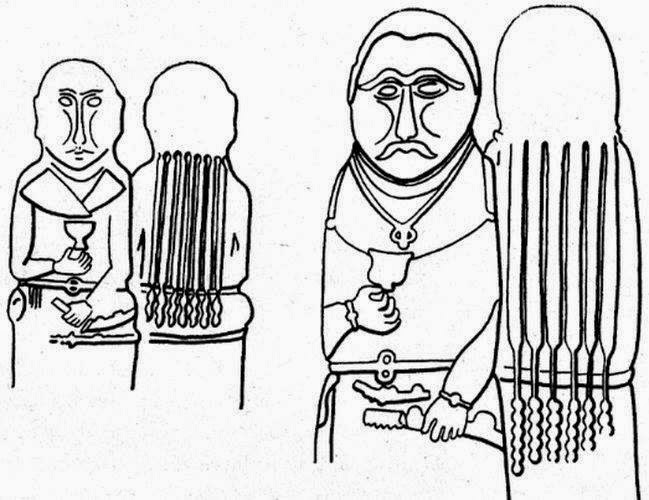

A drawing of Taşbaba (Tashbaba-Stonefather)

Turkish Taşbaba with his oath cup, dagger and long hair.
These "stonefathers" are used on graves, represents the brave fearless Turkish warrior or leader.

You can see it everywhere , from the Altai , Central Asia, to Europe....
from the Scythian Turks period (even earlier) till 15th c...

Ancestor of the gravestones....


Kars Province; 19th c AD;  Turkish Gravestones


Delilah gets Samson to tell her the secret of his strength: 
"My hair has never been cut," he says. "From the time that I was born, ..."
I wonder where the myth of Samson and Delilah comes from... ;)


Under Attila (reigned 434-453 CE) the Huns became the most powerful, and most feared, military force in Europe. After Attila's death, however, his sons fought each other for supremacy, squandered their resources, and the empire which Attila had built fell apart by 469 CE

According to the Roman historian Priscus of Panium, the men of the army had cut their long hair and slashed their cheeks, so that the greatest of all warriors should be mourned not with tears or the wailing of women but with the blood of men. (is a expression of mourning in Turkish culture)

The Huns are descended of the Scythians and were the same people as the Xiongnu and they are Turkish of nation. Most of the scholars don't mention the word Turk on purpose!


ilgili:


THE TURKS
_____________
_____________


9 Şubat 2015 Pazartesi

SCYTHIANS - HUNS - TURKS - NATiVE / Burial Ceremony


* Mourning Natives: Cutting Hair
* Mourning Türks: Detail of the wall painting “Peoples of the World Mourning Buddha”. Kyzyl, Mingoi, Maya cave
* Turkish Taşbaba: Giving food for the ancestors.
* Turkish Taşbaba with his oath cup and dagger.
* Pazyryk 5th Kurgan: Turkish Kurgan
* Scythian Taşbaba with his oath cup and dagger.


Scythians


The tombs of their kings are in the land of the Gerrhi, who dwell at the point where the Borysthenes is first navigable. Here, when the king dies, they dig a grave, which is square in shape, and of great size. 


When it is ready, they take the king's corpse, and, having opened the belly, and cleaned out the inside, fill the cavity with a preparation of chopped cypress, frankincense, parsley-seed, and anise-seed, after which they sew up the opening, enclose the body in wax, and, placing it on a waggon, carry it about through all the different tribes. 


On this procession each tribe, when it receives the corpse, imitates the example which is first set by the Royal Scythians; every man chops off a piece of his ear, crops his hair close, and makes a cut all round his arm, lacerates his forehead and his nose, and thrusts an arrow through his left hand. 


Then they who have the care of the corpse carry it with them to another of the tribes which are under the Scythian rule, followed by those whom they first visited. 


On completing the circuit of all the tribes under their sway, they find themselves in the country of the Gerrhi, who are the most remote of all, and so they come to the tombs of the kings. There the body of the dead king is laid in the grave prepared for it, stretched upon a mattress; spears are fixed in the ground on either side of the corpse, and beams stretched across above it to form a roof, which is covered with a thatching of osier twigs. 


In the open space around the body of the king they bury one of his concubines, first killing her by strangling, and also his cup-bearer, his cook, his groom, his lacquey, his messenger, some of his horses, firstlings of all his other possessions, and some golden cups; for they use neither silver nor brass. After this they set to work, and raise a vast mound above the grave, all of them vying with each other and seeking to make it as tall as possible. 


When a year is gone by, further ceremonies take place. Fifty of the best of the late king's attendants are taken, all native Scythians - for, as bought slaves are unknown in the country, the Scythian kings choose any of their subjects that they like, to wait on them - fifty of these are taken and strangled, with fifty of the most beautiful horses. When they are dead, their bowels are taken out, and the cavity cleaned, filled full of chaff, and straightway sewn up again. This done, a number of posts are driven into the ground, in sets of two pairs each, and on every pair half the felly of a wheel is placed archwise; then strong stakes are run lengthways through the bodies of the horses from tail to neck, and they are mounted up upon the fellies, so that the felly in front supports the shoulders of the horse, while that behind sustains the belly and quarters, the legs dangling in mid-air; each horse is furnished with a bit and bridle, which latter is stretched out in front of the horse, and fastened to a peg. The fifty strangled youths are then mounted severally on the fifty horses. To effect this, a second stake is passed through their bodies along the course of the spine to the neck; the lower end of which projects from the body, and is fixed into a socket, made in the stake that runs lengthwise down the horse. The fifty riders are thus ranged in a circle round the tomb, and so left.


Such, then, is the mode in which the kings are buried: as for the people, when any one dies, his nearest of kin lay him upon a waggon and take him round to all his friends in succession: each receives them in turn and entertains them with a banquet, whereat the dead man is served with a portion of all that is set before the others; this is done for forty days, at the end of which time the burial takes place. 


Herodotus IV.71-72-73


* * * 

AL-TABARI:
Two texts of Al-Tabarī (Cafer el-Tabari) from AD 728/729;

He describes mourning for a chief from Transoxiana: 

“His Turks cut off their ears, becoming the worst of those with bowed heads, weeping.”

Ten years later ( AD 738/739) Arabs killed in Transoxiana Kūrşūl, a Turgesh (Turkish Tribe) leader.


His mourning is described in a similar way: 

“They cut their ears and tore the skin on their faces and began weeping over him.”


* * *


Mourning Turk. 
Detail of the wall painting “Peoples of the World Mourning Buddha”. 
Kyzyl, Mingoi, Maya cave


Early Turks: Male Costume in the Chinese Art Second half of the 6th – first half of the 8th cc

Prof.Sergey A. Yatsenko - link


IMAGES OF THE EARLY TURKS IN CHINESE MURALS AND FIGURINES FROM THE RECENTLY-DISCOVERED TOMB IN MONGOLIA

Prof.Sergey A. Yatsenko - link
Russian State University for the Humanities, Moscow


* * * 

NORTH AMERICAN INDIANS.

"Supplying food to the dead is a custom which is known to be of great antiquity; Many of the tribes of North American Indians followed these customs. The cutting of hair as a mourning observance is of very great antiquity, and Tegg relates that among the ancients whole cities and countries were shaved (sic) when a great man died....."  


CUTTING HAIR, BRINGING FOOD AND DRINKING 
IS CALLED AS
"BLOODLESS SACRIFICE" 

In Turkish bringing food for the dead, we call; 
"ölü aşı" "dead meal".


* * * 

"When Attila died, the Huns "as it the custom of that race, cut off a part of their hair and disfigured their faces horribly with deep wounds, so that the gallant warrior should be mourned not with the lamentations and tears of women, but with the blood of men."

Sidonius had the Huns in mind when he wrote about the peoples " to whom wailing means selfwounding and tearing the cheeks with iron and gouging the red traces of scars on the threatening face."

a line in Kalidasa's Raghuvamsa alludes to the same custom among the Huna on the Oxus: " The exploits of Raghu, whose valof expressed itself among the husbands of the Huna women, became manifest in the scarlet color of their cheeks".

Slashing or scrating the face as an expression of mourning was so widespread that only a few parallels to the Hunnic custom need to be adduced: The Kutriger cut their cheeks with daggers, the Turks cut off their hair and slashed their ears and cheeks; so did the Magyars and Slavs; on a wall painting in Pandzhikent patterned on Parinirvana scenes, the mournes are shown cutting their cheeks with knives. Until quite recently the custom was observed by Serbs and Albanians, and in some regions in Tadjikistan. The lines on a gold mask found at the Shami Pass in the Chu Valley, datable to the Fourth or fifth century, might represent scars.

The Getica account of Attila's obsequies, going back to Priscus, reads:

His body was place in the midst of a plain and laid in state in a silken tnet as a sight for men's admiration. The best horsemen of the entire tribe of the huns rode around in circles, after the manner of circus games, in the place to which he had been brought and told of his deeds in a funeral dirge in the following manner:

Here lies Attila, the great king of the Huns.
the son of Mundzucus
the ruler of the most courageous tribes;
enjoying such power as had been unheard of before him
he possesed the Scythian and Germanic kingdoms alone
and alos terrorized both empires of the Roman world
after conquering their cities and
placated by their entreaties
that the rest might not be laid open to plunder
he accepted an annual tribute
After he had achieved all this with great success
he died not of an enemy's wound, not betrayed by friends
in the midst of his unscathed people
happy and gay
without any feeling of pain
Who therefore would think that this was death
which nobody considers to demand revenge?

(Praecipuus Hunnorum rex Attila, patre genitus Munzuco fortissimarum gentium dominus)


The world of the Huns: Maenchen-Helfen
* "The Kutrigur cut their cheeks with daggers" ; - Agathias
* "The Turks cut off their hair and slashed their ears and cheeks" ;  Menander "Protector" the Memorial to Bilge qaghan, Malov 1959 (Bilge Kagan)
* "so did the Magyars" - Liutprand


"Socio-cultural history: Those who not take a attention on social memory history, ie social DNA, 
have to explain how and why they appear in Turkish cultural geography." 
Dr.Mustafa Aksoy


Huns=Turks=Scythians coming from the same family 
And Magyars are cousin of Turks.


SB.

______


6 Ağustos 2014 Çarşamba

TÜRKLERDE VE YERLİLERDE YAS VE ÖLÜ GÖMME ADETLERİ


Right : "Mourning Türks". 
Detail of the wall painting “Peoples of the World Mourning Buddha”. 
Kyzyl, Mingoi, Maya cave
Early Turks: Male Costume in the Chinese Art / link
Sergey A. Yatsenko
Left : Native Americans Mourning


Eski Türklerde Yas ve Ölü Gömme Âdetleri:

Emel Esin : Eski Türklerde cenaze merasimine (yoğ) Çinlilerin “kubbeli otağ altındaki tabut” adını verdiklerini, çünkü Türk geleneğinde ölen kimsenin cesedinin, kubbeli otağ altına konarak otağın etrafında at koşturulduğunu belirtir. Otağın kapısına gelinince matem tutanlar yüzlerini ve kulaklarını bıçaklarlar. Matem işareti olarak saç kesilir, tütsü kullanılır, tütsülü matem meşalesi (yug yıpar) yakılırdı....

Volga Bulgarlarının defin töreni X. yy.’da İbn Fadlan tarafından kısaca anlatılmıştır. Buna göre, Bulgarlarda eski Şamanî defin törenleri olduğu gibi devam ettirilmekte idi. Ölünün çadırı kapısına gelirler, yüksek sesle ağlarlardı, köleleri kendilerini kamçı ile döve döve feryat ederlerdi. 


Ölünün çadırına bayrak asarlardı. Ölü mezara bayraklı araba ile götürülür, silahları mezarının çevresine bırakılırdı. Yas tutma iki yıl devam ederdi. İki yıl sonra saçlarını keserler, bayrağı indirirlerdi. Bu törenden sonra dul kalan kadına evlenme izni verilirdi. Bayrak unsuru Kazaklarda aş törenlerinde ve ölü çıkan ailelerin çadırlarında da bulunmaktadır. 


S. Buluç, saç kesmenin, ölüye sunulan bir nevi kurban addedilmiş olmasının muhtemel olduğu düşüncesindedir....


Yrd. Doç. Dr. Yıldız Kocasavaş / Türkler, Cilt 3


**

Heredot İskitlerin eni ile boyu dikdörtgen bir mezara mumyalanmış ölünün defnedildiğini ,ölünün yakınlarının başlarını kazıyıp, kollarını çizdiklerini, alınlarını burunlarını yırttıklarını belirtiyor. 

Benzer ölü merasimi Orhun Kitabelerinde var ;Bilge Kağan Abidesinin güney cephesinde; Çinli Elçilerinde hazır bulunduğu Bilge Kağan babasının Ölüm töreninde, bütün halkın saçlarını tıraş ettiği ve kulaklarını yaraladığı yazılıdır . Aradan birkaç bin yıl geçse de  farklı zaman ve mekanda da olsa, İskit Ölü merasimiyle Göktürklerin Ölü merasimi neredeyse tıpatıp örtüşmekte.


SCYTHIANS Burial Ceremony - HEREDOT AND AL-TABARI


HEREDOT BOOK 4-71

The tombs of their kings are in the land of the Gerrhi, who dwell at the point where the Borysthenes is first navigable. Here, when the king dies, they dig a grave, which is square in shape, and of great size. 

When it is ready, they take the king's corpse, and, having opened the belly, and cleaned out the inside, fill the cavity with a preparation of chopped cypress, frankincense, parsley-seed, and anise-seed, after which they sew up the opening, enclose the body in wax, and, placing it on a waggon, carry it about through all the different tribes. 

On this procession each tribe, when it receives the corpse, imitates the example which is first set by the Royal Scythians; every man chops off a piece of his ear, crops his hair close, and makes a cut all round his arm, lacerates his forehead and his nose, and thrusts an arrow through his left hand. 

Then they who have the care of the corpse carry it with them to another of the tribes which are under the Scythian rule, followed by those whom they first visited. 

On completing the circuit of all the tribes under their sway, they find themselves in the country of the Gerrhi, who are the most remote of all, and so they come to the tombs of the kings. There the body of the dead king is laid in the grave prepared for it, stretched upon a mattress; spears are fixed in the ground on either side of the corpse, and beams stretched across above it to form a roof, which is covered with a thatching of osier twigs. 

In the open space around the body of the king they bury one of his concubines, first killing her by strangling, and also his cup-bearer, his cook, his groom, his lacquey, his messenger, some of his horses, firstlings of all his other possessions, and some golden cups; for they use neither silver nor brass. After this they set to work, and raise a vast mound above the grave, all of them vying with each other and seeking to make it as tall as possible. 

Herodotus 4.71


AL-TABARI:
Two texts of al-Tabarī (Cafer el-Tabari) from AD 728/729;


He describes mourning for a chief from Transoxiana: 
“His Turks cut off their ears, becoming the worst of those with bowed heads, weeping.”


Ten years later ( AD 738/739) Arabs killed in Transoxiana Kūrşūl, a Turgesh leader.(Türgişler/Erken Türkler/Earlier Turks-Türgişler hakkında daha fazla bilgi için: LİNK). 


His mourning is described in a similar way: 
“They cut their ears and tore the skin on their faces and began weeping over him.”


Attila’nın 453 yılındaki ölümü ve akabinde düzenlenen ve Slavca olarak “strava” adıyla anılan cenaze merasimi münasebetiyle Jordanes tarafından anlatılan bilgilerden, Avrupa Hunlarındaki gelenek hakkında oldukça teferruatlı bilgilere sahibiz. Buna göre, cenaze merasimine katılan "Hunlar, âdetleri üzere, saçlarından bir kısmını kesmiş ve yüzlerini derin yaralar bırakacak şekilde bıçaklarla korkunç bir biçimde çizmişlerdi; öyle ki cesur savaşçı [Attila] için, sadece erkek ve kadınların ağlamaları ve göz yaşlarıyla değil, insanların kanlarıyla da yas tutuluyor, kadınlar tarafından ağıtlar yakılıyor, gözlerden akan yaşlarla yanaklardan akan kanlar birbirine karışıyordu."

The world of the Huns: Maenchen-Helfen 


Mutilation of mourners. 
Wall painting in Cave 158 of Tun-huang, 
8th or 9th century AD


*SAÇ KESMEK, YEMEK VE İÇECEK SUNMAK 
"KANSIZ KURBAN" DİYE DE GEÇER. 


Native Americans offering food to deads, 
like the Turks. 

Yas adeti dünyada bilinen bütün kültürlerin genel ritüellerinden biridir. Büyük afetler, yenilgiler, ölümler sonucu insanlar davranışlarıyla, sözleriyle üzüntülerini ortaya koymaya çalışmışlardır. Bu ritüellerin bazıları zaman içinde toplumda uyulması gereken bir kural haline gelebilir.

Türk kültüründe de Şamanizmin etkisiyle yas adetinde yıllar içinde insanların uyması gereken birçok inançların ortaya çıktığını görüyoruz. Bu adetler Sultanların hakimiyet alameti bile olmuştur. Sultan tahta çıktığında ölen babası için siyah giyer, atının kuyruğunu keser, saçı (ulufe) dağıtırdı. Eğer bu ritüeller yapılmazsa Sultanın hakimiyeti eksik kalırdı.


Baş açmak, elbiseyi ters giymek, kara ve gök elbise giyilmesi vs., gibi yas ritüelleri, gerek halk, gerekse de sultanlar tarafından İslamiyette pek uygun görülmese de devam ettirilmiştir. bu yas adetleri sanki bir İslami bir kuralmış gibi de kabul edilmiştir. Bundan dolayı bunun bazı İslami yansımaları da olmuştur. Bunun en büyük yansıması Kerbela matemidir....


Çin kaynaklarında anlaşıldığına göre; Hunlar, Gansu (Kansu) eyaletindeki Tsilen-şan (Tanrı) dağından ayrıldıktan sonra ağıt yakmışlardır. Bildiğimiz en eski ağıt örneği ise MÖ.119 yılında Hunların bir savaş sonucunda Ordos'un kuzeyindeki topraklarını kaybederek büyük çölün kuzeyine çekilmeleri üzerine söylenilmiştir.


Ayrıca Türkler'in en eski ağıtları içinde Alp Er Tunga'ya yakılan Kaşgarlı Mahmut tarafından sagu denilen ağıtı da zikretmemiz gerekiyor. Alp Er Tunga'ya yakılan ağıtlar ve yuğ töreni ile ilgili ilk bilgi kırıntılarını Bilge Kağan anıtında buluyoruz.....


Türklerin İslamiyeti kabulünden önceki yas törenlerinin temellerinin Şamanizme dayandığını söylememiz mümkündür. Türkler ölen kişinin ruhunun insanlara zara vermemesi için "yoğ" törenleri düzenlerlerdi. Bu törenden sonra "ölü aşı" adı verilen yemeğe yalnız dirilere değil, bilhassa ölülere ikram edildiğine inanılırdı...


Türklerde Yas Âdeti Temelleri ve Sonuçları
SÜ Fen-Edebiyat Fakültesi Tarih Bölümü

Dardanos, MÖ.3.yüzyıl lahit - Priştina Arkeoloji Müzesi


Kadın ağıtçılar tutulurdu, Hıristiyanlıkta yasaklanmış , 
İslamda lanetlenmiş. 
Roma döneminde ağıtçılar gözyaşlarını şişede toplar 
ve ölü ile gömerdi, 
Ne kadar çok gözyaşı şişesi o kadar çok mutlu.


Pelasglılar - Amphora - MÖ. 760-750  Atina Arkeoloji Müzesi


NATIVE AMERICANS

We should find some of the mourning customs interesting. The friends of the dead wail and scream fearfully; they cut off their hair; they gash their bodies; they sometimes even chop off their finger tips or whole joints. They watch by the grave—this is particularly true of women. Food and drink are often carried to the grave for some time after the burial. Fires are kindled to supply light or heat to the soul on its long journey.


Ojibwa Gravestone- from Schoolcraft


Supplying food to the dead is a custom which is known to be of great antiquity; in some instances, as among the ancient Romans, it appears to have been a sacrificial offering, for it usually accompanied cremation, and was not confined to food alone, for spices, perfumes, oil, &c., were thrown upon the burning pile. In addition to this, articles supposed or known to have been agreeable to the deceased were also consumed. The Jews did the same, and in our own time the Chinese, Caribs, and many of the tribes of North American Indians followed these customs. The cutting of hair as a mourning observance is of very great antiquity, and Tegg relates that among the ancients whole cities and countries were shaved (sic) when a great man died.....


STUDY OF THE MORTUARY CUSTOMS OF THE
NORTH AMERICAN INDIANS. 
BY Dr. H. C. YARROW
FIRST ANNUAL REPORT OF THE BUREAU OF ETHNOLOGY TO THE
SECRETARY OF THE SMITHSONIAN INSTITUTION - 1879-’80


Native Americans 

Fig. 12 shows the dead warrior's totem, a tortoise, and beside it a headless man, which is a common symbol of death among Indian tribes. 

Below the trunk are three marks of honour. The next and more elaborated figure (13) records the achievements of Shingabawassin, a celebrated chief of the St. Mary's band. His totem, the crane, is shown reversed. 

The three marks on the left of the totem represent important general treaties of peace to which he had been a party; the six strokes on the right probably indicate the number of big battles which he fought. 

The pipe appears to be a symbol of peace, and the hatchet a symbol of war. In like manner head-boards erected over a woman have the various articles used by her in life, as cutting and sewing instruments and weaving utensils, depicted upon them.


Orta Asya Türk Bengütaş'ları


Alaska - Native


Fig. 26, which depicts some general features of Alaskan life on a piece of walrus tusk. 

1, a native is resting against his house, and on his right stands a pole surmounted by a bird, apparently a totem-post. 
2. A reindeer. 
3. One man shooting at another with an arrow. 
4. An expedition in a dog-sledge, and, 
5, in a boat with sail and paddle. 
6. A dog-sledge, with the sun above; perhaps indicating the coming of summer. 
7. A sacred lodge. The four figures at each outer corner represent young men armed with bows and arrows to keep off the uninitiated from the forbidden precincts. The members of the occult society are dancing round a fire in the centre of the lodge. 
8. A pine tree up which a porcupine is climbing. 
9. Another pine tree, from which a woodpecker is extracting larvæ. 
10. A bear. 
11, 12. Men driving fish into, 
13, the net, above them being a captured whale, with harpoon and line attached.
THE STORY OF THE ALPHABET


.......


BU ARADA BİZE NOT;
"YABANCI" AKADEMİSYENLER, 
TÜRKLERDEN BAHSETMEZ 
TÜRKLERİ  HAZMEDEMEZLER !
ÇÜNKÜ EL ATTIKLARI HER ÇALIŞMADA 
TÜRK KÜLTÜRÜ
ÇIKAR KARŞILARINA.
SB.