russia etiketine sahip kayıtlar gösteriliyor. Tüm kayıtları göster

29 Nisan 2020 Çarşamba

Doğu Roma'da Theme - Türklerde Tümen


Doğu Roma'da kullanılan Theme sistemi ve kelimesi Türklerden geçmiştir.

"Bizans İmparatorluğu ile yapılan savaşlar sonunda esir düşen veya anlaşmalı olarak kendi istekleriyle Bizans arazilerine iskan edilen onbinlerce Bulgar, Peçenek, Uz ve Kuman-Kıpçak Türkü’nün yerleşimi belirli bir sistem dahilinde gerçekleştirilmiştir. Bahsi geçen bu sistemin temeli İmparatorluğun yüzyıllar boyunca Pers ve Arap istilaları, iç savaşlar, hastalık, kıtlık gibi nedenlerle insan gücünün azalmasına bağlı olarak dışarıdan temin edilen yerleşimcilerle nüfusu azalan bölgelerin yeniden canlandırılmaya çalışılmasına dayanmaktadır. Nitekim, özellikle İmparatoratorluğa yönelik dış tehditler arttıkça böyle bir teşkilat geliştirilmiş ve bu teşkilata theme adı verilmiştir. Diğer bir ifadeyle theme’ler, başlangıçta olmasa dahi zamanla, askeri ve mülki idareyi bir elde toplayan Stratikosların emrinde bulunan idari birimlerdir.

Kelime olarak kökeni tam açıklanamayan theme’in Yunanca bir kelime olan ve İmparatorluk görevlileri tarafından kayıt defterine yazılma anlamına gelen thesis’den geldiğini ileri süren Aikatarina Christophilopolou’ya (7) karşın, Mark Wittow, kelimenin ‘step dünyasıyla’ ilgili olduğu görüşünün ikna edici olduğunu belirtmekte ve Türkçe’de 10.000 kişiden oluşan ve Tümen adı verilen askeri birlikle alakalı olabileceğinin altını çizmektedir. Nitekim, göçebe komşuları Türklerin savaş kabiliyetlerine aşikar olan Roma ve Bizanslıların kelimeyi almış olmalarının gayet doğal olduğunu belirten Witthow, kelimenin başlangıçta askeri birliği ifade ederken, 10. yy.’dan itibaren bu askeri birliklerin yerleştiği yerleri ifade etmeye başladığını belirtmektedir.(8)

Tüm Bizans tarihi boyunca themeler’den sınırlara yakın olanlar ayrı bir öneme sahip olmuştur. Bu birimlere askerler aileleriyle birlikte yerleştirilir vergiden muaf tutulur ve dolayısıyla askerlik karşılığı toprak sahibi olurlardı. Aslında bu türden sınır bölgelerine asker yerleştirme uygulaması eskiden limitanei olarak adlandırılan ve sınırlara asker yerleştirme anlamına gelen eski sistemin geliştirilmiş şeklidir. (9) Yabancı olan bu askerler aileleriyle birlikte ve kendi mülklerinde oturduklarından sahip oldukları toprakları müdafaya mecbur olurlardı ve bu da beraberinde İmparatorluğa sadakatı getirmekteydi. Genel olarak bakıldığında theme sisteminin Anadolu’da daha fazla geliştiği söylenebilir. 6. yy.’dan itibaren Anadolu’da meydana gelen nüfus azalmasına karşı oluşturulan bu themelere yerleştirilmek üzere İmparatorluğu’n çeşitli bölgelerinden özellikle de Balkanlar’dan yeni insanlar nakledilmiştir.(10) Diğer taraftan, zaman içerisinde benzer organizasyon Balkanlar’da da gündeme gelmiştir.

7. yy.’ın orijinal themeleri Anatolikon (669), Armeniakon (667), Thracian (680-685) ve Opsikion’dur (680). İlk iki theme eski “magister militum per orientem ve magister militum Per Armeniam” olarak adlandırılan ordulardır. Doğu ordusu Mezopotamya ve Suriye’den çekilip Güney- Orta Anadolu’ya yerleşmiş ve Anatolikon theme’i adını almıştır. Armenia ordusu da Yukarı Fırat bölgesinden çekilerek Kuzeydoğu Anadolu’ya yerleşmiş ve Armeniakon adını almış, Balkanlar’daki eski “Magister militum per Thraciam” olarak bilinen Batı birlikleri de Trakya’dan çekilerek verimli batı Anadolu topraklarına yerleşip Thrakesion theme’sini oluşturmuştur.(11) Son theme olan Opsikion ise İstanbul’a yakın, Kuzeybatı Anadolu’da ve İmparatorluk muhafız birliklerini ve 6. yy.’da merkezi ordudan kalan birlikleri içeren bir theme’dir. 

Ancak 9. yy.’a gelindiğinde Anadolu themeleri küçültülerek Opsikion, Bucellarion, Optimaton, Paphlagonia, Armeniakon, Chaldia, Colonea, Charsianon, Anatolikon, Thraceion, Kappadokya, Mezopotamya, Sebastea, Lycandus, Leontocomis, Seleukia ve Cbyraeots(12) adlarında yeni theme’ler oluşturulmuştur."


Yonca Anzerlioğlu
Bizans İmparatorluğu'nda Türk Varlığı
Hacettepe Üniversitesi Atatürk İlkeleri ve İnkilâp Enstitüsü
Türkler Ansiklopedisi, Cilt 6, s.351-375 ya da link
Dipnotlar:
[7] Aikatarina, Christophilopolou, Byzantine History, II, 610-867, trans. by Timothy Cullen, Amsterdam, 1993, s. 346.
[8] Mark Whittow, The Making of Orthodox Byzantium, 600-1025, London, 1996, s. 113.
[9] George Ostrogorsky, History of the Byzantine State, tran. By John Hussey, oxford, 1968, ss. 97, 131-132; Baykurt, op. cit., s. 115; Diehl, op. cit., s. 42.
[10] Peter Charanis, ”The Demography of Byzantine Empire,” Proceedings of 13th international Congress of Byzantine Studies, ed. by J. M. Hussey, D. Obelensky and S. Runciman, Sofia, 1935,.
[11] Witthow, op. cit., ss. 113-114; Christophilopolou, op. cit., s. 349.


Rusya'da Tümen Oblastı ve Tümen (Tyumen) adında bir kent de bulunmaktadır.

The name of the Russian city Tyumen is Turkish of etymology, just like the Theme's of the Byzantine Empire.
Tümen = Tr.ety., Army of 10.000 soldiers.
SB


17 Temmuz 2016 Pazar

Karamazov ve Dostoyevski


"Her şeyden önce, kendine yalan söyleme. 
Kendisine yalan söyleyen ve söylediği yalanları dinleyen kişi bir noktaya gelince, etrafındaki veya 
kendi içindeki gerçeği ayırt edemez. 
Ve böylece hem kendisine hem de diğerlerine bütün saygınlığını yitirir."
Fyodor Dostoyevsky - Karamazov Kardeşler


* KARA kelimesinin kökeni Türkçedir. Renk belirtmesi dışında , gözü kara, cesur, yürekli, atılgan anlamına da gelir. Romanda kavgacı ve ahlaksız tiplerdir, bu yüzden olumsuz ek olan MAZ ile KARAMAZ kelimesi olumsuz davranışlarını belirtir. Çok Yaramaz'lar çok. (Karamaz=Yaramaz ;) )

* -ov Rusçada erkek adlarında kullanılan iyelik ekidir. -ov -ev aynı zamanda oğul anlamını da taşır. 
Örn: Karamaz+ov/ev = Karamazevi - Karamazoğlu - Yaramazoğlu


Sürgünden sonra Dostoyevsky'in Türklere bakışı olumsuzdur, ancak köken olarak da Türk'tür.


ALÇALDILMIŞ VƏ TƏHQİR EDİLMİŞ
İNSANLARIN DOSTU DOSTOEVSKİ (1821-1881)

Dostoevskinin müasiri rus riyaziyyatçısı Rusiya EA-nın ilk qadın akademiki yazıçı Sofya Kovalevskaya xatırlayır: Bir dəfə Dostoevski bizdə öz köhnə dostu ilə qarşılaşdı. Onlar çoxdan görüşmürlərmiş, indi bu iki dost ətrafdakılara fikir vermədən yalnız hər ikisinə zövq verən mövzulardan danışırdılar. Çox keçmədi ki, onların sənətdən, ədəbiyyatdan başlayan söhbətləri gedib din üzərinə çıxdı.

Dostoevski mömin, dostu ateist idi. Söhbət qəlizləşmişdi; Dostoevski "Allah vardır!" deyə xüsusi vəcdlə qışqırırdı. Biz də unutmuşduq ki, bayram axşamıdır, söhbətə elə aludə olmuşduq ki... Birdən yaxın kilsənin fərəhli zəng səsləri içəriyə doldu. Dostoevski elə ehtizaza gəldi ki: Sanki göylə torpaq birləşərək məni uddu və mən allahın özünə qovuşdum deyə həmin andaca deyə bildi. Siz sağlam adamlarsınız, məni anlamazsınız. Məhəmməd inandırır ki, cənnətdə olmuş, onu görmüşdür. Siz ağıllı dəlilər isə ona şübhə edirsiniz. Amma o sızə düzünü deyir. O həqiqətən cənnəti görmüşdür. Dostoevski artıq bu sözləri sehirli pıçıltılarla deyirdi (15, s.27).

Dostoevski ədəbi mühitə qədəm qoyanda Krılov, Puşkin, Lermontov kimi "bahadırlar" yenicə əbədən susmuşdular. Bununla da rus ədəbiyyatında lal bir boşluq açılmışdı. Belə bir zamanda hərbi qulluqdan istefaya çıxan Fyodor Mixayloviç Dostoevskinin "Yazıq adamlar" əsəri rus oxucularının qulağına yazıqların, binəsiblərin ah-nalələrini çatdırdı və bu qulağı ağlaşma səsləri ilə doldurdu; bu acıma və mərhəmət xristian mühitində dərhal əks-səda verdi. Elə bu ilk əsəri də Dostoevskinin bütün gələcək yaradıcılığının epiqrafı ola bildi. Bütün yaradıcılığı boyu belə dərdli və yazıq adamlar onun ədəbi qəhrəmanları oldu. Onların fəlakətli həyatı - həbsxanaya bənzər güzəranı və bu hıçqırıqlar, bu fəryadlar qəlbdən kənar keçilə bilməzdi.

Onda uşaqlıqdan ürəkkeçmə xəstəliyi vardı. Yüksək emosiyalar onu özündən çıxarırdı. Bu ən çoxu acımadan, rəhmdillikdən doğulduğu kimi, gözəlliklər qarşısında ağır heyrət nəticəsində də baş verə bilərdi. Fövqəladə gözəl qadın qarşısında, çoxlarının gözləri önündə bir ziyafətdə o qəşi edərək özündən getmişdi
(9, s.386).

Bu çılğınlıq onun "bəzəyi" idi. Moskvada Puşkinin abidəsinin açılışında elə həyəcanlı nitq söyləmişdi ki, ondan sonra gözəl ədəbiyyatşünas sayılan İvan Aksakov öz sözündən imtina etmişdi. Bu çıxışdan sonra elə alqışlar qopur ki, onun əllərini təşəkkür üçün əllərinə alan gənc də çıldırıb bayılır (9, s.581).

Bu ürəkkeçmə onun qəhrəmanlarının da bir çoxunda var idi. Ömrü boyu alçaldılan və təhqir edilən bu insanlar yarımdəli idilər. Yazıçının özünün duyduğu əzabları və iztirabları zavallı qəhrəmanları da təbii bir tərzdə - dəlilik içində daşımaqda idi. Əsil əzabkeş idi; gənclik havasına uyub qoşulduğu gizli təşkilatın fəal üzvü kimi ölümə məhkum olması, son anda əfv olunmaq, həbsxana, sürgün, daha sonra isə sarayda qəbullar, ehtiram ehtişam, ona büt kimi baxan şahzadələr, yüksək saray əyanları.

Taleyə bax, necə amansız, necə də lütfkar, səxavətli! Qumarbaz idi: asan, yüngül yolla qazanılan pul ona ağır, müdhiş nəticələr bəxş edirdi. Arvadının paltarlarına qədər uduzurdu (30, s. 156-167). Ağlayırdı, tövbə edirdi, təkrar qumar masasına dönürdü, yenidən and-qəsəm. Onu yalnız özündən 24 yaş kiçik olan arvadı - son məhəbbəti Anya başa düşüb bağışlaya bilirdi.

...Dostoevskilər nəslinin gerbi ay-ulduzludur; bu gerbdə çalın çarpaz qoyulmuş yatağan və ox təsvir olunmuşdu. Bu təsvirin hər iki tərəfində çiynində oxla dolu sadağı olan, kaftanı qurşaqla bağlanmış, şalvarının balağını yumşaq sapoqlara (uzunboğaz çəkmə) salmış iki silahlı türk əks olunmuşdu (9, s.68). Belə bir gerb özü bu ailənin birbaşa pravoslav nəsillərə mənsub olmadığını aydın göstərməkdədir.

Dostoevskinin kiçik qardaşı hələ yazıçının sağlığından yazmağa başladığı xatirələrində özlərinin Litva zadəganlarından olduqlarını göstərir. Sonradan Ukraynada məskunlaşdıqlarını və ruhani babalarınadək bu şəcərənin tarixini uzada bilir. Əsl mənşələri haqqında bilərəkdən və ya bilməyərəkdən susur (15,s.31).

İnqilabdan hələ çox əvvəldən xaricdə yerləşən yazıçının öz qızı Lyuba da özlərinin mənşəcə ruslara mənsub olmalarını bilmərrə inkar edir. Hər yerdə atasının Norman-Litva əsilli olduğunu israrla qeyd edir. Zira ana nənəsi də İsveçdən gəlmişdi bu qızın. Dostoevskilər nəsli əvvəllər İrtiş adlanırdı. Bu familiya müxtəlif mənbələrdə müxtəlif şəkillərdə - Rtişeviç, İrtişeviç, Artışeviç yazılır. Sonralar güclü və nüfuzlu rus familiyası kimi tanınan Rtişev belə yaranır (44, s.84). Bu familiya Azərbaycanın taleyində görünür: Rusiya və İran arasında Gülüstan müqaviləsi bağlanarkən rus höküməti tərəfdən aktı imzalayan həmin soydan olan baş komandan Nikolay Rtişev idi.

Bəs Rtişevlər (əslində Artışevlər: rus danışıq dilinə xas olaraq söz başındakı sait səs düşür) kimdir?

Bilindiyi üzrə Qızıl Orda öz qüdrətini Əmir Teymurun ardıcıl hücumları nəticəsində itirməyə başlamışdı. Qızıl Ordadakı parçalanmanı daxili çəkişmələr də sürətləndirirdi. Rus zadəganlarının şəcərə kitabında da göstərildiyi kimi 1389-cu ildə Qızıl Ordadan ayrılaraq Arslan Çələbi-Murza başında 30 əyan əşrəfi və yaxınları ilə öz bayrağının altında böyük knyaz Dmitri Donskoya sığınır. Arslan (rus mənbələrində Orslan) Çələbi Mirzə pravoslavlığı qəbul edərək xaçlanır və Prokopi adını alır. 

Böyük knyaz özü belə bir türk əyanını xaçlanmasında iştirak edir və mükafat olaraq bu yeni xristiana dolanmaq üçün Kremenetsk şəhərini bağışlayır. Öz əyanı Zotin Jitovun qızı ilə onu evləndirir (9, s.9, 49). Arslan Mirzə (Prokopi) oğlu doğularkən ona Lev adı verir  yəni oğluna öz Arslan adının rus variantını qoyur. Lev artıq İrtişev yazılır. Sonrakı nəsillər də bu adı unutmurdular; bu ailədə Lev (Arslan) adı tez-tez qoyulurdu. Nüfuzlu əyan, böyük nəsil başçısı olan Arslan Çelebi Murza həm də Arsenyevlərin, Somovların, Rtişevlərin və daha bir neçə rus ailəsinin nəsil başçısı (sələfi) olmuşdur (27, s.292).

Bəs onda Arslan Çələbinin oğullarının Dostoevski familiyası haradandır? O necə yaranmışdır?

1456-cı ildə Moskva knyazı Vasili Temni ilə yola getməyən İrtişevlər öz tərəfdarları olan knyaz ailələri ilə, başlıcası isə öz nəsillərinin vəlineməti olan Dmitri Donskoyun əmisi uşaqları ilə Litva torpaqlarına köçür. (indi onların yaşayış məskənləri müasir Belorusiya ərazisindədir). Düz bu tarixdən 50 il sonra Minskdən 282 verst aralı olan, onlara knyazın bağışladığı həmin Dostoev kəndinin adından da yeni familiyalarını götürürlər. Odur ki, bu nəsil hələ bir müddət müxtəlif familiya ilə - bəziləri Artış, bəziləri isə yeni familiya ilə - Dostoevski çağırılır (9, s.59). Yazıçı
özü etiraf edirdi ki, o Artişevlərdəndir və Dostoevski familiyası soy qohumlarının yaşadığı Dostoevo kəndinin adındandır (27, s.292).

Yazıçı özü də, ailəsi də nəsillərindən çıxmış 1577-ci ildən Minskin Rozesensk monastrının yepiskopu olan Stefan Dostoevskini əslində özlərinin pravoslav qolunun əcdadı sanırdı və onun adını fəxr və ehtiramla anırdı. Çünki bu nəsildən ilk dəfə bu kişi rus dilini öyrənməyə və yazmağa başlamışdı. Bu torpaqlar hələ Rusdan çox aralı idi; istila tarixi hələ qabaqda idi. Bəlkə buna görə Dmitri Karamazov (yazıçının "Karamazov qardaşları" əsərinin qəhrəmanı) sabiq sevgilisinin dalınca gələn polyaklarla mehmanxanada Rusiyanın şərəfinə badə qaldıranda onlar inadla bu sağlığı rədd edirdilər?!  Onlar 1772-ci ilə qədərki Rusiyanın şərəfinə! Deyə güzəştli tost irəli sürəndə özlərinin köhnə yurd qayğısını çəkirdilər bəlkə?! Axı ortada tarixi həqiqət dururdu: 

Rusiya Polşanı istila edib - o zaman Ukrayna, Belorusiya da Reç Pospolitaya daxil idi, - bölmüşdü dəfələrlə.

...1620-ci ildə türklər və Kırım tatarlarının Polşa ilə müharibəsində Stefan Dostoevski türklərə əsir düşür. 1624-cü ildə əsirlikdən qayıdaraq kilsələrdə minnətdarlıq ziyarətləri keçirir (9, s.58). Ailə sonralar Ukraynaya köçməli olur. II Yekaterinanın apardığı rus-türk müharibələrinin nəticəsində xeyli Osmanlı torpaqları Rusiyaya ilhaq edilirdi.

Yazıçının atası isə 15 yaşında məskunlaşdıqları Kamenetsk Podolsku öz başına, xeyir-duasız tərk edir. Moskvada yerləşir, həkimlik sənətinə yiyələnir. Əsrlərlə Belorusiya, nisbətən sonralar Ukraynada (əvvəl bu torpaqlar Rusiya imperiyasına daxil idi) güzəran keçirən bu Qızıl Ordalı ailəsindən ilk kişi yazıçının atası olur ki, nəhayət paytaxtda - Moskvada yerləşir. Uşaqları doğularkən o, kilsə nəzdindəki Yoxsullar xəstəxanasında həkim işləyirdi. Lakin bu xəstəxana padişah himayəsində idi. 

Əvvəlcə çar I Aleksandr və I Nikolayın anası buraya qəyyumluq edirdi, onun ölümündən sonra isə çar özü anasının adını daşıyan bu xəstəxananı öhdəsinə götürmüşdü. Düzdür, əli çörəyə çatandan sonra yazıçının atası nə qədər kəndlərinə məktub yazsa da, hətta qəzetlərdə elan versə də, valideynlərindən bir xəbər çıxmayır. Nəhayət, ata-anasının öldüyünü güman edən gənc həkim axtarışlarını kəsir. Amma valideynlərinin sadəcə naxələf övladlarından inciyə bilmiş olmaları nədənsə onun ağlına gəlmir.

Sonralar Dostoevskinin atası öz kəndliləri tərəfindən öldürülür. Bu barədə uşaqları daim xəcalətlə susurdu. Amma çoxları belə güman edirdi ki, o öz arvadbazlığının qurbanı olmuşdu. Arada bic doğulan uşşaq da var idi. Öz zülmkarlığının bəlasına tuş olduğunu deyənlər də tapıldı. Axır ki, kəndlilərinin onu görməyə gözü yox idi. Deyirdilər ki, yazıçı "Karamazov qardaşları" əsərindəki ata Karamazovda - şərab düşkünü, şehvətpərəst və xəsis Fyodor Pavloviç Karamazov surətində öz atasının obrazını yaratmışdı.

Lakin haqq üçün deməliyik ki, bu ata ağır işdən sonra hər axşam balalarını başına yığıb Karamzinin tarixini onlara oxuyardı. Yazıçı gələcəkdə tez-tez bu səbəbdən rus tarixini əvvəldən axıradək bildiyini qürurla qeyd edəcəkdi (9, s.157).

Varlı və övladsız xalalarının nəzəri hələ çox kiçikkən anasız qalan bu uşaqların üstündə olsa da, eləcə də hələ analarının sağlığından onlarda qalan mehriban dayələrinin nəvazişini hiss etsələr də zalım atanın qəddarlığı onlara öz yetimliklərini daim hiss etdirməkdə idi. Bunlarla bərabər, oğul - gələcəyin yazıçısı isə qəlbində qızılgülləri qönçələndirirdi. Qəlblərə soxulan iblisin boğulmasını, insan ürəyinə daim fərəh bəxş edən gözəlliyin isə var olmasını istəyirdi. "Dünyanı yalnız gözəllik xilas edəcək!" deyir, özü də buna hər kəsdən artıq inanırdı. Yeganə xilaskar olaraq gözəlliyi qəbul edirdi. Ürəkləri fəth edən, iblisi diz çökdürən gözəlliyi. Axı öz insanlıq simasını itirən, içində gözəlliyi boğan, şər qüvvələrə təslim olan və çirkinləşən yalnız bədbəxtlərdir.

Yazıçı beləliklə əsirlikdə qalan, çarmıxa çəkilən ruhani gözəlliyin azad olmasını bəşəriyyətin xilasının başlıca şərti olaraq qəbul edirdi. Mitya Karamazov da belə düşünür. Bu natural gözəllikdən kənar və uca tutulan mənəvi gözəllik, ürəklərin, düşüncələrin gözəlliyidir. Bu gözəlliyi - nəfsdən uzaq gözəlliyi o dəhşətlər içində öz ürəyində daşıyırdı.

Əslən fransız olan sevimli arvadının ölümü, ölmüş qardaşının boynuna çəkdiyi ailəsinin xərcləri, boğazadək girdiyi borclar onu bədbəxt edirdi. Onun katorqa cəzası bitmişdisə də masa arxasında əsil katorqaçı kimi işləyirdi. Yeni arvadı - atası xaxol, anası alman qızı olan Anya daim təşviş içində idi. Xəstə kişiyə güvənə bilmirdi. Onu uşaqlarının gələcəyi dərdə salırdı. Odur ki, o, xəstə yazıçını ciddi rejimli iş şəraitinə salmışdı. "Alman dəqiqliyi" bu qızın öz cəza metodu idi.

Yazıçı isə çəkdiyi qayğının dəhşətindən fantastikaya qapılırdı, xəyallara güc verirdi. Ən qəribəsi o idi ki, İstanbula qaçıb getmək istəyirdi. Hətta bu məqsədlə İstanbuldakı rus konsuluna tövsiyə məktubu da almışdı (14, s.81). Artıq bu fakt bunun əyləncə, xəyal yox, ciddi məqsəd olduğunu göstərirdi. Kilsə əsiri idi və imanında, sevgisində ifrata varırdı, dərvişlər kimi vəcdə gəlirdi. Bir dəfə belə olur: arvadı ilə ciddi bir iş dalınca gedirlər. Küçədə yığıncaq olduğunu görüb dayanırlar. Müharibə başlamış, 12 apreldə (1877) rus ordusu türk sərhədlərini aşmış, indi qəzetlərdə çap olunmuş müharibənin elan olunduğu manifest əllərdədir. Manifesti müjdə kimi əlində tutan yazıçı ekstaz içində: kilsəyə! Deyə sürücüyə əmr edir. Düşüb özü kimi ağlını itirmiş kütləyə qarışır və sidq-ürəklə rus silahının şərəfinə duaya başlayır. Həmin gün aldığı həmin manifesti göz bəbəyi kimi qoruyur. İndi arxivində mühüm sənədlər arasında həmin manifest də vardır (14, s.340).

Ölümündən 4-5 ay əvvəl naşir Suvorinin arvadını kilsədə cani dildən ibadət edərkən görüb dərhal ona yaxınlaşır, and-aman edib yalvarır ki, söz ver mən öldükdə məndən ötrü belə dua edəcəksən. Qadm Suvorinin ikinci arvadı idi; çox cavan və təravətli idi. Belə qadınlar dua edərkən mələyə oxşayarlar...

Qəribəlikləri çox idi. Təbiətən həssas olan Dostoevski elə buna görə də teztez mənzil dəyişirdi. Bu zaman ona fikir verirdi ki, evin pəncərələrindən dünyanın əbədi mənası olan kilsə qübbələri və xaçları görünsün; bu harmoniya ona dinclik, rahatlıq verirmiş. Bir vaxt Sibir katorqasında onunla birlikdə cəza çəkən, xüsusən öz mənəvi təmizliyinə və eləcə də öz aralarında bir-birinə mehri-ülfəti ilə nəzərləri cəlb edən Qafqazlı müsəlmanları (Qafqazda milli azadlıq müharibəsi gedirdi və Sibir həbsxanaları müsəlmanlarla dolu idi) böyük ehtiramla yad edir.

...Ölüm hökmü katorqa ilə əvəz olunduqda qəlbi əfvin riqqəti ilə dolan yazıçı elə o edam kürsüsündən yeni adam kimi düşür. Bu minnətdarlığı ömrü boyu özü ilə gəzdirir. Sonrakı dinc həyatında onu çarpərəstlikdə məzəmməd edənlərə: mən çara qarşı çıxa bilmərəm, o mənə həyat bəxş etdi, - deyir. Həmişə padşahı yerdə allahın kölgəsi sanmağında qalır. Çox gec ata olmuşdu, daim onların fikrini çəkir, onların sabahını düşünürdü. Anasının çox varlı bacısı övladsız ölərkən var-dövlətini bacısı uşaqlarına vəsiyyət etmişdi. Artıq onuncu il idi ki, vərəsələr arasında miras davası gedirdi; hər kəs öz payının az olduğunu, aldadıldığını düşünürdü.

Belə "ailə" davalarının birində ən çox sevdiyi bacısı ilə aralarında düşən mübahisə yazıçının ölümü ilə nəticələndi. Qədimi türk ailəsinin axırına sevdiyi pul çıxdı. ... Oktyabr çevrilişinin yaratdığı o müdhiş hərc-mərclikdə yazıçının dul arvadı Adler yaxınlığında aldıqları torpaqlarındakı malikanəsində yaşayırdı. Bu malikanəyə o "Otrada" adı vermişdi. İndi gəlini və nəvələri də onunla idi. Amma onun öz dalandarı müharibədən qayıdıb elə baş-gözlə ona hücum çəkdi ki, bu təhdid və qorxudan sonra o evdə qalmaq olmazdı. Yazıq Anna Yaltada "Fransa" otelində xəstə yatırdı. Vətəndaş müharibəsi gedirdi. Oğlu onu itirmiş, qızı isə unutmuşdu.

Oğlunun var qüvvəsini sərf etdiyi, sevdiyi və öyündüyü atçılıq idi; indi o özünün at zavodunu itirmişdisə də, atlarından ayrılmır, müsadirə edilmiş at zavodunda mehtərbaşı işləyirdi. Görünür ömrü at belində keçən babalarının - Qızıl Orda xanı Arslan Çələbinin ruhu ölüb itməmişdi. Anna isə özü ilə bir səbət götürə bilmişdi. Bu səbətdə Dostoevskinin ona, onunsa Dostoevskiyə məktubları vardı. Ölümqabağı Anna ərinin məktublarındakı bir çox sözləri, cümlələri bərk-bərk pozdu. Elə pozdu ki, kimsə onu təkrar oxuya bilməsin. Yarımdəli yazıçı Təpəgöz gücündə bir məşuq idi; arvaddan uzaqda bu ehtirası o sözlərə köçürürdü. O yazmağı yaxşı bilən türk idi...


.Prof.Dr.Minexanım Nuriyeva-Tekleli, Türkolog-Azerbaycan 
"Türk asıllı Ruslar"


Dostoyevski’nin Eserlerinde Türklere ve İslâma Bakış
Selahattin Çiftçi

Fransız İhtilali’nden sonra Avrupa’da başlayan milliyetçilik akımları zamanla Slav halkları arasında da etkili olur. Slavlar arasında dil ve kültür birliği olarak başlayan Panslavizm, 1848 İhtilali ve Kırım Savaşı’nın etkisiyle siyasî bir birliğe döner. Panslavizm, 1860’lardan sonra Rus aydınları arasında hızla yayılır. Pogodin, Katkov, Khamyakov ve Danilevskiy Panslavizmi savunup Rus halkını ve Çarı Türklere karşı kışkırtırken Tolstoy ve Granovskiy de Panslavizmi eleştiren yazılar yazarlar. Hayatı boyunca Hıristiyan teolojisini sorgulayan ve Çara isyan ettiği için Sibirya’ya sürülen Dostoyevski, hayatının son yıllarında halkçı, çar taraftarı ve Ortodoks olarak karşımıza çıkar. Ölü Bir Evden Hatıralar, Karamazov Kardeşler ve Bir Yazarın Günlüğü adlı eserlerinde Türklere ve Müslümanlara olumsuz bir bakışı vardır. Devrin sosyal ve politik olayları Dostoyevski’nin bazı hadiseler karşısında objektif kalmasını engellemiştir. Dostoyevski, insan tabiatını anlatmada ne kadar realistse, devrin sosyal ve politik olaylarını değerlendirirken de o kadar romantiktir.


“Above all, don't lie to yourself. 
The man who lies to himself and listens to his own lie comes to a point 
that he cannot distinguish the truth within him, or around him,
and so loses all respect for himself and for others.”
Fyodor Dostoyevsky, The Brothers Karamazov


* Etymology of KARA is Turkish = Black
Except to specify color, it means also brave, fearless, courageous and reckless. In the novel they are brawler and immoral types. With the negative additional -MAZ in Turkish, we can read KARAMAZ, as negative behavior. They are very naughty too...(instead of K using Y = YARAMAZ - Naughty) 

* - ov is Russian possessive endings to use on male name. -ov -ev also carries the meaning "sons" and house (ev).
Example: Karamaz+ov/ev =  Karamaz+the house of  - Karamaz+the son of


* Although the negative attitude of Dostoyevsky against Turks, he was a Turk of origin.
(rev:Prof.Dr.Minexanım Nuriyeva-Tekleli, Turcologist-Azerbaijan "Turkish origin Russians")


EK:
" -maz, -mez ekinin -ma,-me olumsuzluk eki ile -z partisip veya fiilden isim yapım eki ile oluştuğu görüşü, bilim adamlarınca kabul edilmiştir. " - Yrd.Doç.Dr.Ali Cin , 
-mAz+lAn- YAPISI VE KULLANIMI
Turkish Studies - International Periodical For The Languages, Literature and History of Turkish or Turkic Volume 6/2 Spring 2011, p. 297-306, TURKEY - pdf


"The scientists came to the common opinion, that the suffix “-maz,-mez” was the result of the combination of privative suffix “-ma, -me” and the participle or preformative suffix “-z”. " - Ass.Prof.Dr.Ali Cin


*

Bu arada...
Beethoven 7.senfoni - 2.kısmı - Orkestra şefi H.Karajan

- Avusturya doğumlu Herbert von Karajan'ın kökeni Makedonya Kozani'dendir (Osmanlı dönemi). Dedesinin adı Georgios Karajánnis'tir , zamanla Karajan'a dönüşür. 18.yy Viyana'ya göçmüşler ve Yunan veya "Aromani" (Makedon Rumenleri) 
yani Çingenelerden olduğu söylenir.

Şimdi, "Kara" (Qara) kelimesi eski Türkçede "boy adı" "fakir, sıradan halk, avam", "gözü pek,cesur", " kuzey veya batı" veya "siyah renk" anlamlarına gelir ki Orhun abidelerinde de geçer. Soyadı Türkçe olan birinin etnik kimliği ne olabilir?

Ha bunun yanında, Kara-Qara'nın mecazi anlamı "üzüntü veren, utandıran"dır. Galiba her şekilde adına yakışıyor...
Çünkü Herbert von Karajan Nazi partisi üyesidir. (D.1908-Ö.1989)

Bizim, bizden başka düşmanımız yoktur kardeş !...
Bu kadar basit.
Dünya'nın içinde bulunduğu ruh hali,
SB.

Karajan-Karacan.

______________________
______________________

7 Mart 2016 Pazartesi

Dyneper, Dnieper, Oar, Turla River


Dyneper (Dnieper) was called Özü and Dynester, as Turla by Turks. Was called by Saka Oar (Var). The Turks named İdil (Atil), Fin-Ugors Volga. And Yayık river where only Turks settled was renamed by Russians, after 1785 as Ural.


Then, we can ask ourselves : " The Turks in the 5th c BC in Black Sea, how?


Saka/Sacae or Scythians, with all their culture and language as the Hun Turks...


"Jordanes of the 6th century relates that the Huns used to call the river Dnieperas ‘Ver’. This name is etymologised by linguists as connected with the name ‘Özü’ given by the Turks of near ages to the same river. Al-Bîrûnî of the 11th century tells about the ‘Vâr’ steppes, where the Pečeneg Turks lived in his days. This word is associated with the name given by Jordanes for the Dnieper, which was in the mid of the Pečeneg country. No other source gives this name and it seems to be reserved only to Turks. A similar word occurs in Herodotus of the 5th century BC in the form ‘Oares’. This name, used by only Turks for awide time interval, may indicate the very antiquity of settlement of the Turks in the region.


Explain; 
Without no evidence to be said that Sakas are speaking İranian; İndo (Sanskrit and İran (Avesta), the same stock of language; when in those days can easily understand each other, why was it then by Persians excepted as foreign nation and could not understand each other?..."


Yrd.Doç.Dr.Osman Karatay, 2010
more in Turkish:


Dnieper river, watering the part of the territory of Ukraine and the Russian Federation. 
After the Volga and the Danube is Europe's third longest river.


* * * 


The geographical toponyms preserved in the immense territories of Turkic nations are considered in this work. The author speaks about the parallels, twins of Azerbaijani toponyms distributed in Uzbekistan, Kazakhstan, Turkmenistan, Altay, the Ural, Western Siberia, Armenia, Iran, Turkey, the Crimea, Chinese Turkistan, etc. Besides, the geographical names concerned to other Turkic language nations are elucidated in this book. 


FOREWORD
Present-day Turkic peoples dispose their own ethnic name, traditional economic life, material and spiritual culture, developed language. Historically any nation which populates specific geographical dimensions may be regarded either local, autochtonous or alien. The same is true about Turkic peoples. For example, Yakuts, Altaians, Kazakhs, Shors, Tuvinians, other Turkic-language peoples are autochtonous population of their present-day territories. Worthy of note is the following phrase of Gapagan ruler (Turkic runic writing of the VI century): 'The Eilm (concerned Turkic kingdom - B.B.) has been established by Yabga oglu Sobra Tamganchur, his junior brother Hoja together with Sabra Tamgan Tarkhan, and generally by sixty five forefathers".


In emergency Uigurs migrated to neighbouring regions; despite this fact they had historically recognized the Chinese Turkistan as their original and final native land. Yakuts inhabited littorals of Arctic Ocean - Kamchatka, Chukotka and even Alyaska (North American continent). However, Turk-Seljuks migrated to the West-Asia Minor by laying the foundation of the modern Turkish language. So the majority of Turkic-language peoples had primarily populated their present places of residence. As distinguished from IndoEuropean peoples - the English, Spanish, French, German, etc. Who have settled in North, Central and South America, Australia, Africa and Asia - Turks reside historically on their primary lands. This area mostly covers a certain part of Asian continent and south-east of Europe, including North Caucasus, Transcaucasia and South Azerbaijan.


There has been spread an idea that the Turkic-origin Azebaijanese living in Transcaucasia and in both parts of Azerbaijan settled there in the Middle Ages. However, it is currently evident that the ancestors of Azerbaijani nation were originally autochtonous. It is a matter of current interest to study the thousand-year history of the Turkic world, its commonly-rooted culture, ethnography and toponymy.


To some linguists' thinking, all the languages of the world are, one way or another, interrelated, they enrich, extend and develop each other. True, this does not mean that one linguistic family arose at the expence of another. This relationship ("nostratic languages", as linguists used to say) reaffirms that, besides community of their origin, the tribes who spoke different languages maintained mutual contacts. Thus, Altaic-origin toponyms (Turkic toponyms are widely spread on  the Asian part of the former USSR, to the east of Europe - the Ural mountains system, in the basin of the Volga river, Crimean peninsula, south of Ukraine, in Bulgaria, Hungary, North Caucasus, Transcaucasia, Iran) turned out spread far from compact settlement of Turkic peoples.


The present study deals mainly with Turkic toponyms spread on afore-said areas. A branch of onomastics - toponymy examines geographycal names. On the whole, onomastics includes, in addition to toponymy, patronyms, cosmonyms, anthroponyms, etc. 'Topos" is a Greek word, signifies "place, area, relief, while "onoma" means "name". Combination of these words gave rise to "toponymies". Toponymy investigates the geographical names of separate areas (for example, Azerbaijan), toponymies is a science which studies toponymy. Considering the use of "General toponymy" word-combination to be meaningless, Y.M.Murzayev (1973) gives preference to " General and regional toponymies" word-combination. The latter deals with theoretical and practical aspects of the science, prevalence of geographical names in space and time, their stratification, etc.


V.A.Nikonov (1966) attaches great importance to historical, linguistic and geographical aspects of geographical names: 'The towns turned into ruins, states destroyed, languages and related peoples lost but it is names that survived. Fragile words proved firmer than granite". This remark is very much to the point.


You'd better pay attention to the words related to Azerbaijan: Caspiy (name of sea), the Caucasus, passage of Caspiy (later Derbend), Khazar, Gazakh, Gazanchy. 


According to the latest investigations,these toponyms go back to ancient times springing from Turkic origin Kas ethnos. The mid - II millenium B.C. Assyrian sources mention the tribe of Kas on the territory of South Azerbaijan. At present no people with this name exists in the world, though there are still, and ever be, toponyms and ethnonyms of the same name. As the toponymies develops, these ancient evidences are becoming clear. 


The toponymies is founded on three sciences - history, geography and linguistics. It is precisely because of this fact that in the course of toponymic investigation one should be guided by these three sources, otherwise, one-sidedness would yield no desirable results. Many errors found in toponymic investigations carried out in Azerbaijan occur through preference given to one source only. 


Toponymics without geography is spaceless, without linguistics is dumb, without history is rootless. Being investigated one-sidely, toponyms are kept aloof from creative synthesis of two remaining sciences. For this reason researches engaged in studying toponyms should know all three sciences thoroughly, offer their synthesis and achieve practical scientific results. A joint research carried out by the representatives of three sciences may be a great success. 


In V.A.Nikonov's opinion (1966), a person to deal with toponymy must be a toponymist, not geographer, linguist or historian. It is not worth speaking of scientific importance of geographical names' examination. The point is that geographical names imply grandfathers' breath, nation's spirit, historical and temporal dimensions. To delete geographical names is to tear pages out of rare manuscript. If we try to study the geographical names from a language or linguistic system standpoint, we succeed in establishing both "hypocentre" and "epicentre" of geographic names used in said linguistic system. 


As is known, north-east part of Asia (Yakuts, Tuvinians, Altaians), Central Asia, including Chinese Turkistan, Kazakhstan, Middle Asia, Turkestan on the whole, North Caucasus, East Transcaucasus, Asia Minor, North Iran are identified as historical motherland of Turkic-language peoples. At the same time they resided compactly in the east and south-east of Europe. Traces of Turkic language peoples - geographical names are found in Alyaska (North America), north and west of India, in Arabian countries (Kirkuk region of Irag).


Proper names embrace celestial bodies as well. Wandering all over the world, the man paid attention to the sky, stars scattered in the firmament, their motion, Sun and Moon, gave them names arising from their distinctive features (Sun, Moon, Venus, Pleiads, Scales, the Milky Way, the Mecca Way, the Profet's Girdle, Seven Brothers, etc.). In onomastics the names of celestial bodies are traditionally entitled as cosmonyms. As time flew, people were becoming dissatisfied with the names of celestial bodies. Objects on their surfaces got names as well.


Since the XVII century natural objects on lunar surface were entitled like ones on terrestrial surface. These names repeated ones of wellknown geographical objects - seas, gulfs, lakes, ranges, craters found on the Earth. For example, some lunar objects, and among them ranges and seas, are called the Alps, Apennines, Caucasus, Sea of Crisis, Sea of Tranquillity, etc. With the purpose of bringing geographical names of celestial bodies into line with international norms, the International Union of Astronomers has assumed responsibility for setting nomenclature of non-earthly objects in order. "The Atlas of the Back of Moon" (publ. 1960) recorded the names of objects by common consent. 


In the article entitled "Geography of Cosmonyms and the Ethnic Relations" (1973, p. 33-37) V.A. Nikonov, proceeding from comparative analysis of various geographical names of celestial bodies spread among different peoples, traces back ethnic relations between them, makes interesting conclusions. He points out that names of cosmic objects go back to the Earth. Ancient cattle-breeders and hunters translated names of earthly objects to the sky: "The Maiden", "The Swan", "The Scorpion", 'The Scales", etc. Kirghizes call 'The Great Bear" constellation as "Seven Arkars", Mordvinians and a part of Russians as "The Big Scoop", northern peoples as "The Great Deer" or "Elk".


To V.A. Nikonov s thinking, "The Milky Way" called as "Sud Yolu" or "Mekke Yolu" by Azerbaijanese bears the name of 'The Star Dust", or "The Guard in the Night", or "The Way of Winners", etc. As termed by other peoples. There are also peoples who call "The Milky Way" as The Chaff Trace" or 'The Grass Floor". The latter is associated with the development of grain-growing and cattlebreeding. As for Finn-Ugors, they call 'The Milky Way" as "The Birds' Way". Thousand-years co-existence and mutual relations between different peoples account for semantic closeness of the names of celestial bodies. As viewed by V.A. Nikonov, the fact that Finn-Ugors, Turkic and Slav peoples had for thousand years been living next to each other accounts for semantic closeness between the names of celestial bodies. Mongols named "The Milky Way" as "The Celestial Pattern" (or etymologically "The Celestial Knot"); similar names are found in Kalmyk, Buyat, Tuva and Yakut. The time is ripe in Azerbaijan to start studying cosmonymics which is of interest from linguistic standpoint as well. The prof. A.Gurbanov's "Onomalogy of the Azerbaijan language" (Baku, 1988) contains interesting ideas on cosmonomy.


As stated above, geographical names have traditionally been recognized "sacred" and subjected to no alterations. No "bad" geographical names can be found, just "discordant, inharmonious" ones, distorted as time passed. When analysing an etymology of some -"discordant, inharmonious" - geographical names and tracing back their historical origin, one may ascertain that they allegedly clarify, get transparent and purified, find their primary shapes. Thus, the one encroaching upon the sovereignty of a geographical name deals the nation, its dignity and historical roots an appreciable blow. So it seems impermissible to arbitrarily change or fabricate new geographical names for the simple reason that it may result in destructive consequences and cause irretrievable damage to the toponymies as science. 


As is known, as far back as in 1930s Turkic-origin toponyms on the territory of Armenia had totally been eliminated and Azerbaijanians forcibly driven out. So thousand years old geographical names witnessing life and history of local Azerbaijanians were fully obliterated. It is pressing demand to start carefully studying geographical names of Azerbaijan-Turkic origin. The last fifty years' official policy of Yerevan aimed at changing Turkic toponyms in Armenia witnesses official circles' aspiration to prove that Armenians have, from time immemorial, lived on this territory. As a matter of fact, by changing Turkic toponyms Armenians err from the truth, they ignore the fact that the history cannot be changed or remade, for it remains as it is. It is becoming imminent for the Azerbaijan scholars to resort to historical sources and publish atlas of places where Azerbaijanians lived and deported to within a century. The problem could be solved easily provided some organization or enterprise set financially about this work. It is vitally important to look after every toponym, including of Turkic origin one, and turn it over to future generation.


As is known, a cattle-breeding part of the Azerbaijanese were elats (nationality). They themselves created geographical names, especially microtoponyms while living in nomad camps or lowlands. In general, geographical names spring up during labour or economic activities of people. When the migration was over, elats started inventing toponyms on the places of their permanent residence. No doubt, as time passed, old geographical names were replaced new ones. In the period of collectivization some newly populated areas, kolkhozes had been called various names. Unfortunately, new geographical names distributed the structure of century-old toponyms; as a result, monotonous, meaningless and fictitious Word combinations cameup. 


Based on toponym-forming words, such as "yeni" or "teze" ("new"), "shefeg" ("dawn"), etc., artificial geographical names - "Yenikend" or "Tezekend" ("Newvillage"), "Shurabad" ("Soviet populated area"), ’Yeni yoi" ("New-path"), "Komsomol", "Kommunizm Yolu" ("Path to Communizm"), "Gyzyl Shefeg" ("Red Dawn"). "Shen Heyat" ("Merry Life") emerged. Suffice it to say, some ancient toponyms had substituted for the names of revolutionaries, party and state officials. Following the 3-years measures, deformations in geographical names on the territory of the Republic have partly been removed.


When analysing geographical names it has to be kept in mind that among various kinds of toponyms (names of villages, rivers, mountains, etc.) there is both historical and genetical link. For example, a certain geographical object may either borrow its name from local itself may adopt its name from geographical objects. Persons giving names to geographical objects proceeded from economic reguirements of their epoch. However, owing to diversity of economic and social activities the name-giving process went on differently. In some cases ethnonym (name of tribe or kin) borrows its name from a toponym (oronym, hydronym, etc.). For example, during the 1918 Armenian-Turkish clashes the population of several villages situated along the river of Garasu (the Araz s tributary), former Vagarshapat region of Armenia (now Echmiadzin) fleeing to safety from Armenian bandits, had settled on populated areas in the east of Turkey. An overwhelming majority of those fleeing to safety from the villages along the river of Garasu chose family name of "Garasu', in full accord with appropriate Turkish tradition. Nowdays the population of various villages and kins enjoy a single family name of "Garasu". 


Another case is possible as well a population area is "old" while a geographical name is "young". Hence, a geographical name may, officially or unofficially be changed within last 70 years by adopting a name of revolutionary, state or party official. Thus, to find out an age of geographical names or ethnonyms - names of tribe, kin or nation, it is necessary to judge from historical point of view. There is a great many ethnotoponyms in Altai, Kazakhstan and the Central Asia (Bayan, Gypchag, Garagashlar, Arbat, Chagan, Shagan, etc.). Ethnonym-users moved, at different historical times, to the west, to the present regions of Turkic language peoples' habitation, including Azerbaijan. It is no mere coincidence that presently in Azerbaijan there are villages called Bayan, Gypchag, Kangarly, Garagashly, Arbat, Shagan (Chagan), etc. The names of the said populated areas go back to ancient Turkic ethnonyms. 


Hence, when analysing an origin of geographical names it is necessary, along with social, historical, economic, migrational factors, to base on linguistic principles as well. Geographical names spring up sometimes occasionally, sometimes in connection with an event. In October 1944 a 70-years old inhabitant of the village of Mehmandar Shollusu, Zangibasar region of Armenia, Hasan-Kishi, while moving on a donkey from Echmiadzin, was attacked by 2 Armenian cutthroats who had stabbed him. Luckily, the half-dead man contrived to reach the village of Boyuk Chobankere, Gara Irza's house. Surgeons saved his life. A place he was stabbed gained the name of "Hasanolen" (lit. "a place Hasan died in"). (in Turkey we have it to Hasan Boğuldu-Hasan in Drowned-SB)


Geographical names, conformably to linguistic laws, are subject to toponymic regulations, within the limits of certain time and place. Provided toponyms are examined with no due regard for time and place, vided toponyms are examined with no due regard for time and place, one cannot find out their etymoiogy and historical roots. It is a man who creates a toponym, this man can speak a certain language, lives in a certain place and time. This accounts for the fact toponymies is concidered a discipline which combines linguistics, history, geography and ethnography (Ch.KH.Mirzazade, 1988, p.5). There is a lot of works, historical essays and studies on geographical names of Azerbaijan. Some fragments of them are included in our bibliography. In view of the fact that these works are dealt with in the text of our research, we consider it unnecessary to take up this point.


As for research into Azerbaijani geographical names, it seems to be essential to point out special services of those who made a valuable contribution to this branch of science. They are as follows: A.A.Bakikhanov, M.Baharly, A.Demirchizade, Y.Yusifov, A.Huseynzade, G.Geybullayev, Sh.Sadiyev, A.Gurbanov, K.AIiyev, A.Akhundov, S.Mollazade, L.Guliyeva, Ch.Mirzade, G.Mashadiyev, Kh.Khanmammedov, E.Nuriyev, T.Ahmedov, S.Kerimov, A.Z.Gafarova, S.Mirmahmudova, N.Bandaliyev, R.Yuzbashov, B.Budagov, etc.


Significance of geographical names does not depend on their small (microtoponym) or large (macrotoponym) forms. The chief thing is a determination of place and part of a geographical name in economic and socio-political processes within the limits of space and time. To E.M.Murzayev's thinking (1964, p. 23-24), geographical names are subject to changes in from and content depending upon the historical period. This results from migrations of the population, wars, economic, cultural, and linguistic contacts, etc.


Some geographical names (Sankt-Petersbourg, Riga, Moscow, Petropavlovsk, Khabarovsk, Komsomolsk, etc.) may be identified easily. At the same time, there are ones which cannot - as yet – be identified and dated exactly. This is true about ancient geographical names. For example, dates of Tabriz, Baku, Shamakhy, Ganja, Nakhichevan, other geographical names' springing up are still obscure. It is easy, in particular, to date personal names or names of populated areas, holy places (pirs), etc. by Arabs' coming to Azerbaijan in the VII century, by the period of Islam religion's adoption. In other words, geographical names going back to Arabs may be dated by the VII-VIII centuries and later. It is natural that same Arabic origin names might have been created later as well. These may be exemplified by toponyms made of Arabic words and widely spread in Azerbaijan.


As stated above, there are geographical names whose age is "old" but notion implied is "young". For example, the town of Sumgait  had been under construction since 1945 while the toponym itself is much more ancient. This name goes back to Turkic language tribes (Kungut, Oriyat, Sarai, Jorat, Alar, Sunit, Tangyt, Sukait, etc.) who following the Mongolian invasion, settled in Azerbaijan in the XIII century. 


As is seen, geographical names are created differently. There are quite different reasons, and among them those linked with natural conditions, ethnonyms, numerals, odours, taste, treatment effect, temperature, colours, profession, technological progress, natural resources, branches of agriculture, etc. It is people who create and bring life to microtponyms - names of small place. Toponyms unfixed in writing survive through people's memory. They are hardly to live provived they remain in people's memory only, not in writing. For instance, if the names of Agkol, Gorug, Gobu, Saz, Meshe, Mamedrza govsheni, Gultepe, Gyr, Agbulag, etc. scattered around the village of Boyuk Chobankere (Zangibasar region of Armenia) had not been fixed in written literature, they would have completely been consigned to oblivien. In some cases (caused by migration of the population) language disappears while toponyms are alive, or vice-versa, toponyms disappear while language is still alive. Latin is a dead language while Latin origin toponyms are alive. The Azerbaijanese are alive while Azerbaijan toponyms in Armenia are dead. Turkic (Azerbaijani) toponyms in Armenia have been wiped out in two ways: completely renamed or through deportation of the population. As is known, the Azerbaijanese were departed from their native lands in Armenia through the language and belief difference, and historical enimity. Traditionally geographical names related to the people forced to migrate are respected by the people who has replaced the former. In other words, previous geographical names remain invariable. For example, some toponyms (Uskiya, Gullar, Kharkhar, etc.) spread on the territory of South Azerbaijan and mentioned by ancient Assyrian sources (IV-VIII centuries B.C.) are living up to the present. However, the said is incompatible to Armenians who occupied ancient Azerbaijani lands guided by diehard nationalism. As far back as in the period preceding 1988, Turkic origin geographical names in Armenia had totally been changed (see The Armenian SSR, Administrative-territorial division. "Ayastan" Publishing House, Yerevan, 1971).


As G.A.Geybullayev writes, a number of acient toponyms of Armenia - Gudark, Sisyan, Shirak, Gumru, Gengerk, Katak, etc. – go back to old-Turkic tribal names. Among them there is an acient Turkic origin word of "Sevan"- "suv" ("lake", "water"). Armenians are unaware of it as yet. They tend to believe that, though the words of this kind are not of Armanian origin, they are not Turkic either. They are unaware of the fact that actively used words like Aran, Vachagan, Vasai, Mamikov, Urnayir, Ohan, Sanatruk, etc. are old Turkic origin personal names of the IY-Y c. Vachagan, Asai, Mamigun, Umar, Sanaturk. The manly character to refuse to acknowledge Azerbaijani origin words like Aganbekyan, Agayan, Balayan, Atayan, Babayan, Igityan, Demirchyan, Khanjanyan, Saryan, etc. as purely Armenian. The examples of this kind are innumerable.


After Crimean Tatars had been exiled from the peninsula, the century old Turkic origin toponyms were substituted for new artificial geographical names. A sort of toponymic assault have been launched against geographical names on the territory of the Crimean peninsula. However, the ancient Turkic origin toponym of the Crimea (to famous researcher M.Farsmer's thinking, the very word of "Kremlin" goes back to "Crimea") has not been renamed through absentmindedness.


The present work is based on author's observations, questioning of long standing, different research works in the field of the Azerbaijan toponymy. List of references and quotations used are enclosed. The work dealing with toponyms used on a certain territory, their parallelism from the Azerbaijan have been given as well. It is of great importance for toponymic study to find out an area of toponyms. The fact that the author used works related to toponyms of Turkic language peoples gave him a chance to reveal an etymology of these toponyms as compared with their toponymic parallels in Azerbaijani, to specify an etymology of this group. The work is intended for wide sections of readers and popularly presented. The author believes his work is likely to make a modest contribution to the study of national toponymies and thus, prolong the life of Azerbaijani toponyms. Arif Zeynalov is the person "guilty" of the publication of "Place Names of Turkic Nations". The author expresses his thanks to the Azerbaijan Inter-Sectoral Economic Association and its President. 


Turkic Toponyms of Eurasia
BUDAG BUDAGOV Translated By ZAHID MAHAMMAD oglu AHMADOV , “Elm” Publishing House, 1997 - e-book:


Prof.Dr.Minexanım Nuriyeva-Tekleli


27 Ekim 2015 Salı

Kipchak Cuman Turks in Europe and Codex Cumanicus


Codex Cumanicus - 1362
Worth a priceless treasure in the history research, especially for Kipchak Turkish and North-West Turkish dialects.


Codex Cumnaicus is written probably between the years 1303-1362 , by Franciscan Italian and German missionaries who lived down by the Volga (İdil) river. It is Kipchak Turkish-German dictionary, text, grammer, word lists of Kipchak (Cuman) Turkish, Latin, Persian.


Codex Cumanicus was by the collector Petrach as a gift given to Republic of Venice, and took place in Venice Cathedral Library collection. The single copy is kept today in St.Marcus Monastry Library.


Codex Cumanicus consists two main parts:

First chapter, July 11, 1303, Latin, Persian, Cuman (Kipchak Turkish) dictionary and grammar rules, there are various words about the social and economic life. This part of the work has the influence of Italian than Latin, was written by Italians, and they named this section as Italian Codex.


In the second part: Text, units and puzzles about Christianity in Cuman (Kipchak Turkish) . At the beginning Cuman-Latin, Cuman-German dictionary. This section is called the German Codex. Because of the many religion texts, many Turcologist believe that this section was written by German Franciscan missionaries, for Christianization of the Cuman Kipchak Turks.


İn Hungarian "KUUN-KUN" means CUMAN.

A Kun Miatyánk
„Bezen attamaz kenze kikte
szen lészen szen adon
dösön szen küklön
nitziengen gerde ali kikte
bezen akomezne oknemezne
bergezge pitbütör küngön
ill bezen menemezne
neszen bezde jermez
berge utrogergene
illme bezne algyamanna
kutkor bezne algyamanna
szen börsön boka csalli
batson igye tengria.
Ámen.”

Szappanos Lukácstól lejegyezte Baski Imre, Kunszentmiklós, 1968
A kunszentmiklósi helyenként kiigazított változat


"Bezén attamaz kenze kikte
szenlészen szen adon
dösön szen küklön
niciegen gerde, ali kikte
bezen akomezne oknemezne
bergezge pitbütör küngön
ill bezen menemezne
neszen bezde jermez
bezge utrogergene
illme bezne al gyamanna
kutkor bezne al gyamanna
szen börsön bo kacsalli
bo cson igye tengere.
Ámen."


"Babamız Kun"
bizim atamiz kim-szing kökte
szentlenszing szening ading
düs-szün szening könglügüng
necsik-kim dzserde alaj kökte
bizing ekmegimizni ber bizge büt-bütün künde
ilt bizing minimizni
necsik-kim biz ijermiz bizge ötrü kelgenge
iltme bizni ol dzsamanga
kutkar bizni ol dzsamannan
szen barszing bu kücsli
bu csin ijgi tengri amen.


in todays Turkish:
Bizim Atamız ki sensin gökte
Aziz olsun senin adın
Hoş olsun senin gönlün
Nasıl ki hem yerde hem bütün gökte
Bizim ekmeğimizi ver bize bütün günler
İlet bizim aklımızı
Nasıl ki boyun eğeriz bize (emir) gelince
İletme bizi hiç kötülüğe
Kurtar bizi her kötülükten
Sen varsın bu güçte bu yücelikte Tengrim
Amin....

Mándoky Kongur István
Stephen Mándoky Kongur ( Karcag,1944 - Kengsza,1992 ) 
İSTVAN MANDOKY KONGUR 
(Hungarian turcologist, Kipchak Turkish ethnic)


Murad Adji
KIPCHAKS and OGUZES - link to read
Medieval History of the Türkic People and the Great Steppe

Moscow 


Kipchaks and Cross


The story of Jean de Joinville the funeral of a noble Cumana


In the "Book of pious sayings and good deeds of our St. Louis," written in 1309 Seneschal of Champagne Jean de Joinville (1225-1317), there are two episodes on Kumans [1]. Joinville tells them the words of the knight Philippe de Tusi, who had returned from Constantinople to Caesarea (Palestine), where in May 1251 on May 1252 remained free from Muslim captivity King Louis IX [Le Goff, 2001: 148-153, 156-157] . In one of them said on the conclusion of the last emperor of the Latin Empire Baudouin II alliance with Kumans directed against the emperor of Nicaea John III Vatatzes, and reported interesting details which completed a joint agreement oath Latins and Cumans. In another episode, he described in detail the funeral of a noble Cumana, which became an eyewitness said French knight during his stay in the Polovtsian horde.

 Baudouin II is not less than twice the Polovtsy entered into alliances against Vatatzes. The first time it happened in 1239, when Baldwin was going with his troops from Europe to Constantinople, through Hungary and Bulgaria [George Acropolita, § 36: 218, n. 482]. The contract, reported by Joinville, most likely, was imprisoned in the late 40's or early 50's of the XIII century. When Philippe de Tusi twice (1247 and 1251) was a regent of the Latin Empire [Larks, 2000: 82] . The fact that in this case it is not an agreement with Kumans 1239, shows, in particular, references to Constantinople as the starting point of the route of the Embassy of the Latins.

 It seems that the events described Joinville, occurred in the vicinity of the capital of the Latin Empire, as to the point in question, the land of this state is so reduced that includes only Constantinople itself and its surroundings. Probably, this circumstance meant F.I.Uspensky when in his fundamental work on the history of the Byzantine Empire found it possible to write that the city's population, "observed the spectacle of the funeral feast and slaughter his slaves (" Cuman knight. "- JG) grave outside the walls "[Assumption, 1997: 380-381], although no details of the source. F.I.Uspensky also states that "the regent de Tusi" was married to the "daughter of the Polovtsian prince" and attended the funeral of his father, what, in principle, there is nothing incredible, but it is unclear from the information gleaned.

 It should be noted that the "Cuman Passage" Joinville always attracts the attention of historians, mainly of Byzantine and medievalists. Description funeral Koeman is well known Turkologist [Sinor, 1954: 316]. Peter Golden have important parallels to some elements of the funeral ritual mentioned in the story of Philippe de Tusi [Golden, 1998: 195-196]. However, it is very laconic comment that, in my opinion, does not correspond to the potential opportunities informative source. Despite the abundance of archaeological connotations, the description of the funeral of a noble Koeman still virtually avoided by all national experts of Late antiquity. This was probably due to the absence of the Russian translation of the book by Jean de Joinville. Today this obstacle removed [Jean de Joinville, 2007: § 497-498]:

 In addition, he (Philippe de Tusi. - Yu) told us about the great curiosities he had seen during their stay in the army when he died a noble knight, he dug into the ground and a huge wide grave, sat him on a chair and preblagorodno decorated; and it put the best horse, which he had, and the best of his warrior alive. Warrior before it was lowered into the grave with his lord, bade farewell to the King of the Cumans and the other noble lords; and as he said goodbye to them in his bag sprinkled a lot of gold and silver, and said to him: "When I come to the other world, you will return to me what I give you." And he answered: "I have performed this very willingly."

 Great King Kumans handed him a message addressed to their first king, in which he said that this worthy man lived a very worthy and well-served to him and asked the king to reward the warrior for his service. When this was done, they were lowered into the pit of a warrior with his lord and live horse; and then close the opening graves tightly whipped boards, and all the army struck the rocks and earth; and before going to bed, they were in memory of those buried, was built over them a high hill.

 Referring to the component of the story of the episode of the funeral, each of which corresponds to a specific item or several items of the funeral ritual. Our task is to find the historical, ethnographic and archaeological parallels this ritual elements. Such a study, on the one hand, will assess the reliability of the story of Philip de Tusi, and the other - will help to identify some aspects of the funeral rites Polovtsian caught outside the usual habitat in the era of the Crusades, and the last of the Mongol expansion.

 ... when he died a noble knight, he dug in the ground and a huge wide grave ...

 Of course, the expression "a huge and broad grave" may surprise some to pass Philippe de Tusi about a few of the large graves in comparison with known him Christian burial. Yet burial construction, destined for the noble Polovtsian which probably added a considerable number of things, his servant alive and vibrant horse had to be large enough. Indeed, some graves Polovtsian nobles are quite large. Thus, the pit shoulders Chingulskogo mound of the second third of the XIII century. (Zaporozhye), in which, apparently, was buried in one of the Polovtsian khans (Tigaki?) At the top had the dimensions 4.35 x 2.1 m and a depth of 5 m [Otroshenko-Rassamakgn, 1986: 18, fig. 3]. However, chingulskoe burial is a rare exception: the vast majority of the Polovtsian graves inferior to him in size [Atavin, 2008: 88-89].

 ... put him on a chair and preblagorodno decorated ...

 This phrase could be interpreted so, that noble Cumana buried sitting as hereinafter does not say that, before you put it in the grave, he was removed from his chair. However, as far as I know, sitting practically marked burial archaeologists Polovtsian neither one nor the other Turkic-speaking nomads of Eurasia Middle Ages. What, then, he told his king Philippe de Tusi?

 The Chinese dynastic chronicles "Zhou PSU" containing information on the burial and funeral rites of Turkic nobility during the First Turkic khanate, says: "When one of them dies, the body is placed on a hill in a yurt ...". S.G.Klyashtorny and D.G.Savinov, outlining the cultural, historical and archaeological context of the message (data "Wei Shu" on the graves tiele people (Uighurs) standing [2] with a bow in the hands of "nezasypannyh graves"; tesinskie "head" - Tashtyk mask - medieval stone sculptures), came to two interesting conclusions. First, the ancient Turks, apparently, there was a tradition to use for ritual purposes "dummy" or body of the deceased, which is not so much to "put" (exhibited in the supine position) as "shrinks" in specially designated religious premises . Secondly, there is a definite connection between this tradition and custom manufacture of stone images of the dead and honor them [Klyashtorny Savina, 2005: 238-239].

 In order to develop this productive ideas, can point to some Turkic and Mongolian matching custom sitting dead body. First of all turn to the medieval written sources.

 Arab diplomats X century. Ibn Fadlan thus tells the story of post-mortem rites Turki-Oguz on the Volga, "If a man die of their [number], then it will dig a big hole in the form of home, take it, will put on him by his jacket, his belt, his bow ... and put them in his hand a wooden cup with nabizom will leave in front of him a wooden vessel with nabizom will bring everything he has and put him in the house. Then put him (hereinafter italics mine. - JG) in it, and the house over them and cover the deck above him nakladut something like a dome of clay. [Then] take his horses depending on their number killed one hundred heads, or two hundred heads, or one head and eat their meat, except for the head, legs and tail skin. And, really, they stretch [all] it on wooden structures and say, 'This is his horse, on which he will go to heaven. "If he ever killed a man and was brave, that [they] cut down the image of wood by the number of those he killed, put them on his grave and say, "Here is the young men who would serve him in paradise" "[Kovalevsky, 1956: 128].

 In the composition of the papal nuncio John de Plano Carpini describes the rites of burial militarily significant groups: foremen, centurions, thousanders and noyans in the service of the Mongol Khan [Yurchenko, 2008: 290]. According to him, the burial of junior officers was as follows: "And when he [already] dead, [that] if he is from the less important people buried him secretly in the desert where they decide. And buried it along with one of the houses, sitting in the midst of it, and give it to him [low] table and a small box full of pieces of meat and a bowl of mare's milk »[LTIII. 12]; Wed. the parallel passage from the report of Benedict the Pole: "If you die rich, he secretly buried in a field with his yurt, sitting in it, and with the [wooden] trough full of meat, and a bowl of mare's milk" [HT § 45].

 Since, as already emphasized, we have no archaeological evidence of burials in the pose of "sitting", suggests that Ibn Fadlan describes not a funeral, but the beginning of a ceremony that preceded the funeral and was basically limited to a period of relative preservation of the body. Provided the content remains in a special place and maybe use some tricks that prevent decomposition, this ceremony could probably be extended.

 Something similar has been done after the death of a noble Nordic viking funeral is also described Ibn Fadlan. While they were preparing for the burning of the dead in his ship, the body wrapped in a blanket, was laid in "grave", which was placed as "nabiz, some fruit and a lute." "Tomb" blocked wood flooring, over which was sprinkled on the ground. After 10 days, "Grave" was opened, the deceased and the accompanying items recovered from it. From the corpse, he adds Ibn Fadlan, not smelled and he just "went black from the cold of this country" [Kovalevsky, 1956: 143-144]. It is curious that while Arab diplomat in this case clearly distinguishes separated short time predpogrebalny and funeral rites in respect of underground storage body, he used the word "grave". It also suggests that similarly arranged "grave" Turk-Oguz actually also is a temporary repository for the dead body, which could be made available for carrying out the rituals.


More difficult to understand whether different informants Franciscan burial ritual status of the individual ritual preceding the funeral. Burial of the dead (and even in a sitting position) in a portable housing (yurt, tent, etc.) have been recorded ethnographic Turkic and Mongolian peoples [Galdanova, 1987: 46, 64], as well as the peoples of Siberia [Family, 1980: 115 , 135, 224; Grachev, 1983: 107, 123-124]. However, in my opinion, can not be entirely ruled out that informants Franciscans mistakenly called a temporary dead body sitting in a yurt funeral. However, regardless of whether this action is part of funeral rites or predpogrsbalnyh, its presence and importance in the context of post-mortem ritual Mongols XIII century. can not be questioned.

 In connection with the discussed topic is of interest to one of the episodes of the Kyrgyz epic "Manas" (series "Funeral for Koksteyu") in translation and S.Lipkina L.Penkovskogo. Dying Koketey asks his son not to take the following actions: "My body oskrebya sword / Fresh rinsed his mare's milk, / Water zamzanskoy sprinkling; / Subtlest white linen / throwing his corpse my carefully; / Washing ritual / nobles entrusted; / The zlatotkannuyu brocade / The red velvet clothed me, / Battle damask sword / I on wearing a loins; / Pious elderly / Instructing my dead body guard; / Singers hired punishing / Immensely praise me; / Kin surrounded, / As if I stayed I / between people living alive / gilt throne on me / With honors seated; / Many days were not buried / Truth likening lie ... "etc. [Manas, 1960: 48-49]. (In the academic translation of this episode, instead of "gilded throne" featured "golden box", which is placed with honor richly decorated body of the hero [Manas, 1990: 251]).

 We emphasize that the sitting / installation late - one of the universals of human ritual. In ancient Rome, the noble dead body in a sitting position imposed on a forum for pronouncing a panegyric on them [Kuznetsov 1906: 107]. Even in the nineteenth century in Europe, in a similar way to bury royals, and in Russia - the hierarchy of the Orthodox Church [Kuznetsov, 1906: 115-116]. Describing the ritual burning of a boat in a noble Virus (Scandinavian Vikings) on the Volga in 922, a witness of what is happening Ahmad Ibn Fadlan mentions that the deceased was seated on a bench, covered with mattresses, brocade, and is backed by pillows [Kovalevsky, 1956: 144].

 In Tibet, the death of the Dalai Lama, a great man or saint his body in a special way (without dissection) embalmed, making of it a mummy, stuffed with silk and fastened with lacquer, then dried in a special oven, re-varnished and coated with thin strips of gold, whereupon He exhibited at the tomb, sitting in the lotus position [Smirnov, 1997: 58-59, 105]. Similar rituals exist and Mongolian Lamaism. Body hubilganov (reincarnations of famous lamas), before burning to betray, seated in prayer and embalmed. After three weeks or a month of in the same position they take out on a stretcher to the cremation ground and burn. There is another kind of "funeral" hubilganov when the mummified body (fumbled) decorated with gold leaf, painted face, and placed in a joss is the subject of veneration [Pozdneev, 1993: 272-275].

 In the New World of the Incas embalmed and dressed the body of kings sat on golden chairs in front of the image of the Sun in the temple Cosco, and they were brought numerous victims [Smirnov, 1997: 59]. Sitting and installation of mummies, bone remains of the deceased were very common in the memorial and funeral rites Polynesians [Fedorov, 1995: 155-166]. Some peoples of the Philippines late after hoisting the mourning on the "chair of death" - a structure reminiscent of a normal chair, but with two legs. She leans back to the pile (the wall) home or digged into the ground. The body is at the "chair" as much time as determined by the wealth and social status of the deceased. Then it is removed, put in a coffin and buried in the ground or cave, considered the abode of ancestral spirits [Pochagina, 1986: 112-114]. [3]

 To summarize. In the light of comparative data analyzed detailed story of the French knight, apparently, it indicates the presence of Cuman nobility in the Balkans predpogrebalpogo archaic ritual, dating back to the era of ancient Turkic and include as part of the parade dressed sitting on a dead body. Perhaps ritual usually probably longer, it has been reduced under the influence of some extraordinary situation in nomadic horde (see. Below) or Philippe de Tusi saw only its completion.

 We can assume the existence of such a ritual practice and Polovtsian inhabiting the Black Sea, the Volga and the Don-Ciscaucasian steppe. In this regard, we call attention to the Polovtsian anthropomorphic statues made of stone or wood, representing richly dressed male and female figures. As it turned out, these sculptures are more or less realistically depict specific dead as heroes, or mythical ancestors [Pletnev, 1974: 73-76; Gurkin, 1987: 108; Ermolenko, 1994: 160-163; Ermolenko, 2004: 65-67; Gugu-Miroshin 2002: 57]. More A.N.Veselovsky expressed the idea that the pedestals have seated and some standing Polovtsian statues southern Russia played "stools" [Veselovsky 1915: 432]. Subsequently, it was completely forgotten. However, ignoring this guess A.N.Veselovskogo can not understand why the front side of the pedestal most statues has a "step", and the podium in some cases, "decorated" the back and sides "notches", "square", "crosspiece" [Pletnev, 1974 Cat. Number 122, 250, 1067, 1156, 1163, 1286, 1313]. It is also unclear and frequent continuation of the pedestal top, forming the sides of the figure from the waist up so-called background. Ukrainian researcher L.S.Geraskova correctly noted that the background can not be treated purely technologically, as its sample cutter hampered the process of making monuments, and, therefore, this feature had pictorial meaning [Geraskova 1991: 38, 82-83]. Finally, you can remember Dariganga sculptures that are likely to XIII-XIV centuries. and depict the Mongols and the Mongol nobles, seated on folding chairs (Chin. huchuan - "barbaric seat") [Bayar, 1985: 156-158].


[1] In domestic and foreign historical and archaeological literature generally accepted identified Kumans Polovtsy Russian chronicles, as the latter is considered the western branch of Kipchak. A different view is held S.G.Klyashtorny, believing that they are different tribal groups. According to him, in the centuries XT-XIII. Kipchaks continued to occupy land between the Irtysh and the Caspian Sea, and the Polovtsian-Cuman conglomerate of tribes settled in the European steppe; Polovtsi while anchored on the southern borders of Kievan Rus and kumamy moved further west [Kljashtornyj, 1997: 151-153; Klyashtorny Sultana, 2000: 108-128; Kljashtornyj, 2005: 243-247; Klyashtorny Savina, 2005: 125-134, 136-142]. S.G.Klyashtornogo The argument based on the identification in the Muslim, Chinese, Russian and western written sources equivalent ethnonyms, very convincing. Nevertheless, in the present paper this writer uses the word "Cumans" and "Cumans" interchangeably because there is a certain probability that the nomads, who came to the embassy of the Latins, were from the hordes Kotyan (See below.). It should be noted another aspect of the problem: those ethnic discrimination, which historians rightly removed from the texts of ancient and medieval authors, often not so obvious at the level of the archeology. As far as I know, yet none of the archaeologists, at least domestic, did not try to somehow distinguish between Kuman Kuman and monuments.

[2] The authors used the translation N.Ya.Bichurina. V.S.Taskin translated chronicles of this place because: "During the funeral for the dead dig a hole, put in carrying the corpse, straighten arms, inserted in them extended onion, surround the dead sword under his arm and clamped spear, doing everything as if a living corpse , pit not fall asleep "[Materials, 1984: 402].

[3] Throughout entrenched in the ritual of sitting on a dead body, or installing it in an upright position are under a very clear psychological foundations. Sit or stand - the prerogative of the living. That's why giving the deceased a position is one of the "archetypal" ways "to overcome death." It is significant that even in modern society, a European-style he sometimes spontaneously reproduced outside (despite) the authority of the church consecrated a formal funeral ceremony [Ares, 1992: 325; Vertinsky, 1991: 262-264].

[4] For example, sitting on a dead Turk-Oguz, investing in his hand a cup nabizom and Ancient memorial statue representing a seated man with a cup in hand, etc. In general, the relationship between predpogrebalnymi ritual manipulation of the body and the various forms of images of the deceased is quite obvious and can be traced everywhere from Europe to the islands of Polynesia. It was shown that the rite could determine the iconography of the posthumous sculpture [Kuznetsov 1906: 105- 118; Fedorov, 1995: 165-166] and, in turn, subjected to a reverse influence on the part of [Ares, 1992: 168-171, 208-254]. Yes, and the custom to make the image of the deceased ("dummy" doll idol, mask, statue and others.) Occurs as a rule, where it was decided to use the body or its parts as the seat of the soul of the deceased (parent) and were distributed embalming and mummification. The boundary beyond which terminates the procedure aimed at the preservation of the remains, and begin creating your own posthumous sculpture, often elusive. So, on the "dummy" dead could put it on a real "simulated" skull in a clay statue to add cremated or comminuted bones, in a metal - to invest reliquary with bones or body parts, etc. [Fedorov, 1995: 153-154, 159; Nikitin, 1982: 251, 290-291; Gerasimov, 1989: 119; Vadetskaya, 1999: 93-103 et al.]. A classic example of a nomadic society, whose posthumous rituals developed along similar standard way (+ embalming sculpture) is an Eastern Scythians [Herodotus TV. 70-73, n. 436, 437 (pp. 309-310); Olkhovskiy-Yevdokimov, 1994]. By the way, recently received a rare archaeological evidence of attempts to mummification of the body and the preservation of skeletal remains from the late nomads [Kiyashko-Sergatskov-Yavorskaya 2005: 342; Matyushko 2008: 141-156], and it is consistent with the fact that they have a commemorative sculpture.

[5] From work to work [Gorodtsov 1907: 250-261; Fedorov-Davydov, 1966: 192-193; Pletnev, 1974: 73; Gurkin, 1987: 106-107] becomes erroneous assertion that human sacrifice took place in the sanctuary at the beam average Ayula on the left bank of the Manych, where more than 100 years ago in the mound Don ethnographer I.M.Sulin found a hole with four wooden Polovtsian statues near which were the skull of the dog, the sheep, and the skeleton of a child. However, promising on the situation of children's skeleton (stretched on his back, head to the north, hands folded on his chest) and save it with the things, in particular beads of Egyptian paste [Gorodtsov 1907: 250], it Sarmatian burial. Availability under the embankment next to him Polovtsian svyatilisha-pit - a pure accident.


[6] I am grateful dokt.ist. V.Ya.Petruhinu Sciences, who drew my attention to it. from russian language google translate


At Europe's Borders: Medieval Towns in the Romanian Principalities 
By Laurențiu Rădvan


The roots of Balkanization - Hungarian Cuman king
author, historian, educator, and philosopher/Romania


Ion Grumeza


István Vásáry


krimicae, nogaicae, kazanicae, baskiricae, kirgizicae = turcicarum

"ubique eandem indolem hujus linguae turcicam conspricimus"
"Everywhere we see the same qualities of the Turkish language"

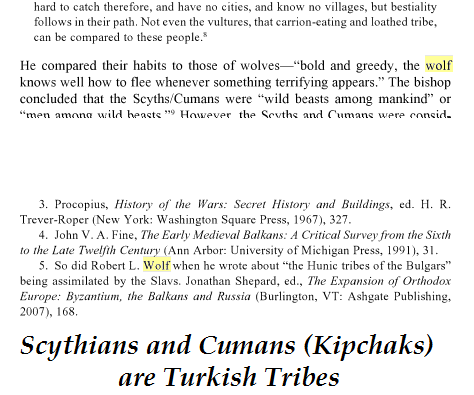
Scthas / Scythians are Turkish speaking Turkish Tribe

Massagetis + Parthi = Turci
Temerinda - Karbaluk


Cuman Turks in Hungary

A Cuman Turk King


Kipchaks Turkish Tashbaba (Taşbaba/Taşnine)


"Biz qıpçaq soyundanıq ! Qumuqların, qaraçaylıların, kazakların, balkarların, qaqauzların, krım tatarlarının, həmçinin rusların və ukraynalıların bir hissəsinin soyağacından." 
Murad Adji Kitap Rusça

"I will bring here is not about Russia but about "the Great Steppe" about my home Dasht-i-Kipchak, now unknown country, which lived Polovtsi-Turki." 
Murat Acıyev - Turcolog e-book in Russian language

"Я поведу здесь речь не о Руси, а о «Великой Степи», о моем родном Дешт-и-Кипчаке, неизвестной ныне стране, в которой жили половцы-тюрки. "


Murad ADJI
THE KIPCHAKS

An Ancient History of the Turkic People and the Great Steppe
A Handbook for Schoolchildren and Their Parents

This book is about the Turkic people, from its rise in the Altai Mountains and its spillover to the rest of the Eurasian continent. The touching narrative and thrilling legends relate about little-known facts of world history and the life as it really was for the ancient Turkis, their contribution to human civilization, their victories and setbacks. Nothing like this book has ever been published anywhere around the world.
link


An inscription in ancient Turkic in an Armenian church says, for example, "Accept this gift for the monastic brotherhood." It ends with the donor's tamgha.
    
This gift was given, among other donations, by the Turkis to the Armenian people about seventeen hundred years ago to celebrate the Armenians' admission to the new faith. A short phrase, it speaks much about the peoples' destinies. A stone block in another church, near the chapel dedicated to Vachagan III the Blessed, bears a mason's engraving of a horseman wearing a priest's clothing. He sat on his horse in a Turkic fashion, straight up, his legs down without stirrups.
    
Another puzzle to be unravelled? No, if we know that priests never used stirrups riding in the steppe. Simply, they were not allowed to use them, the stirrups being a prerogative of warriors.
    
November 10, 326, was a day for celebrations in Armenia - the Tengri Cross was raised on that day over Europe's first few churches. From that day on the Armenian people have been loyal to their newly acquired faith and the liberation mission of their cross.
    
The Holy Cross feast has always been a joyous occasion for celebrations in Armenia, for it was a turning point in its history. And right were the Armenians calling St. Gregory the Illuminator, head of the Armenian Church, a Saint - he actually showed the road to the Turkis to his grandson and his people. St. Gregory departed from Derbent riding a royal chariot under a cavalry convoy - he was carrying with him an equal-armed cross, a sacred symbol and sign of a new Europe, from the Turkic world.

more to read in English
Murad ADJi
THE KiPCHAKS
An Ancient History of the Turkic People and the Great Steppe

Turks and Religions - Kipchaks

European Kipchaks

Murad ADZHI (Deutsch)
Die Kiptschak
Geschichte des Altertums des Turkvolkes und der Großen Steppe

Adzhi Murad.(Espanol)
El secreto de San Jorge o lo regalado por Tengri 
(de la herencia espiritual del pueblo turcomano)


İn Russian

Аджиев Мурад. Мы – из рода половецкого! Из родословной кумыков, карачаевцев, казаков, балкарцев, гагаузов, крымских татар, а также части русских и украинцев.

Аджи Мурад. Полынь Половецкого поля: Из родословной кумыков, карачаевцев, балкарцев, казаков, казахов, татар, чувашей, якутов, гагаузов, крымских татар, части русских, украинцев и других народов, ведущих свое начало от тюркского (кипчакского) корня и забывших его.

Аджи Мурад. Тайна святого Георгия, или подаренное Тенгри: Из духовного наследия тюрков.

Аджи Мурад. Европа. Тюрки. Великая Степь. - 1-е изд.

Аджи Мурад. Кипчаки.   Древняя история тюрков и Великой Степи.

Аджи Мурад. Полынь Половецкого поля. – 2-е изд., доп. и перераб.

Аджи Мурад. Кипчаки. Огузы. Средневековая история тюрков и Великой Степи.

Аджи Мурад. Европа. Тюрки. Великая Степь. - 2-е изд.

Аджи Мурад. Тюрки и мир: сокровенная история.

Аджи Мурад. Азиатская Европа.

Аджи Мурад. Дыхание Армагеддона.

Аджи Мурад. Полынь Половецкого поля. – 3-е изд.

Аджи Мурад. Древняя история тюрков и Великой Степи: Книга для школьников и их родителей. – 2-е изд.

Аджи Мурад. Средневековая история тюрков и Великой Степи: Книга для школьников и их родителей. – 2-е изд.

Аджи Мурад. Без Вечного Синего Неба: Очерки нашей истории.

Аджи Мурад. Полынный мой путь. - М., Издательство АСТ, 2014. Тираж 3 000 экз.

Аджи Мурад. Великая степь. Приношение тюрка. - М., Издательство АСТ, 2014. Тираж 2 000 экз.

Аджи Мурад. История тюрков. Такими знали нас. – М., Издательство АСТ. – 317. [3] с.: ил. Тираж 2000 экз. ISBN 978-5-17-087192-6 (ООО «Издательство АСТ»)

Аджи Мурад. Полынь Половецкого поля. – 9-е изд. – М., ООО «Издательство АСТ», 2015. – 404 с.: ил. –(Великие империи) Тираж 2000 экз.

Аджи Мурад. Европа. Тюрки. Великая Степь. – 9-е издание, дополненное и переработанное

Adji Murad. Asia's Europa. Volume 1 (Europe, Turkic, the Great Steppe) (Аджи Мурад. Азиатская Европа.)

Adji Murad. THE KIPCHAKS. Volume 1 (Аджи Мурад. Кипчаки.)

Adji Murad. Asia’s Europa. Volume 2 (The Turki and the World: The Secret Story)

Adji Murad. THE KIPCHAKS and THE OGUZ. Volume 2 (Аджи Мурад. Кипчаки. Огузы.)

Adji Murad. Die Kiptschak. Geschichte des Altertums des Turkvolkes und der GroBen Steppe Ein Buch fur Schulkinder und ihre Eltern. (Кипчаки: Древняя история тюрков и Великой Степи)

Adji Murad. Die Kiptschak, die Oghusen. Das Mittelalter des Turkvolkes und der GroBen Steppe Ein Buch fur Schulkinder und ihre Eltern. (Кипчаки. Огузы: Средневековая история тюрков и Великой Степи)

Adzhi Murad. El secreto de San Jorge o lo regalado por Tengri (de la herencia espiritual del pueblo turcomano) (Тайна святого Георгия или Подаренное Тенгри: из духовного наследия тюрков)

main menu


Kipchak Cuman Christian Turks in Europe and Codex Cumanicus
____________________________________________