museum etiketine sahip kayıtlar gösteriliyor. Tüm kayıtları göster

13 Ağustos 2025 Çarşamba

No Culture when it Suits You!


Metropolitan Müzesi ve Sanat Tarihçilerinin

İkiyüzlülüğü,

Önyargısı,

Politik görüşü,

Propaganda, gerçekler değil ve

Bilinçaltına etkisi!

Not Asia Minor and definitely not Smyrna
it is Türkiye and İzmir


Metropolitan Müzesi'ne;
Neden Türk Kültürü veya Sanatı olarak sınıflandırmıyorsunuz? Büyük bir aile olduğumuz ve zengin bir kültüre sahip olduğumuz için mi? Yoksa adımızı mı söylemekten korkuyorsunuz? Eserlerin İran, Mısır veya Suriye'den gelmesi de önemli değil. Selçuklular Türk'tür. Kıpçaklar/ Kumanlar/ Memlükler Türk'tür. Yani hepsi Türk Kültürü ve Sanatı'nın içinde yer alır.

Bu arada, başka kültürlere (örneğin Hint, Çin vb.) ait eserlerin kültür gruplarını yazıyorsunuz. Bu ikiyüzlülüğe son veriniz!

*
To Metropolitan Museum;
Why don't you classify it as Turkish Culture or Art? Is it because we are a big family and have a rich culture? Or are you afraid to say our name? It doesn't matter whether the works come from Iran, Egypt, or Syria. The Seljuks are Turks. The Kipchaks/Cumans/Mamluks are Turks. So, they are all within the Turkish Culture and Art.

Meanwhile, the works that belongs to other cultures (e.g., India, China, etc.) are being written.
Stop this Hypocrisy, and write Turkish Culture and Art !

Prejudiced,

Political,

Propaganda, not facts, and

Subconsicious influence

of Metropolitan Museum and Art Historians!

SB

PS. And they are not the only museum with hypocrisy!..


30 Kasım 2017 Perşembe

Türk Sanatı ve Kültürü - Turkish Art & Culture


Memluklar Dönemi, Kupa - 12.yy , 
Suriye veya Mısır, British Müzesi
Büyük bir ihtimalle Haçlı Seferleri sırasında Fransa'ya getirilmiş.

"Palmer Cup" olarak adlandırılmış olup "İslam Sanatı" altında sunuluyor!...Halbuki "Türk Sanatı" altında sunulmalı, tıpkı diğer milletlere ait olanları millet adıyla sundukları gibi... Hiç, Hıristiyanlık döneminde yapılmış sanat eserlerini, herhangi bir yerde, "Hristiyan Sanatı" kategorisi altında gördük mü?..Hayır..


A leader in the "Turkish sitting position"
Glass Beaker, 12th c AD
Mamluk Kipchak Turks. Egypt or Syria, British Museum.

Probably was brought to France during the Crusades. It's called "The Palmer Cup" and presented under "Islamic Art"! ... However, it should be presented under "Turkish Art" just like they presented those who belong to other nations.. Have you ever seen, artworks made in the Christian period, under the category of "Christian Art"?..No..

SB.


Pair of Iznik-style Glass Mosque Lamps
19th/20th century
Turkish Art & Culture
NOT İSLAMİC Sotheby's! Must be presented under "TURKİSH ART & CULTURE"


Standard (‘Alam), Safavid - 16th c, İran 
Aga Khan Museum !-Canada
Safavids, a Turkish Empire, not Persian!
Turkish Culture & Art.
#Turks #Turkic


 Sırlı Turkuaz Kase, 12.yy-13.yy / Selçuklu – İran
Glazed Turquoise Bowl, 12th-13th c /Seljuk Turks – İran
Municipal Archaeological Museum of Madrid

Turkish Culture & Art 
And Not Persian like Balclis represents!
Esto es "Cultura y Arte Turco", ¡Y No Persa!

! Wrong İnformation from Balclis, about ethnic and culture !
"Persian bowl "minai" in glazed earthenware in turquoise, from the XII-XIII centuries. Some descantillados and fissure. Bibliography: "Catalog of the Exhibition of Persian Antiquities, Commemoration of the XXV Centenary of the Empire of Iran", Municipal Archaeological Museum of Madrid, 1971, p. 97, no. 610
8.5 cm alt. and 19 cm dia"

Esto es "cultura y arte turco" ¡Y no persa!
! información incorrecta de Balclis !, sobre étnico y cultura !


Memluk Türklerine ait Minyatür - 1325-50
Aga Khan Müzesi, Kanada
Mamluk Turks Miniature - 1325-50
The other name of Mamluks is
"Dawla al-Turkiyya" (The State of The Turks)
The Aga Khan Museum !, Canada
Turkish Culture & Art.
#Turks #Turkic


Long-Necked Bottle - 12th-13th century
Seljuk-Atabeg Period - from İran

Everything till here is a correct info, but then the info goes as "Culture: Persian" !
This is typical Turkish Art, and not Persian! So, it must be registered as "Turkish Culture". 
And then you call yourself "Harvard"... 
May I ask, from where, which respect do you deserve? 

Seljuks and Atabegs are the Turks.
One of the 24 Oghuz (Oğuz) Turks is Kınık (reading as Kynyk) Tribe, and they are the founder of the 
Seljuk Dynasty/Empire in İran and Turkey.

Atabegs are experienced statesmen, their job was to educate the Seljuk princes, to be a commander, 
about governing and as counsel to the Seljuk princes.

Atabeg (Tr.etym.); 
Ata = Ancestor, Father.
Beg (Bey) = Gentleman, Sir, Mister.


Turquoise Bowl with Lute Player and Audience
Late 12th–early 13th century - Seljuk Turks.
From Iran, in Metropolitan Museum!
Turkish Culture & Art.


@Metropoltian Museum, when it comes to other cultures, you write the culture name, but when it comes to Turks, it is "uncultured".. and only the Ottoman period is categorized as Turkish culture.! We are a big family, which you can't ignore; for instance Seljuks, non of them are listed as Turkish culture!.. Shame on you...SB.

More in Metropolitan Museum without culture name, without mention the "Turkish Culture & Art"!
Seljuk Turks , Mirror with a Pair of Addorsed Sphinxes with Scorpion Tails , is Turkish Culture & Art ! 
Seljuk Turks, Hexagonal Tile Ensemble with Sphinx, is Turkish Culture & Art ! 
Seljuk Turks, Bowl with a Majlis Scene by a Pond, is Turkish Culture & Art ! 

Other mistake! :
Are you also playing with the kids mind Metropolitan Museum? Syria? Turkey? Which one is it?
Daphne is the Roman name given to Antioch (Hatay today), and it is in modern Turkey, and not modern Syria! 


Mirror with Zodiac signs,  Seljuk Turks - 12th c AD, Found in İran,
Turkish Culture & Art
!Department of Islamic Art ! -Musée du Louvre !
pas le département islamique ! mais la culture Turque et l'art !


Seljuk Turks, 12th-13th c,found in İran
Turkish Culture & Art
And Not "Early Islamic Pottery" or some other İslamic category !
İslam contains many ethnic!
Fitzwilliam Museum - Cambridge/England


one more:

The Vaso Vescovali


Shame on you British Museum ! This is "Not İslamic Culture",  
İt is "Turkish Culture & Art", I condemn you!
Seljuk Period. Horasan (Khorasan) was the center of Seljuk Turks,
which comes from an Oghuz tribe: Kınık!

Title (object): The Vaso Vescovali
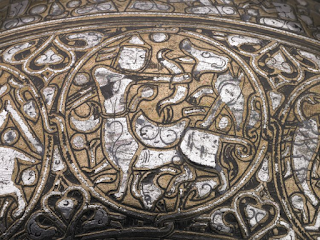
Description: A lidded bowl of high tin bronze, engraved and inlaid with silver. Decorated with signs of the zodiac, the sun and the moon, it displays a complex astrological imagery. It has twelve roundels, each containing the personification of a planet with the sign of the zodiac representing its day or night house. The figure drawing water from a well is Saturn in his night house Aquarius. The figure riding a ram is Mars in his night house Aries. The eight roundels on the lid contain personifications of the planets, including the dragon 'Jawzahr' who represents the lunar eclipse. Each figure has six arms with which to carry the emblems of their magical influences.
Culture/period : Middle Islamic (!!!) 
Date: 1200 (circa)
Production place: Made in: Khurasan
The Trustees of the British Museum !


If the European and the other states museums exhibited the art of; Safavids, Avshar, Kipchak, Mamluk, Avars, Huns, Seljuks, Ottomans, Akkoyunlu (White Sheep Turkomans), Artuqids, Kachars, Babur (Mughal), Delhi, Zengids, Khazars, Karakoyunlu (Black Sheep Turkomans), Anatolian Principalities and the art of more I can not remember, which belongs to a lot of Turkish tribes and states; and more art which are under the category of Islamic Arts, but those who belongs to the Turks; if these arts comes under the "Turkish Culture & Art", Europeans shall have a problem, like getting hot :) On top of that, if we add the other Turkish states like; Azerbaijan, Kazakh, Kyrgyz, Turkmen, Uzbek, Uyghurs, Sakha (Yakuts), Khakassia and others, plus the Turks from BC times like; Sacae (Scythians) art, and of course more tribes from BC times; all of these brings a huge Turkish Culture, that shall give the Europeans a culture shock and they will faced "a sick Europeans, in terms of culture and art"... Do you have an aspirin?... 

Why did I say that? Artifacts in these museum in the names of tribes, which the citizens don't know that their ethnic is Turkish; "Turks". Some of these artifacts are in Persian and some don't have a culture "ethnic" name. And some are under the "İslamic Category" listed, which, the religion is spread among different ethnics/states (like Arabs!). What they are doing is completely wrong and I call as "discrimination" against the Turks and other Turkish tribes.

SB.


Safavi, Avşar, Kıpçak, Memluk, Avar, Hun, Selçuk, Osmanlı, Akkoyunlu, Artuklu, Kaçar, Babür, Zengi, Hazar, Karakoyunlu, Beylikler ve daha hatırlayamadığım bir çok Türk boylarının ve devletlerinin sanatı ile İslam Sanatı altında gösterilen, ama Türklere ait olan sanat eserlerini, Avrupa ve diğer ülkelerin müzeleri "Türk Kültürü ve Sanatı" altında sergilerlerse, Avrupalılara sıcak basar ve dudakları uçuklar :) Üstüne diğer Türk devletleri; Azerbaycan, Kazak, Kırgız, Türkmen, Özbek, Türkistan, Uygur, Yakut, Hakasya, v.s. ile MÖ dönemi Türklerini, Sakalar gibi, de eklersek .. Çok büyük bir kültür açığa çıkar, ki "Kültür ve Sanat açısından Hasta bir Avrupa" ile karşı karşıya kalırız... Aspirin var mı?... 

Müzelerdeki sanat eserlerine boy adları konuluyor, ama halk onların Türk olduklarını bilmiyor. Hatta bazılarına Pers, bazılarına da hiçbir etnik adı yazmıyorlar. Bazılarını da İslam kategorisi altında sunuyorlar. Bu yaptıkları tamamen yanlıştır ve buna "ayrımcılık" denir.


How do you call yourself "scholars", "museums" ?
Are you all anti-Turk?...
This is a crime against the  "Culture of Turks", more then that,
This is an"Ethnic-Hate-Crime"
I condemn you all!..


Türk Sanatı ve Kültürü
Turkish Art & Culture
Art et Culture Turque
Arte y Cultura Turca
Arte e Cultura Turche
Türkische Kunst und Kultur
Турецкое искусство и культура


Neden Türk Kültürü ve Medeniyeti Denmez?


Türk Kültürü ve Sanatı ; Turkish Culture and Art


Safavi, Avşar, Kıpçak, Memluk, Avar, Hun, Selçuk, Osmanlı, Akkoyunlu, Artuklu, Kaçar, Babür, Zengi, Hazar, Karakoyunlu, Beylikler ve daha hatırlayamadığım bir çok Türk boylarının ve devletlerinin sanatı ile İslam Sanatı altında gösterilen, ama Türklere ait olan sanat eserlerini, Avrupa ve diğer ülkelerin müzeleri "Türk Kültürü ve Sanatı" altında sergilerlerse, Avrupalılara sıcak basar ve dudakları uçuklar :) Üstüne diğer Türk devletleri; Azerbaycan, Kazak, Kırgız, Türkmen, Özbek, Türkistan, Uygur, Yakut, Hakasya, v.s. ile MÖ dönemi Türklerini, Sakalar gibi, de eklersek .. Çok büyük bir kültür açığa çıkar, ki "Kültür ve Sanat açısından Hasta bir Avrupa" ile karşı karşıya kalırız... Aspirin var mı?... 

Niye mi dedim bunları? British müzesinde İskitler sergisi var: "İskitler için İrani dilli" dediler! Müzelerdeki sanat eserlerine boy adları konuluyor, ama halk onların Türk olduklarını bilmiyor. Hatta bazılarına Pers, bazılarına da hiçbir etnik adı yazmıyorlar. Bazılarını da İslam kategorisi altında sunuyorlar. Bu yaptıkları tamamen yanlıştır ve buna "ayrımcılık" denir.

SB

Two soldiers with tensioned bow and arrows, and standing back to back, symbolizing proto-Türkic oğ/oq/ok arrow tamga (mark) (clan, tribe, people, i.e. Oğuz). By Elşad (Elshad) Alili / Institution of Linguistics, Azerbaijan
#Scythians #Turks #Turkic


If the European and the other states museums exhibited the art of; Safavids, Avshar, Kipchak, Mamluk, Avars, Huns, Seljuks, Ottomans, Akkoyunlu (White Sheep Turkomans), Artuqids, Kachars, Babur (Mughal), Delhi, Zengids, Khazars, Karakoyunlu (Black Sheep Turkomans), Anatolian Principalities and the art of more I can not remember, which belongs to a lot of Turkish tribes and states; and more art which are under the category of Islamic Arts, but those who belongs to the Turks; if these arts comes under the "Turkish Culture & Art", Europeans shall have a problem, like getting hot :) On top of that, if we add the other Turkish states like; Azerbaijan, Kazakh, Kyrgyz, Turkmen, Uzbek, Uyghurs, Sakha (Yakuts), Khakassia and others, plus the Turks from BC times like; Sacae (Scythians) art, and of course more tribes from BC times; all of these brings a huge Turkish Culture, that shall give the Europeans a culture shock and they will faced "a sick Europeans, in terms of culture and art"... Do you have aspirin?... 


Why did I say that? There is a exhibition in the British museum: they said "Scythian language is iranian"! Artifacts in these museum in the names of tribes, which the citizens don't know that they Turks. Some of these artifacts are in Persian and some don't have a culture "ethnic" name. And some are under the "İslamic Category" listed. What they are doing are completely wrong and called as "discrimination".

SB.


Şimdi gelelim British Müzesinin açmış olduğu hashtag'li Scythians hesabının altındaki cevaplarıma... 
(bazılarına sansür bile uyguladı!)

My answers to British Museum (which some was censored!)


One from #Scythians period, 3 from Gokturks period Tashbaba (Stonefather)
Scythians are Turkic, and not İranian!.. @britishmuseum


My other answer to British Museum on youtube:

"Scythians are Turkic, İranian did not and do not drink mare's milk, and don't bury their deads with horses! and only the Turkish tribes continued the culture of stone statue : Tashbaba (Taşbaba/Balbal) on Kurgans. Even the word "Kurgan" is Turkish. link

Not a single Greek, Latin (Roman), Byzantine, Arab or Persian author ever claimed that the Scythians spoke Persian (İranian) language!..

Turkic Scythians by Gahraman Gumbatov: link

Even the Kurgan in Ukraine is OGUZ, like the Oğuz Turks. : Курган Огуз : link


Stone Statue "Tashbaba (Taşbaba)" #Scythians - 5th c BC /Ukraine; The #Turkic Khaganate (Gokturks)- 6th-8th c AD/Altai&Kazakhstan; Kipchak-Cuman #Turks -12th c AD/Ukraine. Tashbaba represent the leader, 
who holds an Oath Cup in his hand.


"..a number of Central Asian Turkic tribes, known as Sakas in India and #Scythians in West, came to Hindustan and 
settled down there." - K.Gajendra Singh


"Carthasis" was not the name of Scythian kings brother, who met Alexander the Great, it was the word himself ; "Kardeşi" (kardaschi) - meaning: Brother. #Scythians are #Turkic people and spoke Turkish.
Source: Eugen Oberhummer - Die Türken und das Osmanische Reich (page 25)


The national drink of the #Scythians was 'koumiss'-Mare's milk;  a #Turkic people Kyrgyz here, is getting milk. 
İranian did/do not drink koumiss!.. Scythians=Turkic.


In #Amazons film they used Pazyryk (ety.Turkish+belongs to Turkish tribes) style 5th c BC, but stirrups was not invented till the 6th c AD by the Turks!. Amazons were called by the #Scythians as Oerpata, etymology Turkish: Er=Man+Pata=Killer. Amazons=Scythians=Turkish Tribes.


Double-Edged Knife "AKiNAK" i.e. KiNGiRAK / Saka (i.e. #Scythians)- #Turks. 7th c BC. Arzhan II-Tuva . Tr. Kingirak, with silent ğ > kinirak, qïŋïraq, "a double-edged knife","the oldest Turkish word on record" - N.Kisamov.


#Scythians =Huns= #Turks -BOW & PARTHİAN SHOT,i.e. TURKİSH SHOT
Parthians, are a Scythian/Sacae Tribe.  #Turkic
Turkish Culture&Art continues, before and after christ, never changed. Bow, Style, Horses, Warriors. 
We do not see this continuity among other nations...


At şeklinde altın riton, MÖ.3.yy, İskit-Türk 
Horse shaped gold rhyton, 3rd c BC, #Scythians #Turks #Turkic
İskitler, şarabı sek olarak içerdi-"İskit usulü".
Scythians drink their wine undiluted-"Scythian style" (Podskif).


2600-year-old Issyk Inscription.Two lines of Saka inscription that changed view on the history of the Türkic people. by Elshad Alili, Institution of Linguistics, Azerbaijan
and there is one more inscriptions, which was read as "Ak-Maral"
#Scythians #Turks #Turkic


Double Headed Eagle. Saka (i.e. #Scythians) #Turks, at the end of the 7th c BC, Arzhan II, Tuva. Arzhan proves that Scythians are not under the influence of "Greek Art". Tuvans-Tuvinians are #Turkic people.


"The Europe-centered researchers describe the Sacae (#Scythians) as the predecessors of the İranians, but in fact they are the ancestors of the Turkic peoples." (more in Kazak Turkish)
 #Turks #Turkic


Avrupa merkezli araştırmacılar Sakaları (İskitleri) İranlıların atası olarak nitelendiriyor, fakat aslında onlar Türk halklarının atasıdır. Son yıllarda, Avrupa merkezli araştırmacıların çalışmalarını inceleyenler, bunların çok fazla hata içerdiğini ve bilimsel dayanağı olmadığını kanıtladı. Tarihsel veriler, destan-efsaneler, etno-kültürel kimlik, arkeolojik ve dil açısından antik dönem Sakaların torunlarının Türkler olduğunu ortaya koymuştur.


Türkolog, Altaist, Filoloji, L.N.Gumilev Üniversitesi, Kemal Atatürk Tarih Kurumu Üyesi, Uluslararası Cengiz Han Akademisi Üyesi, Uluslararası Türk Kurultay Üyesi


The Europe-centered researchers describe the Sacae (Scythians) as the predecessors of the İranians, but in fact they are the ancestors of the Turkic peoples. In recent years, those who study the work of Europe-centered researchers, have proven that they contain too many mistakes and are not scientific proofs. Historical datas, legends-myths, archaeological, ethno-cultural identity and linguistic resources revealed that the descendants of ancient Sacae' are the Turks.

Каржаубай САРЖЖОЕВИЧ (Qarjawbay SARTQOJAULI)
Turkolog-Altaist-Philology Scientist, Director of the Turkic Studies at L.N. Gumilyov Eurasian National University (ENU), Member of Kemal Atatürk Historical Society, International Genghis Khan Academy, the International Turkish Kurultay (Academy).


So, Scythians (Sacae) are NOT İranian speakers,
they are Turkish speakers!


öteki müzelerden bazı örnekler bir sonraki sayfada...
some other examples from other museums on the next page...


Neden Türk Kültürü ve Medeniyeti Denmez?