islamic art etiketine sahip kayıtlar gösteriliyor. Tüm kayıtları göster

10 Ağustos 2026 Pazartesi

To The Metropolitan Museum


To The Metropolitan Museum

It's a very nice presentation, but presenting Greek-Roman and Japanese works under their "ethnic" names while presenting Turkish works under "Islamic Art" is hypocritical! As you know, Islam is a religion accepted among many "ethnicities and nations," and a work of art cannot be presented under the name "Islamic" simply because it has "Arabic" writings on it. Works from the Seljuk, Safavid, Kajar, Mamluks (which the name of the state was Ed-Devletü’t-Türkiye)  and Ottoman periods should be presented as "Turkish Art". Because all these works (except for some) are reflecting the culture and art of Turks. All these empires are Turkish Empires and don't be afraid to say "Turkish Art"! Or do you have another hidden agenda?..


SB

*PS: At 7:43 the bowl from Syria is not Kajar or Khazar (because it is not understable, and Khazar is also Turk), but Mamluk, if it is from the 13th c.

Exhibition Tour—Collecting Inspiration: Edward C. Moore at Tiffany & Co. | Met Exhibitions (The Met YT, 2024 / link)


#ArtofTurks

#TurkishArt

#Turks #art

.

17 Kasım 2020 Salı

Turkic değil Turk !


Ben bu "Turkic" terimine karşıyım. Öncelikle bu terimi Batılılar verdi, İkincisi ise "Turkic" "işş", yani "gibi" anlamında, ayrıca açıklamasını "birçok etnik gruptan oluşan topluluk" olarak vermekteler. Üçüncüsü Türkiye Türkleri ne kadar Türk boyu varsa hepsinden bir parça taşır... Hollandacada "Turkse volkeren" yani "Türk Halkları" denilmektedir ki atalar da hepsine "Türk" demiştir. Bilmem anlatabildim mi? 😉 Batılılar bizi tanımlayamaz, bizi ancak BİZ tanımlayabiliriz!


SB


Turks- Turkish and not Turkic!


Me personally (and some) do not use the word "Turkic", because of the meaning: "The Turkic peoples are a collection of ethnic groups that live in central, eastern, northern, and western Asia as well as parts of eastern Europe. They speak languages belonging to the Turkic language family".


This is a wrong expression, especially "collection of ethnic groups", because they are TURK of ETHNİC, and not some strange ethnic groups who came together.


Among us there are ; Siberian Turk (Sibirya Türkü), Altai Turk (Altay Türkü), Kazakh Turk (Kazak Türkü) , Uzbek Turk (Özbek Türkü), etc. and not like Kazakh Turkic, or Turkmen Turkic ...


The world is confused about the tribe names, they think that these tribe names represents a different ethnic. On the contrary, all these tribes are the TURKS.


Some Tribe names:

Aqqoyunlu (Ak=White, Koyun=Sheep, Turkoman=I am Turk) , Karaqoyunlu (Kara=Black, Sheep, also written as Qara Qoyunlu, Artuqid (Artuklu), Zengid, Safavid, Afsharid, Seljuk, Ottoman, Pecheneg, Kipchak, Mamluk, Avar, Hun, Khazar, Cuman, Oghuz, Turkmens, Uyghur, Gokturk, Nogai, Kazakh, Kyrgyz, Azerbaijani, Bashkir, Crimean Tatars, Qashqai, Yakut (Saha-Saka), Kumyk, Karachay, Gagauz, Tuvan, Uzbek, Karaite, Bulgar (before slavified), Atabegs, etc... and there are subgroups of these tribes with there clan or family names:


Example: Huns and Oghuzes have 24 tribes and many subgroups, like Ağaçeri Turks (Tree people: in ancient times as Agathyrsi, a Scythian+Hun tribe); or Oghuz tribes like Kayı (Ottoman comes from); Kınık (where Seljuk Turks comes from).... but all of them are TURK of ETHNİC.


And many of these Turkish Tribes live in Turkey, and that's why it is called only "Turks". In Dutch they called as TURKSE VOLKEREN; the meaning is TURKISH PEOPLES, and that is one of the right expression.


They do call also as "Islamic", but religion is spread among differend nations. You have under "İslam Art" : Arabic Art, Persian Art, Malaysian Art, etc.... and you have of course Seljuk, Mamluk and Ottoman, but they are as İslamic represented by some scholars and in museum explanations. Somehow, determination of the political identity of the Turks is "Islamic", or with false ethnic identity, which is absolutely wrong ...


So the history, art and culture must be written as "TURKİSH CULTURE AND ART", then with their dynasty, tribal or clan name but not as Turkic ! So can the rest of the world understand in which ethnic are these art and culture belong to... We are A Huge Family, don't forget that... And I won't allow them to steal it from us with the so-called expression "Turkic"! It is TURK.


Regards,

SB.


For example for the image: 

"Turkish Art, Seljuk period, 12th c"

Seljuks are NOT Turkic !

Seljuks are TURKS.

And definitely NOT "İslamic Art"


20 Eylül 2018 Perşembe

Parlak ve Şans - Glans & Geluk


Seljuk Turks


"Parlak ve Şans- İslam Dünyasından Sanat" Sergisi 
Den Haag Belediye Müzesi'nde 900-1900 arası 300 parça 08 Eylül 2018 - 03 Mart 2019 sergilenecek.

Lakin, parçaların çoğu "Türk Kültürü ve Sanatı"na ait ! "İslam Sanatı" olarak adlandırılmasına şahsen karşıyım, çünkü "İslam" bir dindir ve birçok millet barındırır, ki sanat eserlerinde arapça veya farsça yazması da onu ne "Arap" ne "Fars" ne de "İslam" sanatı yapar! Sanat milletlere göre değişir ve "Türk Sanatı"nın kendine özgü bir stili var! Eserlerin Mısır'dan, İran'dan ya da Suriye'den olması da "o bölgenin halkına aittir", yani "Arap" ya da "Mısır"lı yapmaz ! Buna maalesef bizimkiler de dikkat etmiyor ve Türk Kültürüne ait ne varsa, hanedan, boy veya kavim adlarıyla ayrıştırılması dışında, "İslam" adıyla da "ötekileştiriyor"! "Parlak ve Şans" sergisindeki eserlerin bilgi içeriklerini bilmiyorum, ama netteki kısa bilgilendirmede "Türk Sanatı" yazmadığını söyleyebilirim. 

SB.


Seljuk Turks


NL

08 september 2018 t/m 03 maart 2019
"Glans en Geluk - Kunst uit de Wereld van de İslam"


Titelen als "İslamitische kunst" is niet correct, İslam bevat verschillende nationaliteiten !

Bijvoorbeeld:


- (hoofdfoto) "Moskeelamp met het lichtvers uit de Koran en titels van opdrachtgever, Syrië of Egypte, 1322-1328" ;
Turkse Kunst, behoort aan Mamluk Turks !
Ook als het uit Syrië of Egypte komt !


- "Tegel in de vorm van een ster, Oost-Iran, midden 15e eeuw" ;
Turkse Kunst, Ottoman / Safavid Turks. 
Ook als het uit İran komt, dat betekent niet "het is Perzische Kunst"!


- "Tegel met kalligrafie in reliëf (eretitels van opdrachtgever), Iran, 1200-1400";
Turkse Kunst, Seljuk Turks !


- "Schaal met arabeskpatroon, Turkije, Iznik, circa 1480";
Turkse Kunst, Ottoman Turks !


- "Schenkkan, Iran, circa 1200, kiezelaardewerk met lusterglazuur";
Turkse Kunst, Seljuk Turks !


- "Kom met kalligrafie en streepdecor, Iran, 1200-1250, kiezelaardewerk";
Turkse Kunst, Seljuk Turks !

link1: gemeente museum  /  link2: den haag centraal


Het meeste stukken van de tentoonstelling behoort aan Turkse Kunst ! Ben er persoonlijk tegen de titel "Islamitisch", omdat deze titel scheidt alle werken die aan Turkse Cultuur behoort van elkaar af! Arabische geschriften bewijst ook niet dat de kunst aan "Arabieren" of "Perzen" behoort!


Seljuk Turks


ENG

Titles such as "Islamic art" is not a correct, İslam contains different nationalities! I am personally against the title "Islamic", because this title separates all works that belong to Turkish Culture! Arabic writings also do not prove that the art belongs to "Arabs" or "Persians"! Most of the exhibition belongs to Turkish Art!

For example:

- (main photo) "Mosaic lamp with the light verse from the Koran and titles from the principal, Syria or Egypt, 1322-1328 ";
Turkish Art, belongs to Mamluk Turks!
Even if it comes from Syria or Egypt!

- "Tile in the shape of a star, East Iran, mid-15th century";
Turkish Art, Ottoman / Safavid Turks.
Even if it comes from Iran, it does not mean "it is Persian Art"!

- "Tile with calligraphy in relief (honorary titles of principal), Iran, 1200-1400 ";
Turkish Art, Seljuk Turks!

- "Arabesque pattern scale, Turkey, Iznik, circa 1480 ";
Turkish Art, Ottoman Turks!

- "Pottery with luster glaze, Iran, circa 1200 ";
Turkish Art, Seljuk Turks!

- "Pottery, with calligraphy and stripe decor, Iran, 1200-1250 ";
Turkish Art, Seljuk Turks!

SB.


Turkse Cultuur & Kunst 
Turkish Culture & Art

30 Kasım 2017 Perşembe

Türk Sanatı ve Kültürü - Turkish Art & Culture


Memluklar Dönemi, Kupa - 12.yy , 
Suriye veya Mısır, British Müzesi
Büyük bir ihtimalle Haçlı Seferleri sırasında Fransa'ya getirilmiş.

"Palmer Cup" olarak adlandırılmış olup "İslam Sanatı" altında sunuluyor!...Halbuki "Türk Sanatı" altında sunulmalı, tıpkı diğer milletlere ait olanları millet adıyla sundukları gibi... Hiç, Hıristiyanlık döneminde yapılmış sanat eserlerini, herhangi bir yerde, "Hristiyan Sanatı" kategorisi altında gördük mü?..Hayır..


A leader in the "Turkish sitting position"
Glass Beaker, 12th c AD
Mamluk Kipchak Turks. Egypt or Syria, British Museum.

Probably was brought to France during the Crusades. It's called "The Palmer Cup" and presented under "Islamic Art"! ... However, it should be presented under "Turkish Art" just like they presented those who belong to other nations.. Have you ever seen, artworks made in the Christian period, under the category of "Christian Art"?..No..

SB.


Pair of Iznik-style Glass Mosque Lamps
19th/20th century
Turkish Art & Culture
NOT İSLAMİC Sotheby's! Must be presented under "TURKİSH ART & CULTURE"


Standard (‘Alam), Safavid - 16th c, İran 
Aga Khan Museum !-Canada
Safavids, a Turkish Empire, not Persian!
Turkish Culture & Art.
#Turks #Turkic


 Sırlı Turkuaz Kase, 12.yy-13.yy / Selçuklu – İran
Glazed Turquoise Bowl, 12th-13th c /Seljuk Turks – İran
Municipal Archaeological Museum of Madrid

Turkish Culture & Art 
And Not Persian like Balclis represents!
Esto es "Cultura y Arte Turco", ¡Y No Persa!

! Wrong İnformation from Balclis, about ethnic and culture !
"Persian bowl "minai" in glazed earthenware in turquoise, from the XII-XIII centuries. Some descantillados and fissure. Bibliography: "Catalog of the Exhibition of Persian Antiquities, Commemoration of the XXV Centenary of the Empire of Iran", Municipal Archaeological Museum of Madrid, 1971, p. 97, no. 610
8.5 cm alt. and 19 cm dia"

Esto es "cultura y arte turco" ¡Y no persa!
! información incorrecta de Balclis !, sobre étnico y cultura !


Memluk Türklerine ait Minyatür - 1325-50
Aga Khan Müzesi, Kanada
Mamluk Turks Miniature - 1325-50
The other name of Mamluks is
"Dawla al-Turkiyya" (The State of The Turks)
The Aga Khan Museum !, Canada
Turkish Culture & Art.
#Turks #Turkic


Long-Necked Bottle - 12th-13th century
Seljuk-Atabeg Period - from İran

Everything till here is a correct info, but then the info goes as "Culture: Persian" !
This is typical Turkish Art, and not Persian! So, it must be registered as "Turkish Culture". 
And then you call yourself "Harvard"... 
May I ask, from where, which respect do you deserve? 

Seljuks and Atabegs are the Turks.
One of the 24 Oghuz (Oğuz) Turks is Kınık (reading as Kynyk) Tribe, and they are the founder of the 
Seljuk Dynasty/Empire in İran and Turkey.

Atabegs are experienced statesmen, their job was to educate the Seljuk princes, to be a commander, 
about governing and as counsel to the Seljuk princes.

Atabeg (Tr.etym.); 
Ata = Ancestor, Father.
Beg (Bey) = Gentleman, Sir, Mister.


Turquoise Bowl with Lute Player and Audience
Late 12th–early 13th century - Seljuk Turks.
From Iran, in Metropolitan Museum!
Turkish Culture & Art.


@Metropoltian Museum, when it comes to other cultures, you write the culture name, but when it comes to Turks, it is "uncultured".. and only the Ottoman period is categorized as Turkish culture.! We are a big family, which you can't ignore; for instance Seljuks, non of them are listed as Turkish culture!.. Shame on you...SB.

More in Metropolitan Museum without culture name, without mention the "Turkish Culture & Art"!
Seljuk Turks , Mirror with a Pair of Addorsed Sphinxes with Scorpion Tails , is Turkish Culture & Art ! 
Seljuk Turks, Hexagonal Tile Ensemble with Sphinx, is Turkish Culture & Art ! 
Seljuk Turks, Bowl with a Majlis Scene by a Pond, is Turkish Culture & Art ! 

Other mistake! :
Are you also playing with the kids mind Metropolitan Museum? Syria? Turkey? Which one is it?
Daphne is the Roman name given to Antioch (Hatay today), and it is in modern Turkey, and not modern Syria! 


Mirror with Zodiac signs,  Seljuk Turks - 12th c AD, Found in İran,
Turkish Culture & Art
!Department of Islamic Art ! -Musée du Louvre !
pas le département islamique ! mais la culture Turque et l'art !


Seljuk Turks, 12th-13th c,found in İran
Turkish Culture & Art
And Not "Early Islamic Pottery" or some other İslamic category !
İslam contains many ethnic!
Fitzwilliam Museum - Cambridge/England


one more:

The Vaso Vescovali


Shame on you British Museum ! This is "Not İslamic Culture",  
İt is "Turkish Culture & Art", I condemn you!
Seljuk Period. Horasan (Khorasan) was the center of Seljuk Turks,
which comes from an Oghuz tribe: Kınık!

Title (object): The Vaso Vescovali
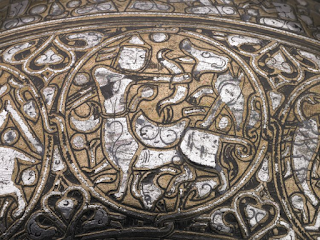
Description: A lidded bowl of high tin bronze, engraved and inlaid with silver. Decorated with signs of the zodiac, the sun and the moon, it displays a complex astrological imagery. It has twelve roundels, each containing the personification of a planet with the sign of the zodiac representing its day or night house. The figure drawing water from a well is Saturn in his night house Aquarius. The figure riding a ram is Mars in his night house Aries. The eight roundels on the lid contain personifications of the planets, including the dragon 'Jawzahr' who represents the lunar eclipse. Each figure has six arms with which to carry the emblems of their magical influences.
Culture/period : Middle Islamic (!!!) 
Date: 1200 (circa)
Production place: Made in: Khurasan
The Trustees of the British Museum !


If the European and the other states museums exhibited the art of; Safavids, Avshar, Kipchak, Mamluk, Avars, Huns, Seljuks, Ottomans, Akkoyunlu (White Sheep Turkomans), Artuqids, Kachars, Babur (Mughal), Delhi, Zengids, Khazars, Karakoyunlu (Black Sheep Turkomans), Anatolian Principalities and the art of more I can not remember, which belongs to a lot of Turkish tribes and states; and more art which are under the category of Islamic Arts, but those who belongs to the Turks; if these arts comes under the "Turkish Culture & Art", Europeans shall have a problem, like getting hot :) On top of that, if we add the other Turkish states like; Azerbaijan, Kazakh, Kyrgyz, Turkmen, Uzbek, Uyghurs, Sakha (Yakuts), Khakassia and others, plus the Turks from BC times like; Sacae (Scythians) art, and of course more tribes from BC times; all of these brings a huge Turkish Culture, that shall give the Europeans a culture shock and they will faced "a sick Europeans, in terms of culture and art"... Do you have an aspirin?... 

Why did I say that? Artifacts in these museum in the names of tribes, which the citizens don't know that their ethnic is Turkish; "Turks". Some of these artifacts are in Persian and some don't have a culture "ethnic" name. And some are under the "İslamic Category" listed, which, the religion is spread among different ethnics/states (like Arabs!). What they are doing is completely wrong and I call as "discrimination" against the Turks and other Turkish tribes.

SB.


Safavi, Avşar, Kıpçak, Memluk, Avar, Hun, Selçuk, Osmanlı, Akkoyunlu, Artuklu, Kaçar, Babür, Zengi, Hazar, Karakoyunlu, Beylikler ve daha hatırlayamadığım bir çok Türk boylarının ve devletlerinin sanatı ile İslam Sanatı altında gösterilen, ama Türklere ait olan sanat eserlerini, Avrupa ve diğer ülkelerin müzeleri "Türk Kültürü ve Sanatı" altında sergilerlerse, Avrupalılara sıcak basar ve dudakları uçuklar :) Üstüne diğer Türk devletleri; Azerbaycan, Kazak, Kırgız, Türkmen, Özbek, Türkistan, Uygur, Yakut, Hakasya, v.s. ile MÖ dönemi Türklerini, Sakalar gibi, de eklersek .. Çok büyük bir kültür açığa çıkar, ki "Kültür ve Sanat açısından Hasta bir Avrupa" ile karşı karşıya kalırız... Aspirin var mı?... 

Müzelerdeki sanat eserlerine boy adları konuluyor, ama halk onların Türk olduklarını bilmiyor. Hatta bazılarına Pers, bazılarına da hiçbir etnik adı yazmıyorlar. Bazılarını da İslam kategorisi altında sunuyorlar. Bu yaptıkları tamamen yanlıştır ve buna "ayrımcılık" denir.


How do you call yourself "scholars", "museums" ?
Are you all anti-Turk?...
This is a crime against the  "Culture of Turks", more then that,
This is an"Ethnic-Hate-Crime"
I condemn you all!..


Türk Sanatı ve Kültürü
Turkish Art & Culture
Art et Culture Turque
Arte y Cultura Turca
Arte e Cultura Turche
Türkische Kunst und Kultur
Турецкое искусство и культура


Neden Türk Kültürü ve Medeniyeti Denmez?