peru etiketine sahip kayıtlar gösteriliyor. Tüm kayıtları göster

22 Ekim 2016 Cumartesi

KÜN-TİKİ ya da “bilinen” adıyla Kon/Con-Tiki


İnka-öncesi (Pre-İnka) döneminde "Viracocha" ya da "Tici Viracocha" medeniyetin yaratıcısı, güneşin ve fırtınaların tanrısıdır ve İnkaların mitolojisine girer. Güneşten tacı ve ellerinde de yıldırım vardır. Quechua dilinde: Apu Qun Tiqsi Wiraqutra olarak adlandırılır ki bu da bizi Türkçe'ye getirir.


APU - Hakasya'da Apu yani Abakan Nehri ; 
QUN = KÜN (İnka’da da Güneş Tanrısı olması sebebiyle) 
"Kon-Tiki" veya "Con-Tiki" değil KÜN-TİKİ
TİQSİ = TİKİ = CON TİKİ = KON TİKİ = KÜN TİKİ

"Tiki" ise geceleri işitilen sestir. Bu kelime atalar kültüyle bağlantılı bir kelimedir, Peru'da da Türkler'de de aynı anlamı vardır. Heyerdahl haklıymış "Asya orijinli". Kitabında Atua kelimesi geçer: "O, öldükten sonra düşük değerde tanrılığa terfi eden, sıradan insanlardan oluşan bir grup büyük ilahi varlıkların prototipidir. Ve daha önce sözü edilen gerçek tanrılarla birlikte onlara ATUA denir." ATALAR yani... tıpkı Peru'nun son İmparatoru gibi - ATAHUALPA'daki ATA gibi.

Hecelemeden emin değilim: Wi-RA-QUT-RA ?!
ama: QUT=KUT (Kutsal)
RA-Güneş Tanrısı (Mısır) olabilir mi?
Araştırılmalı!

SB


Viracocha is the great creator god originally worshiped by the pre-Inca inhabitants of Peru and later assimilated into Inca mythology. He was also the God of the sun and storms. "Apu Qun Tiqsi Wiraqutra" is the name of the god in Quechua language, which brings us to Turkish.

APU=APU RİVER (Abakan-Khakassia/East Siberia); ; 
QUN=KÜN (Sun) ; 
TİQSİ=TİKİ= CON TİKİ = KON TİKİ = (Tr.)KÜN (SUN) TİKİ ;

"Tiki" is the sound heard at night, associated with the "Cult of Ancestors" and have the same meaning as in Turkish Culture. Heyerdahl was correct.

"Stolpe [1891, p.206], in an attempt to analyse the implications of the Tiki traditions throughout Polynesia, writes: “In Rarotonga, Tahiti, and New Zealand he is considered to have been the first man. He is the prototype of a great group of divine beings, all of whom have been ordinary men who have after death been promoted to be gods of a lower rank than the previously mentioned actual gods, and who are collectively called Atua. Tiki, regarded as a class of gods, are thus the ancestral spirits, to which are attributed divine worship, thus they are the protecting spirits of their own descendants and are venerated with images in which they take up abode on certain occasions. Such images are found in many forms, from the colossal stone statues of Easter Island to the small portable images of polished nephrite which are worn by the Maori.”

THOR HEYERDAHL'S
"AMERICAN INDIANS IN THE PACIFIC"
PART V: TRACES OF CAUCASION-LIKE ELEMENTS IN PRE-INCA PERU.


ATUA in Heyerdahl's writings is ATA= in Turkish "Ancestor". Like the last emperor of İnca/Peru - ATAHUALPA.
not sure about spelling : Wi-RA-QUT-RA ?! = 
but: QUT=KUT in TURKISH (Holly) + RA=SUN God of Egypt?!

SB.


Pre-İnka Dokuması "Chancay" - MS.1200-1450
Pre-İnca Fabric "Chancay" 1200-1450 AD
for more:


Mayan statue/Guatemala and Turkish Rug-19th c/Türkiye


The term Yörük /Yürük (Youruk) is derived from the Turkish verb "to walk, to march" "yori" (today yürü- walk). And Yörük (+ler) (Youruk+s) are not a different ethnic. They are Turkish people.


(second half of the 18th century and early 20th century)
Autor : V. A. Muradov
(Azerbaijans are Turks)


Turkmenistan Turks (photo from Eishan Art, a Turkmenistan Turk)


EFES (Ephesus) Turkish Symbol "Ram's Horn" 


From Kazakhstan (also Turkish people)

An other Turkish Rug from Azerbaijan


Turkmenistan Turks


onlar anlamını hala çözememiş :) 
Peki, Tamgalar bize tanıdık mı?

Do you have these symbols-motives in "German Carpet", or "English Carpet", or "French Carpet" or in "Persian Carpet" ?
No you don't. And yet, you (westerners) claim that Pazyryk Carpet is a "Indo-European" carpet! "Hide" the History of all Turkish Tribes. That's what you do! You all are a Joke!  Because , These are the Social-Culture DNA of Turkish people, who is a Turk, or have Turkish blood in his veins.


Seljuk Turks Tattoo - Scandinavian Petroglyph- New Mexico/USA Petroglyph

For the petroglyph of New Mexico they explained as: "The symbolic meaning of the circle and dots is undetermined, however, it is believed to be linked to the Aztec god Quetzalcoatl."... Well this is the sign of the God (which is Tengri in Turkish) and Four Direction. Quetzalcoatl was a God afterall. And the origin of this symbol is Central Asia Turks. Scandinavians have also connection with the Turks, with Odin and his people and Hun-Turks after the dead of Attila. - SB.

Scandinavian petroglyph and the tattoo of a Seljuk-Turkish Girl is exact the same, God/Sun Symbol - Nuray Bilgili


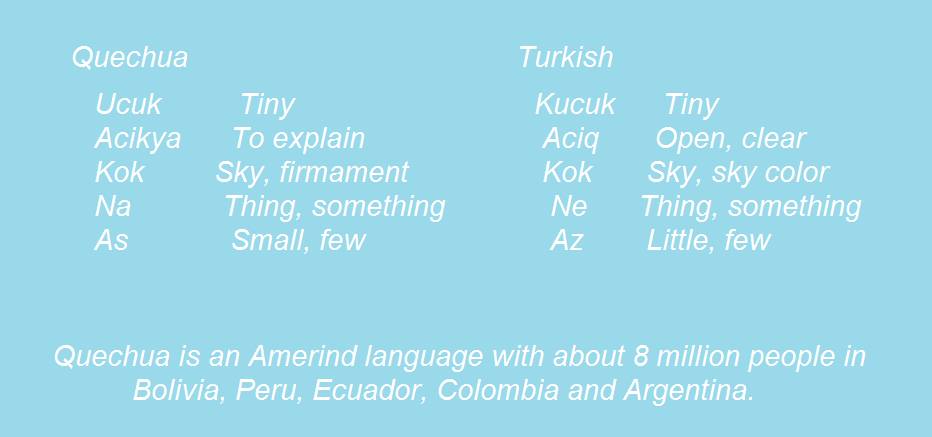
Also similar in languages :
Chapultepec + Ometepe = TEPE = Little Hill in Turkish (have the same meaning as theirs/Quechua)


an other source:

Thor Heyerdahl and other scientists report a presence of a significant layer of American Indian words in the languages of the many tribes occupying Pacific ocean islands. It gives reasons to think that the settlers on these islands were Maya, Aztec, and Inka Indians from the continental Americas, among others. In that light can be attempted etymological understanding of the "Kon-Tiki", the name of the basalt log raft in the Thor Heyerdahl book, borrowed from an Inca legend. 

As notes Thor Heyerdahl, "Kon" in Inca language means "Sun". As was already seen above, in the Mayan language "K'in" also means "sun", "day". And "Tik" means "God", "Leader". Inca language has a word teki in sense "leader, heading, going in the head", from which comes the word "tiki". In the Türkic languages the word "teke" means 
simultaneously a ram-producer, and a leader of the sheep herd 


Abrar Karimullin (1925-2000)
Professor, Kazan University
(and "kun" also means "day" and "sun", see above -
Translator's Note = N.Kisamov)


Proto-Türks and American Indians


an other similarity:


2 Temmuz 2016 Cumartesi

ESKİ TÜRKLERDE ÖLDÜREN SES: TİKİ


"Divanü Lügati't Türk'de Kaşgarlı Mahmud; yılda bir defa işitilen ama işiteni öldüren gizemli bir sesten söz eder. Bu "tiki" kelimesi ile bilinir ve atalar kültüyle bağlantılı bir kelimedir. Sözlüğün "tiki" maddesinde bu gizemli ses hakkında şöyle bilgi verir.

Türkler ölülerin ruhlarının yılda bir kez olmak üzere, bir gece toplandığına ve yaşıyorken bulundukları yerlere gittiklerine inanırlardı. İşte bu esnada "tiki", "tigi" ya da "tegi" şeklinde çıkan hışırtılı bir ses vardı ki geceleyin o sesi işiten kimse can verirdi." (aktaran L.Gözaçan)


TİKİ için başka bir kaynak:

DİVÂNÜ LÛGATİ’T-TÜRK’ÜN HALK BİLİMİ AÇISINDAN ÖNEMİ
Dr. Muharrem Kaya - link

"Tiki ((III, 230-1) ise geceleri işitilen sestir. Bu kelime atalar kültüyle bağlantılı bir kelimedir. Zira bu kelimenin açıklaması yapılırken, ruhların sağ iken yaşadıkları şehirlerde her yıl bir gece toplandıkları ve halkı ziyaret ettikleri belirtilir. Gece bu ruhların sesini, tikiyi duyanın öldüğüne inanılır."


BİR DE HEYERDAHL'A KULAK VERELİM....


Heyerdahl'ın kitabında da TİKİ bir çeşit tanrı sınıfı, ataların ruhları olarak geçiyor... :)


Stolpe [1891, p.206], in an attempt to analyse the implications of the Tiki traditions throughout Polynesia, writes: “In Rarotonga, Tahiti, and New Zealand he is considered to have been the first man. He is the prototype of a great group of divine beings, all of whom have been ordinary men who have after death been promoted to be gods of a lower rank than the previously mentioned actual gods, and who are collectively called Atua. Tiki, regarded as a class of gods, are thus the ancestral spirits, to which are attributed divine worship, thus they are the protecting spirits of their own descendants and are venerated with images in which they take up abode on certain occasions. Such images are found in many forms, from the colossal stone statues of Easter Island to the small portable images of polished nephrite which are worn by the Maori.”


THOR HEYERDAHL'S
"AMERICAN INDIANS IN THE PACIFIC"
PART V: TRACES OF CAUCASION-LIKE ELEMENTS IN PRE-INCA PERU.


Yani Tiki : Peru'da da aynı şekilde "Atalar kültü = Ataların Ruhları" demekmiş. 


American Natives are from Central Asia. Many Mayan words are to be explain in Turkish language, like Chapultepec - Chapul (Çapul = Plunderer) Tepec (Tepe = Hill, little mountain). Similar symbols, burial culture, mourning culture, etc. The name of Yakut Turks in Siberia (also called Saka, Saha) to be seen in Alaska as Yakutat or Yokut in Central America.


* Ass.Prof.Dr.İsmail Doğan book Mayans and Turks

* Scientists have discovered a community of Kazakhstan in the work of the Turkic peoples and American Indians : link in Russian Language

* Can also look into Amerindian: link
-mtDNA Amerind - Tuvinians and Kets - E.B.Starikovskaya 2005
-Amerind Genetics - Wontack Hong, Th.G.Schurr 2004
-Entry of Native American Y Chromosomes into the Americas - S.L.Zegura 2004
-Siberian Affinities of Native American Y Chromosomes - J.T.Lell 2002
-mtDNA Amerind - Türkic Altai Roots - M.Derenko 2001
-mtDNA Amerind - Tuvinians and Buryats - M.Derenko 2000
-Native American Language List
-Proto-Türks and American Indians - A.Karimullin 1995 


*Turkic Evidences of Amerind Languages / PDF
by Prof.Dr.Ekrem Arıkoğlu
Kyrgyzistan-Türkiye Manas Üniversitesi

Amerind word, American and Indian words are abbreviated and used to refer to the natives of the first to set foot in America. According to research from the Old World to New World migrations have been three different times. Amerind those who moved to America about 12-15 thousand years ago, those who moved from 5-7 thousand years ago, those who moved from the Na-Dene and Eskimo-Aleut about 1-2 thousand years ago is called. Na-Dene speakers of Sino-Caucasian languages research in the way of their relatives are opinions. Eskimo-Aleutlar both the America and in Asia live in the present. 

Amerind is considered to be of Asian origin, but which does not have precise information on Asian nations were connected. In our country, some of the studies carried out so far may be the American way of links between the American Indians and the Turks are thoughts. According to J. H. Greenberg, developed the theory of Amerind and his followers Ruhlen deeper with each other most of the relatives of American Indians. This view is correct, the Turks are not so many locals are just some of the Native American group of American bonds should be. In this paper, written by Greenberg and Ruhlen "An Amerind Etymological Dictionary" from Turkish words similar to the ones investigated in the work of the words. Matches the sound balance and ask the synonym of words will be doing this. 

Dictionary, Amerind language speakers are also deemed to be 910 words. Some of the small differences in the sound of these words, used by all the Amerind. Ismail Dogan before, "prepared by the Mayans and Turkishness" in the words from the list in the work of 106 words will not be included in this study. The paper will focus on the origins of 28 words we think might be the same. The first word shape Amerind languages. In parentheses, is the same as we think of Amerind language of Turkish origin provided for.


SB.


24 Eylül 2014 Çarşamba

TURANiAN RACE


(...) the Etruscans appear to be an original Turanian race which formed the underlying stratum of population over the whole world, and which cropped up, like the Basques in spain, in that part of taly and Etruria."


"Like all Turanians, the Etruscans were a tomb-building race."

"Hence, we meet in America temple-tombs (the pyramids of Mexico were undoubted temple-tombs) an animistic belief, tent life, language in agglutinative phase, etc. Many other features, counterparts of which will be found occuring in the Turanian stage of the eastern world, will be met with in Mexico and Peru, all the necessary growth of that phase of civilisation".


Hodder M.Westropp, Handbook of Egyptian, Greek, Etruscan and Roman Archeolohy, 
Kessinger Publisching, 1878, (and 2003, p.482, book)


in Mexico from Mayans period
and in Saymalytash (Turkish petroglyph: Saymalıtaş 15.000 years old)


_______