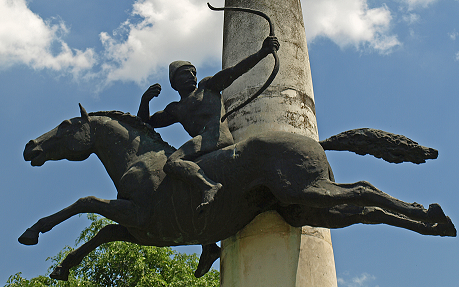
Eski Türklerde Rütbeler / Kazak Türkçesiyle beraber
* Jüzbası – jüzdik äskerdiñ basşısı. Olar sonımen qatar bütindey bir awılğa da basşılıq jasay aldı.
Yüzbaşı - 100 askerin başı, köyü de yönetir.
* Mıñbası – köne türik jäne moñğolğa ortaq äskerï ataw. Mıñ qoldıñ basşısı. Mıñbasın türkiler bek dep atasa, moñğoldar noyan, arabtar ämir dep atağan. Mıñbasılar äkimşilik basqarw jüyesi men saray isine de aralasa alatın boldı.
Binbaşı - Eski Türk ve Moğollarda ortak isim. Binlerin başı. Eğer Türkse "Ataca", Moğolsa "Noyan", Arapsa "Emir" deniyor.
* Tümen. Bul da türik jäne moñğol ulıstarı arasında asa joğarı äskerï lawazım bolıp sanaldı. Bir tümenge on mıñ qol bağınıştı boladı.
Tümen - Bu da Türkler ve Moğollar arasında yüksek bir rütbe. Emrinde 10 bin asker var.
* Tarxan – eñ joğarğı ataq. Äri türik-moñğol xalıqtarında öte ertede payda bolğan lawazım. Tek aqsüyekter men layıqtı äskerï adamdarğa berilgen. Xannan keyingi ekinşi därejeli ataq bolıp sanaldı. Bul ataqqa ïe bolğan batırlar belgili jeñildikterge ïe boldı. Salıq jïnadı. Wälayattarğa äkimdikke tağayındaldı.
Tarkan - En yüksek ünvan. Türk ve Moğollar arasında en eski pozisyon. Sadece soylu ve hak edenler bu konuma gelebiliyor. Kağan'dan sonra gelen rütbedir. Bu ünvanı hak kazanan kahramanlar bazı ayrıcalıklar alır, vergi toplama gibi. Vali olabilir.
* Sardar – saray isi nemese el şarwasına aralasw quqına ïe bolğan qolbasşılar. Olar xandardıñ senimdi ökili sanaldı.
Serdar - Saray veya ülkeye müdahale etme hakkına sahip olan Kolbaşılardır (komutandır). Hakanların güvendiği temsilcilerdir.
* Bahadür – joğarı deñgeydegi äskerï mansaptardıñ biri. Yağnï bir sözben aytqanda Qabanbay, Bögenbay, Nawrızbay sındı batırlarğa berilgen ataq. Munday jawıngerler jeke tw ustadı, erekşe ülgidegi kïim, patşa nemese xannıñ arnayı ökili ekenin rastaytın arnayı belgisi (köbine qawırsın tağıldı) bar dwlığa kïetin bolğan.
Bahadır - En üst düzey askeri kariyerlerden biridir. Kahramanlara verilir, Kabanbay, Bögenbay, Naurızbay gibi. Bu savaşçılara kağan tarafından verilmiş özel tamgalı tolgası (genellikle tüylüdür) ve sancağı vardır.
devamı: History of Kazakhstan
Berkut Nuresil - 14. Mart. 2019
Aqtaşı – armïyağa qajetti maldı qadağalawşı ofïcer. Yağnï saray mansap ataqtarınıñ biri, onıñ bastapqı fwnkcïyası – qoy bağwşılardıñ üstinen qarawşı, Raşïd ad Dïnniñ jazbasında osı atawmen xannıñ jeke jılqı üyirleriniñ at bağwşısın atağan.
Bularğaşı – äskerï mülikti qadağalaytın ofïcer. Bul da Şıñğıs äskeri ştabınıñ quramında kirgen alpağılardıñ (mansaptardıñ, kızmetterdiñ) biri. Bularğaşınıñ qarawında erekşe jasaq bolıp, olar äskerdiñ köşi (lageri) ornınan qozğalğanda jurt ornında umıtılıp qalğan zattardıñ, qalıp qoyğan jawıngerler men quldardıñ, sonday-aq mal-jannıñ bar-joğın tekseretin bolğan.
Bulğay – işki basqarw men qarjı mäselesi jönindegi ofïcer.
Jurtşı – ofïcer-kvartïrmeyster, äskerdi ornalastırwşı, qozğalw marşrwtın anıqtawşı. M. Ïvanïnniñ jazwına qarağanda, jurtşı ofïcerlerdiñ bastığı ewropalıq äskerdegi general-kvartïrmeysterge säykes kelgen. Onıñ jäne onıñ komandasınıñ mindeti: jazğı jäne qısqı äskerï köşterdi ornalastırw, äskerdiñ qozğalwı kezinde de, soğıs qïmıldarı kezinde de köş (lager) toqtaytın orındı tawıp, belgilew, xan men qolbasşılar ordalarınıñ ornalasw ornın belgilew.
Tabaşı – jük tïelgen köşti, tasımaldı qadağalaytın ofïcer. Şıñğıs xan zamanındağı äskerdiñ ştabındağı ofïcerlik qızmetterdiñ biri, ol, sirä, jorıqqa şıqqan äskerdiñ jük tïegen kerwenine ilesip jürgen jük arqalawşı tüyelerdi qadağalağan bolsa kerek.
Tarğwşı (targwdjï nemese djargwçï) – Şıñğıs xan zamanındağı äskerdiñ ştabına kiretin şenniñ biri, tarğwşılar mör saqtawşı qızmetin atqarğan, sonday-aq sot, ädil qazı retinde äskerï tender arasındağı dawdı qarap, isterin şeşwşi bolğan.
Tarğwşı (targwdjï nemese djargwçï) – Şıñğıs xan zamanındağı äskerdiñ ştabına kiretin şenniñ biri, tarğwşılar mör saqtawşı qızmetin atqarğan, sonday-aq sot, ädil qazı retinde äskerï tender arasındağı dawdı qarap, isterin şeşwşi bolğan.
Ğalımnıñ aytwınşa, XIII ğasırğa tän köne qujattardan belgili bolğan bul äskerw atawlar XIV-XVI ğasırlar yağnï Ämir Temir men Babır sarayı jäne Altın Orda zamanında öz mañızdılığın joymağan. Tek mağınalıq jağınan azdap özgerister ğana engizilgen. «Jasawıl», «Ar-tawıl», «Qarawıl», «Aydawıl», «Qaydawıl», «Dombawıl», «Baqawıl», t.b. sözderdi jatqızwğa boladı. Bulardıñ birazı bügingi qazaq tilinde saqtalğan. «-wıl» - moñğol tilindegi «äreket etwşi» degendi bildiretin jurnaq», – deydi Serikbol Qondıbay «Jawıngerlik rwx kitabı» attı kitabında.
Erewil – «uzaq jortwğa şıdamdı, mıqtı» degendi bildiredi, yağnï «desant» nemese «specnaz» sïyaqtı arnayı mağınalı, jattıqqan, bärine tözimdi jawıngerlerdi osılayşa atawğa bolar edi.
Tosqawıl – jasırın tosıp turıp, tutqïıldan şabwıl jasawğa jasalğan sarbazdar.
Şığawıl – belgili bir istiñ, ärekettiñ aldıñğı qatarında (şebinde) jüretin adam, avangard. Babır zamanında (XVI ğasır) «şığawıl» dep «xatşını, orındawşılıq qızmetti atqarwşını» atağan. Şığawıl – adyutant, ordïnarec, denşçïk nemese odan ülken äskerï mansap ataqtarınıñ biri.
Bögewil – jayaw äsker men tankige qarsı kedergi. Jortwıl – jorıq, attanıs.
Torwıl – şolğınşı. Orıstıñ «dozor» degenine säykes keledi.
Aydawıl – qılmıstı bolğandardı, sottalğan adamdardı aydawşını osılay dep ataydı. Sonımen qatar soğıs jağdayında qolğa tüsken tutqındardı aydaytın jawınger jasağında «aydawıl» degen.
Qarawıl – moñğolşa xarwwl – «küzetşi, baqılawşı, gawptvaxta» degendi bildiredi, biraq sözdiñ negizinde türkiniñ «qara, qaraw» degen etistikteri jatqanın bayqaw qïın bolmas. Tüsindirme sözdikte «qorğaw, saqtaw, küzet» degen mänge ïe, sonday-aq osı sözdiñ «nısana, mıltıqtıñ közdeytin jeri» degen awıspalı mağınaları da bar.
Kejewil – köne qazaq tilinde «küzet, qarawıl, şolğın» degendi bildirgen, söz tirkesi de saqtalğan, mısalı: kejewil saldı – «qarawıldadı, şoldı, torwıldadı», kejewilşi – «şolğınşı, qarawıl qarawşı, torwşı». Bügingi äskerï baqılawşılardı (voennıy nablyudatel) bir sözben osılayşa atawğa bolar edi, sonday-aq basqa jerlerde de qoldanwğa mümkindik bar.
Baqawıl (bökewil, bakavwl). Bul sözdiñ negizgi mağınası («Babırnama», «Tarïx-ï-Raşïdï», Äbilğazınıñ twındıları) – «patşağa berer tamaqtı tekserip otıratın senimdi adam» degendi bildiredi, tüsindirme sözdikte de osı anıqtama berilgen. M. Ïvanïnniñ köşpelilerdiñ soğıs öneri twralı kitabında «baqawıl» atawına ïe bolğan kisiniñ «äskerge azıq-tülik taratw men saqtawdı iske asırwşı jäne soğıs oljasına kelgen zattarğa öziniñ tañbasın baswşı, oljanı durıs bölwdi uyımdastırwşı» degen qızmet atqarğandığın jazadı.
Tutğaq – til alwşı, tünde jawdıñ küzetşileri men aldıñğı ayğaqşıların ustaw üşin jiberiletin şolğınşı attı qosın tobı.
Sonday-aq, ol eñbeginde tarxan atağınıñ birneşe deñgeyge bölingenin aytadı: «Apa – tarqan», «Bağa – tarxan» jäne «Boyla bağa tarqan». Serikbol Qondıbaydıñ aytwınşa, Toñıköktiñ Boyla bağa tarqan degen atağı bolğan. Eñ ükeni – tarxan. Eñ joğarı äskerï şen äri aqsüyektik tïtwl. Yağnï – qazirgi generaldıñ deñgeyindegi lawazım.
Tarqan (tarxan) – türikterdiñ ortasındağı eñ ejelgi belgili äskerï alpağılardıñ biri, osı ataw VI ğasırdıñ qujatında kezdesedi, mäselen, 590 jılı köktürki qağanı Dïzabwldıñ sarayına vïzantïylik Yustïn patşadan elşi bolıp kelgen Zemarx elge qaytwğa ruqsat alğanda, türki qağanı onıñ qasına tarxan şenindegi Tagma degen köktürki ofïcerin öz elşisi retinde ertip jiberedi (Memander, Excerpt de le Legationibus). «Tarxan» sözi äskerï alpağı retinde Orxon-Enïsey jazbalarında, «egemen xaqığa ïe iri aqsüyekter men bïlewşilerdiñ tïtwlınıñ atı» retinde Maxmut Qaşğarï sözdiginde de kezdesedi.
Kitap avtorı öz eñbekterinde Maxmut Qaşğarïdıñ sözdiginde ğana kezdesetin köne ataqtarğa da toqtalıp ötken. Solardıñ biri – Jortıq (yortuk) lawazımı. Ğalımnıñ payımdawınşa, köbine orta azïya xalıqtarına tän «yortük» lawazımı xannıñ qorğawşılarına berilgen.
Ağınşı. Maxmut Qaşğarïdıñ sözdiginde ağınşılar dep «duşpandı tünde barıp, tutqïıldan basatın äskerdi» yağnï ağındı, uşqır äsker tobın atağan.
Yalıman – basqınşılıq jortwıl degendi bildiredi.
Jizek (yizek). Äskerdiñ aldında jüretin şolğınşı top. «Bul – kädimgi, ewropalıq dästürde qoldanılğan «pïket» söziniñ twra balaması bolıp tabıladı» deydi ğalımnıñ özi.
Nebarı 35 jasında ömirden ötken jas ğalım Serikbol Qondıbay bul eñbeginde «Qazaqtıñ töl jawıngerlik kodeksi» bolğanın aytadı. Sonımen qatar rıcarlıq, «Sıpayşılıq», «Saltıq – rıcarlıq», «Şınjırlı tuqım», «Ïnaq», «Ïnanşı», «Tegin», «Tarxan», «Apa», «Şad», «Apa –Tarxan», «Bağa», «Buyrıq», «Öge buyrıq», «Ağışı», «Ordwbaşı», «Juğrışı», «Şabwşı», «arqışı», «Qulabuz», «Tüksin», «Tayañın», «Ïalafar», «Ïalabaşı», «Jabğı», «Idıqut», «Elteber», «Elbilge», «Elteriş», «Tamğaşı», «Bulğay – ağa», «Twtwk», «Rakabdar», «Möherder», «Dastwr», «Moswl», «Mulazım», «Muqtasïb», «Wäzir», «Xan», «Sardar», «Sarbaz» tağı sol sekildi köne türkilik äskerï ataqtar men mansaptardı bildiretin sözderdiñ mağınalarına taldaw jasağan. Äri bul atawlardıñ tüp nusqasına taldaw jasay otırıp, qazirgi zaman talabına say qayta jañğırtw jolın usınğan adam. Mäselen, memlekettik xatşını – Tamğaşı, Premer-mïnïstr lawazımın Elteris, Joğarğı sot jäne onıñ basşısın Jarğan nemese Jorğın dep atawğa bolatının körsetken.
Aytpaqşı, bul eñbeginde qazirgi mïnïstrlerdiñ köne türki tilinde Ïnanşı dep atalğanın aytadı. Işreki ïnanşı – işki ister mïnïstri, Jasawıl ïnanşı Ädilet mïnïstri, Sırtıraq ïnanşı – Sırtqı ister mïnïstri, Erdem ïnanşı – Mädenïet mïnïstri, Ordwbaşı – Prezïdent äkimşiliginiñ basşısı tağısın tağılar...
Bu makalenin de Türkiye Türkçesine aktarılması dileği ile...
SB
ikinci bölümü
Noyan
Nöker
Bektemis - Beklemiş
Alpawıt - Alpağüt
Sypay (Sipahi)
Läşker, lasker, ğasker (Kazasker)
Gusar (Husar)
Ulan
Berkut Nuresil - 23 Mart 2019
ikinci bölümü
Noyan
Nöker
Bektemis - Beklemiş
Alpawıt - Alpağüt
Sypay (Sipahi)
Läşker, lasker, ğasker (Kazasker)
Gusar (Husar)
Ulan
Berkut Nuresil - 23 Mart 2019

Ulan Bator, the capital city of Mongolia
Mongolia was once the center of Turkish Khaganate
Улаанбаатар, Ulaanbaatar
The meaning is "Red Hero", called after their hero "Damdin Sükhbaatar"
BATAR/BAATAR : Etymology Turkish
(that does not mean the hero Sükhbaatar is Turkish, only the word Baatar is Turkish)
- Bator-Batur / Bahadır (reading -ı as -y) - Bagatır / Bağatur (Baghatur) / Badır - Batır
- Meaning hero, brave warrior. Also a military rank.
Persian : Bahador
Russian : Bogatir
Today; Batu, Batı, Batur, Bahadır : male names among Turks.
and
TARKAN/TARHAN - TÜMEN
TARKAN; Turkish of etymology,
meaning: A high rank in the military, iron masters, noble. Also the root word for Turk (Tur/Tar)
which we see in BC times in Anatolia and İtaly (Etruscan):
- Tarhun, also spelled Taru, Tarhu, Tarhunt, Tarhunna, orTarhuis, ancient Anatolian weather god. His name appears in Hittite and Assyrian records (c. 1400–612 BC) and later as an element in Hellenistic personal names, primarily from Cilicia. Tarhunt was the Luwian form and Tarhun (Tarhunna) probably the Hittite, from the common root tarh-, “to conquer.” .. "In art Tarhun’s symbol was a three-pronged thunderbolt..." - britannica
As the Britannica explained "..probably the Hittite"... "or Luwian" is false information. "Tarkandemos" as Cilician name or god in Hittite, which was also found by Schliemann in Troy, "Tarquin" as king title and royal name in Etruscan world is Turkish of origin!
[read also ; Hyde Clarke (1815-1895, was president of Anatolia Academy)]
The symbol of "Tarhun" is to be seen in Crimea Tatar-Turks Flag and as marks among Turkish tribes.
and TÜMEN as in
"Tyumen" Region in Russia
or military rank among AVAR Turks in Europe
SB.
Who Where The Ancient inhabitants of Asia Minor?
"Tyumen" Region in Russia
or military rank among AVAR Turks in Europe
SB.
Who Where The Ancient inhabitants of Asia Minor?
*****
ENG.
Turkish world: military titles I
Burkit Nurasyl
History of Kazakhstan, 14.03.2019
State Secretary - Tamgashi, the position of Prime Minister can be called Elteris, the Supreme Court and its head can be called Zhargan or Jorgyn
Usually, when we talk about the military life of the nomadic Kazakh society, we limit ourselves to ten or twenty ancient names such as onbasi, zhuzbasi, thousandbasi, tumenbasi , bek, begler beg (Commander-in-Chief) or tarkhan . However, many of us do not take into account that the Turkic tribes, such as Saka and Hun, who dominated the vast steppes and built huge empires several times, had their own military order and laws.
Strict military reform, collective responsibility, in the collection of field laws, which became known as the "Great Army" law of Genghis Khan, "Kasym Khan's Kaska Zholy", "Esim Khan's Old Way", "Seven Charters" of al-Tauke, "Abylai's Black Way", There was an unshakable military hierarchy based on such values as loyalty to trust and oath, caution against treachery and abuse, obedience to orders and their unconditional execution. For example, even an ordinary soldier had a certain level of dominance over representatives of other classes. The military structure of the nomads was formed by a well-known system. And it was divided into three bases - the right wing, the left wing and the central part. These military camps consisted of tens, hundreds, and thousands (tumens). He obeyed personal commanders. The commanders continued to go straight to the khan, to the khan...
Now let's look at the most frequently mentioned positions related to the composition and management system of these military units:
The part of society adapted to any emergency, that is, to the field of defense, was called warriors . They had to obey their commanders and carry out the given order without fail. A soldier who underwent special military training was called a soldier . The leaders of the military unit consisting of such warriors and sardars were considered commanders.
The leader of a combat group consisting of ten or slightly more (usually 12 fighters) was called a ten . In the Middle Ages among the Turkic peoples, these military positions were designed to perform certain tasks. The tenth was subordinated to the centurion.
A centurion is the head of a centurion army. They were also able to lead an entire village.
Myngbasi is an ancient Turkic and Mongolian military name. Head of a thousand hands. The Turks called Mynbas Bek , the Mongols called it Noyan , and the Arabs called it Amir . Minbasis could also intervene in the administrative system and palace affairs.
Down. This was also considered a very high military position among the Turkic and Mongolian nobles. Ten thousand hands will be subject to one tumen.
Tarkhan is the highest title. And it is a position that appeared very early in the Turko-Mongol peoples. Only given to nobles and worthy military men. It was considered a secondary title after Khan. Heroes who received this title received certain benefits. Collected taxes. Appointed to governorate of provinces.
Sardars are commanders who have the right to intervene in court affairs or country affairs. They were considered the trusted representatives of the khans.
Bahadur is one of the top military careers. That is, in a word, the title given to heroes like Kabanbay, Bogenbay, Nauryzbay. Such warriors carried their own flags, wore distinctive clothing, and wore helmets with a special insignia (usually a feather) confirming that they were special representatives of the king or khan.
Similarly, there were military positions such as alaman, shora, til, shabarman, and esaul. This title (esaul), which appeared in the 16th century, was awarded to security guards, soldiers who guarded the door of the khan or who performed during special ceremonies.
Of course, military titles and honorable positions of nomadic Turks are not limited to this. There is no doubt that today there were job titles that have become archaic and have completely disappeared from consciousness. For example, the well-known scientist Serikbol Kondybai mentions many job titles typical of the ancient Turkic era in his book "Warrior Spirit Book". According to him, Kazakh military history and military culture have been formed since ancient times. After all, it is impossible to maintain a huge armed force adapted to a nomadic existence without a certain discipline, structure, military titles and positions approved by decree.
The scientist divides the history of Kazakh military history and military culture, including terminology, into the following conventional periods:
The first is ancient times (centuries and millennia before the 5th century BC);
The second is the Turkish era (VI-XV centuries AD);
The third is the Kazakh era (XV-XX centuries).
That is, each period had its own military titles and ranks. Now let's talk about that data:
Aktashi is an officer in charge of livestock needed for the army. That is, one of the palace career titles, its original function is the overseer over the sheep herders, in Rashid al-Din's writings, the shepherd of the khan's personal horse herds was called by this name.
Bularachi is an officer in charge of military property. This is one of the areas (careers, services) included in the headquarters of Genghis army. There was a special squad under the supervision of the latter, and when the army moved (camp), they checked for the presence of forgotten things, soldiers and slaves, as well as livestock.
Bulgai is an officer in charge of internal management and financial issues.
A civilian is an officer-quartermaster, deploying troops, determining the route of movement. M. According to Ivanin's writings, the chief of public officers corresponded to the quartermaster general in the European army. The task of him and his team: to place summer and winter military marches, to find and mark the place where the march (camp) will stop both during the movement of the army and during hostilities, to mark the location of the hordes of khans and commanders,
Tabashi is an officer who oversees the movement of goods. One of the officer positions in the army headquarters during the time of Genghis Khan, he probably supervised the burden-carrying camels that accompanied the loaded caravan of the army on a campaign.
Targushi (targuji or jarguchi) is one of the ranks of the army headquarters during the time of Genghis Khan.
According to the scientist, these military names known from the ancient documents of the 13th century did not lose their importance in the 14th-16th centuries, that is, in the times of Amir Temir and Babur Palace and the Golden Horde. Only minor changes have been made in terms of meaning. "Jasaul", "Ar-taul", "Karaul", "Aidaul", "Kaidaul", "Dombaul", "Bakaul", etc. words can be attributed. Some of them are preserved in today's Kazakh language. "-ul" is a Mongolian suffix meaning "doer", says Serikbol Kondybai in his book "Warrior Spirit Book".
Eruyul means "strong, enduring for a long campaign", that is, special meaning, trained, resistant to everything, soldiers like "paratroopers" or "spetsnaz" could be called this way.
A barricade is a soldier trained to ambush and ambush.
Shygaul is a person who is in the forefront (line) of a certain case, action, vanguard. In Babur's time (XVI century), "secretary" was called a "secretary, an executive".
Shygaul is one of the military career titles of adjutant, orderly, denschik or higher.
Bogueil is an obstacle against infantry and tanks.
Jhortuyl is a trip, a departure.
Torul is a browser. Corresponds to the Russian word "dozor".
Idaul is the name of a person who drives away criminals and convicted people. At the same time, the military unit that drives captured prisoners in wartime is called "drive".
Караул - Mongolian золн - means "watchman, monitor, sentinel", but it will not be difficult to notice that the Turkic verbs "to look, to look" are at the root of the word. In the explanatory dictionary, it has the meaning "to protect, preserve, guard", and this word also has alternate meanings such as "a target, a place where a gun aims".
Kezheuil means "guard, watchman, scout" in the ancient Kazakh language, the phrase is also preserved, for example: kezheuil sal - "guarded, watched, watched", kezheuilshi - "watchman, watchman, watchman". Today's military observers (военный оставлен) could be called this in one word, and it is possible to use it in other places as well.
Bakaul (bucket, bakavul). The main meaning of this word ("Babyrnama", "Tarikh-i-Rashidi", Abilgazy's works) means "a trusted person who checks the food given to the king", this definition is also given in the explanatory dictionary. M. In Ivanin's book on the war art of the nomads, it is written that the person who received the title "bakaul" served as "a person who implements the distribution and storage of food for the army, who puts his mark on things that came as war booty, and organizes the correct distribution of the booty."
Traps are scouts, sent at night to capture enemy guards and advance witnesses.
Also, in his work, he says that the title of tarkhan is divided into several levels: "Apa - tarkhan", "Baga - tarkhan" and "Boyla bag tarkhan". According to Serikbol Kondybai, Tonkykok had the reputation of Boila price. The most common is tarkhan. The highest military rank and aristocratic title. That is, a position at the level of the current general.
Tarkan (Tarkhan) is one of the oldest known military districts among the Turks, this name appears in a document of the 6th century, for example, in 590, when Zemarch, who was an ambassador from the Byzantine king Justin to the court of the Blue Turk Khagan Dizabul, was allowed to return to the country, the Turkish Khagan brought with him a Blue Turk named Tagma of the rank of Tarkhan. sends his officer as his ambassador (Memander, Excerpt de le Legationibus). The word "Tarkhan" can be found in the Orkhon-Yenisei records as a military domain, and in the dictionary of Mahmut Kashgari as "the name of the title of great nobles and rulers with sovereign rights".
In his works, the author of the book also touched on the ancient names found only in Mahmut Kashgari's dictionary. One of them is the position of Zhortyk (yortuk) . According to the scientist, the position of "Yortuk" typical of the peoples of Central Asia was assigned to the khan's defenders.
Streamer. In the dictionary of Mahmut Kashgari, streamers are called "an army that goes to ambush at hostile night", i.e., a group of swift troops.
Yalyman means invasion campaign.
Yizek (yizek). A reconnaissance group that goes ahead of the army. "This is a literal equivalent of the word "picket" used in the European tradition," says the scientist himself.
Serikbol Kondybai, a young scientist who died at the age of 35, says that this work contained the "Native Martial Code of Kazakhs". Also chivalry, "Courtesy", "Tradition - chivalry", "Chain seed", "Inak", "Inanshi", "Tegin", "Tarkhan", "Apa", "Shad", "Apa - Tarkhan", " Baga", "Bayal", "Ogebayal", "Agysy", "Ordubashi", "Jugryshi", "Shabushi", "Arkysy", "Kulabuz", "Tuksin", "Tayanyn", "Ialafar", "Ialabashi" ", "Zhabgyi", "Idykut", "Elteber", "Elbilge", "Elterish", "Tamgashi", "Bulgay - brother", "Tutuk", "Rakabdar", "Moherder", "Dastur", "Mosul" ", "Mulazym", "Muktasib", "Vazir", "Khan", "Sardar", "Sarbaz" and so on, analyzed the meanings of the words that denote ancient Turkish military titles and careers. And he is the person who, analyzing the original version of these names, proposed a way to modernize them according to modern requirements. For example, the state secretary can be called Tamgashi, the post of Prime Minister can be called Elteris, the Supreme Court and its head can be called Zhargan or Jorgyn.
By the way, in this work, it is said that the current ministers are called Inanshi in the ancient Turkic language. Ishreke Inanshi is the Minister of Internal Affairs, Zhasaul Inanshi is the Minister of Justice, Syrtyrak Inanshi is the Minister of Foreign Affairs, Erdem Inanshi is the Minister of Culture, Ordubashi is the head of the Presidential Administration...
To be continued...
***
Turkish world: military titles II
Burkit Nurasyl
History of Kazakhstan, 23.03.2019
The "Kazakhstan tarihy" portal will continue to introduce readers to the military structure and system of the nomads. Military similarities between nomads and European countries
We offer you the name of the cavalry armed with bows of Genghis Khan and his descendants
Noyan : In Mongolian, the word "noeon" means lord. 11-12 centuries. - aristocratic clans, 13-14 centuries. - princes, centurions, centurions, 14-17 centuries. - feudal lords, 17-20 centuries. - various high-ranking military personnel are called noyan. At one time, begs and emirs were also called noyan.
Servant: Means "friend", "companion" in Mongolian. Servant militias serving the nobility. During the war, they served as soldiers. In peacetime, he served as a guard, a palace official.
Bektemis or Beklemish: In the dictionaries of Radlov and Budagov, this word is defined as "head of the night watch station".
Alpaut or Alpagut: An old Turkic military rank name. In the Turkish dictionary, this word means brave hero. In the Kultegin poem, there is the word alpagu, which means rank, rank.
Sherik , is an ancient name meaning soldier, warrior. Often used in Mahmut Kashgari dictionaries. Before Bertin, people colloquially referred to the army as comrades.
Polite : In the encyclopedic dictionary, sypa or sypai is the head of the country in state affairs, owner; is indicated as a military officer, soldier. X called his mercenary soldier "sipay" in Hindi and Urdu. Also, in the Ottoman Turkish Empire, there was a military term like "sipay" (sipah, spakh, spahi, spagi).
Lashker, lasker, or soldier : In the Kazakh language, the term "armed force, armed force, soldier, squad" is a general term. Today it is used as the main synonym of the word "army".
Over time, such Turkish titles began to fade from the national consciousness. In particular, individual names such as "Aktashi", "Tabashi", "Bulgarshi" went out of circulation very quickly. In its place, the names "sardar" and "soldier" appeared, meaning the concept of generality. That is, there was a tradition of calling a member of any combat unit and individual soldiers in general "soldier", the leader of a unit, group (ten, hundred, thousand, etc.) as "sardar".
According to Serikbol Kondybai, this was influenced by the political situation in the 18th and 19th centuries. "Sardar and soldier are concepts of the last period of statelessness in the Kazakh tradition. In the 18th and 19th centuries, the Kazakh state was permanently lost. Accordingly, maintaining a permanent army or professional fighting style disappeared. Old military names are also being forgotten. Amangeldi Imanov, a well-known person who received the title of sardar on behalf of the Kazakh people. During the national liberation uprising of 1916, the soldiers of the Amangeldi sardar were divided into tens, hundreds, and thousands, they were led by tens, hundreds, and thousands, and the general army was led by the sardar, that is, Amangeldi himself.
It is interesting that the word "sardar" is found in the vocabulary of some countries. During the Ottoman Empire, the army commander was given the title of "sardar". This was the name of the commander of the Egyptian army before entering the British colony. Similarly, tribal leaders and influential officials are still called sardar in Iran and Afghanistan.
By the way, modern military terms such as regiment, gaidamak, and hussar are based on the Turkish concept. The author makes an in-depth analysis of this in the book "Warrior Spirit Book". In the Babyrnama song, the word "Bulyk" means an administrative territory, a part. This word was transferred to the Russian-Ukrainian languages in the form of "regiment" during the Kipchak-Polovet or Golden Horde era. And it has become the main title of the military structure in these languages. The word "regiment" is considered to be the name of the parts of the military order and location of the military unit of the 13th-17th centuries in Russia. The whole army, the camp usually consisted of 5-7 regiments: large, front, right and left wings (hand), guard, barrier regiments and scout regiment (ertoul). This military order was transferred to the Russians, probably from the nomads. Regiment-type military units appeared in Russia and Europe (Germany, France, Sweden) in the 16th and 17th centuries.
Similarly, the root of the word "gaydamak" is the ancient Turkic concept of aydamak. According to the definition of S. Kondybai, the name "gaydamak" is the name of a participant in the people's liberation movement in the Volyn and Western Podolia regions of Ukraine in the second half of the 18th century (1734, 1750, 1768). In the army of the Ottoman Turks, units of herders were called gaidamak. In addition, this word means attacker in Turkish.
Hussar : In Hungarian it is called huszar (birds). A type of cavalry (cavalry). For the first time in 1458 In Hungary, aristocracy appeared as the name of a special cavalry unit. In the 16th century, the Poles adopted this term and type of military unit for their army. Poles called "hussars" a special heavy cavalry made up of aristocrats. Regular hussar regiments were formed in France, Austria, and Prussia in the late 17th and early 18th centuries and were used as light cavalry units that conducted combat operations in the rear and flanks of the enemy, scouting, and tracking the fleeing enemy. Hussars kept their importance until the middle of the 19th century, when they were abolished due to the abolition of the distinction between cavalry, and the name hussar was preserved in some armies only as a continuation of tradition.
Ulan: In the 13th and 14th centuries, in the armed forces of Chinggis Khan and his descendants, "Ulan" was the name given to cavalry armed with hooked spears, as distinguished from cavalry armed with bows. Nowadays, this word refers to a type of light cavalry. In our country, the guard is called Ulan.
In the 18th century, Ulan regiments began to be formed in Austria and Prussia, and in France at the beginning of the 19th century. It was first established in Russia in 1803.
Ulans were mainly armed with swords and hooked spears. Later he had a gun. From the middle of the 19th century, they began to be equipped with carbines. The peculiarity of their clothing was a headdress with a square top, called "ulanka" in Russian. The author says that it is based on the headdress of the Nogai ("Tatars").
___