gothic etiketine sahip kayıtlar gösteriliyor. Tüm kayıtları göster

27 Nisan 2021 Salı

The Etymology of Haakon and Earl is Turkish


The origin of this name/word "Hakan" is Turkish, and the meaning is not as they (picture above/wiki) say.


The meaning is "ruler, leader", as today "king".

Turks (7th-8th c) did use the title Hakan before the Scandinavians (10th c) did.


Hakan was also used by the Hun-Turks, which they came to Scandinavia after the death of Atilla the Hun (d.453), and then begins also the age of the Vikings. So, not every Viking was a Scandinavian blood 😉


The word/title "Earl", as in "Earl Haakon Sigurdsson of Norway (937-995)" is also Turkish of etymology.


It was used by the Turkish tribes (even in BC. times) long before the Germanic tribes was using.


So, it is not Germanic as the Oxford English Dictionary says! Or Proto-Norse as the wiki says!


"They" say it comes from Eril (Er-il) > Lord of the country


BUT... It is Turkish.


* Er = Man, lord, ruler, master.

* İl / El = County, province, state.

* Erilaz = Er İl As (Turkish, As is also a tribe name; "Leader of the As County")

> The Scythian-Turks,

> Hun-Turks, Avar-Turks, Khazar-Turks;

> Kipchak (Polovets)-Kuman (Cuman)-Turks, Pecheneg-Turks

in Europe....who was assimilated among Germanic, Celtic, Anglo-Saxon, Fin-Ugor, etc., tribes.


SB

link1 - link2 - link3


Eagle in Gothic (?, Anglo-Saxon or Germanic) art, but influenced by Scythian-Turkish art.


"What indeed was this ‘European’ identity? The early medieval culture that ultimately gave rise to modern European nation states was brought about by a fusion of Hunno-Danubian (i.e. eastern Eurasian culture of the steppe brought to the west by the Hunnic Empire and the Alans) aristocratic culture and the surviving residues of Roman civilization in western Eurasia. The elite of the Frankish, Burgundian, Ostrogothic, Lombard and other states in the West patronized this hybrid culture that later became the dominating ethos of medieval ‘Europe'.... It has also been argued that many of the leaders of post-Roman Europe were either Hunnic or mixed Hunnic in origin. The Huns certainly did not just disappear into oblivion. They left visible political and cultural traces that facilitated the transformation of Roman Europe into early medieval Europe."

Hyun Jin Kim - The Huns


Hun-Turks - 6th c AD, a horse with knotted tail is Turkish tradition "warrior goes to war"


I find this article (Were there Huns in Anglo-Saxon England? Some thoughts on Bede, Priscus & Attila, by Dr. Caitlin R.Green / link) also a progress; Accepting "a Hun-Turk as ancestor"... 


But "ancestor" is not the only thing, we can also trace with art & traditions, plus the using of Turkish alphabet (Scythian-Hun/Turk) and transforming it into "futhark", as they call (German tribes had no writings before Huns, south part did use Latin alphabet with Roman Emp., but literacy rate was also very very low). One of the letter in "Futhark", and after that in "Anglo-Saxon alphabet", has the same meaning as the letter (tamga=mark) in Turkish alphabet (Orhon insc.), and that is "home, land", which is very important in humans life... So, not only as "ancestor" had the Turks an impact on German and Celt tribes, but also with social life and civilization.


Semra Bayraktar


Don't underestimate the power of Turkish and Turks


14 Şubat 2018 Çarşamba

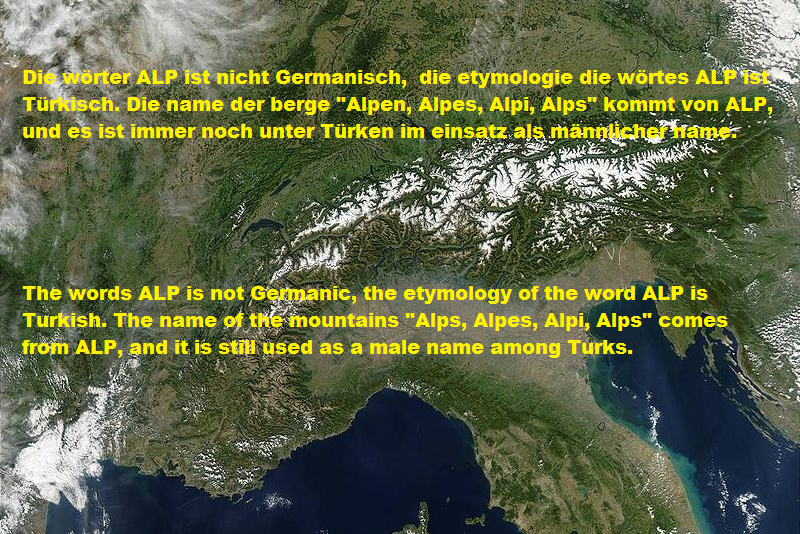
Alp - Alpen


Die wörter ALP ist nicht Germanisch, die etymologie die wörtes ALP ist Türkisch. Die name der berge "Alpen, Alpes, Alpi, Alps" kommt von ALP, und es ist immer noch unter Türken im einsatz als männlicher name.

Denken sie denn das die wörte GERMAN ist "germanisch"? Die nach 500 vor Christus gesprochen wurde! ... Nach Cimmerians und Scythians, wer sprach Türkisch, das Wort ER/AR-MAN hatten, und "fett, heroisch, herzhaft-herzlich" bedeutet !..

Wie im namen eines Türkischen Herrchers "ALP Er Tunga" [7.v.Chr., Großvater von Königin Tomyris (auch Tr.), war könig von Turan als "Afrasiab" in Shahnama], oder Balamber (Bulümar - 360??-378) Sohn "Alp-abai" (Alyp-bi, Arbat oder 'Uldin' - 378-390) das wird Khan der Westhunnen in Europa und besiegt Sadumians (Skandinavier).


* * *


The words ALP is not Germanic, the etymology of the word ALP is Turkish. The name of the mountains "Alps, Alpes, Alpi, Alps" comes from ALP, and it is still used as a male name among Turks.

Do you think that the word GERMAN is "Germanic"? Which was spoken after 500 BC !... After Cimmerians and Scythians, who spoke Turkish, had the word ERMAN, and "bold, heroic, brave, valiant" means !..

Like in the name of a Turkish ruler "ALP Er Tunga" [7th c BC, grandfather of Queen Tomyris (also Tr.), as king of Turan "Afrasiab" in Shahnama] , or Balamber (Bulümar-360??-378) ' s son "Alp-abai" (Alyp-bi, Arbat or 'Uldin'-378-390), which becomes Khan of Western Huns in Europe and defeats Sadumians (Scandinavians).


SB.


By Professor Firudin Agasyoglu Jalilov (Ağasıoğlu Celilov). ..... "At last, the fact that Arman/Armen/Erman is a tribal division known among contemporary Turkic peoples perfectly shows what kind of people it was in antiquity and what ethnic group it belonged to...." (to read more: link)    (-mAn / mEn supplement)


Alp = Elf


"Alp bedeutet im türkischen groß , mächtig, furchtlos, tapfer. Alp ähnelt auch dem deutschen Elfe, siehe Wikipedia  Die Entstehung des Wortes Elfen in der deutschen Sprache geht auf das Wort Alb oder Elb im Singular bzw. Elbe oder Elber im Plural zurück. Aus der femininen Form "Elbe" wurde im 16. Jahrhundert zusätzlich der schwache Plural "Elben" gebildet. Im 18. Jahrhundert wurden die Wortformen durch die englische Form "Elfen" verdrängt. Die Form "Alb" findet sich heute noch in einer eingeschränkten Bedeutung im Wort Albtraum wieder." (von einem freund)


Turkish academician Osman Karatay and Emre Aygün investigated these words to:  "Old Scandinavian records inform that ancestors of the Scandinavian peoples had condensed contacts with the region where ancient Turks used to live, and sometimes directly with the Turks. They contain very significant cultural elements. Besides, some ethnic contacts occurred. Consequently, withnessing the very similarity of typecasting of  heroes, which is one of the most outstanding cultural peculiarities, of the Scandinavian and Turanic realms is not very surprising. In addition, basic words of the two denominating heroes are strikingly similar to each other, and likely cognate." - Alplar ve Elfler: Türk ve İskandinav Dünyalarında Kahramanlık Olgusu link


"Streifzüge des vagabundierenden Kulturwissenschafters" by Roland Girtler (Österreichischer Soziologe, Kulturanthropologe)


"Atta unsar, þu in himinam" = Our Father, who art in Heaven
 Gothic language is an extinct 'East Germanic language' (?) that was spoken by the Goths, and they use the word ATTA, 
which is Turkish of origin.

"Atta" = "Father" = Turkish of etymology
Therefore, which Germanic or Gothic?...
SB.