eski türklerde uzun saç etiketine sahip kayıtlar gösteriliyor. Tüm kayıtları göster

12 Haziran 2017 Pazartesi

Büyük İskender Tarzı - Sakal Traşı


"Tüm bu boyutlar, Batı medeniyetinin gidişatını ve aynı zamanda erkeksi saygınlığın çehresini değiştiren Büyük İskender örneğinde görülebilir. İskender, Mısır ve İran'ı fethederek kendisini ve Yunanca konuşan dostlarını bilinen dünyanın efendileri haline getirmiştir. Yine de Yunan geleneğinde erkekliğe yakışmayan bir görünüm - portreler, heykeller ve sikkeler onu genç ve tıraşlı olarak tasvir eder - seçmiştir. Neden böyle bir şey yapsın ki? Daha da önemlisi, neden saygın Yunan ve Romalı erkekler sonraki dört yüz yıl boyunca onu hevesle taklit ettiler? Cevap, kendisini bir yarı tanrı olarak görmesi ve öyle görünmek istemesidir. Zamanının sanatçıları Akhilleus ve Herakles gibi efsanevi kahramanları ebediyen genç ve sakalsız olarak tasvir ettikleri için, o da kendini tıraş etmiş ve takipçilerini de aynısını yapmaya teşvik etmiştir. Klasik zamanlarda, seçkin erkekler - ya da daha büyük bir onura sahip olmak isteyen daha küçük erkekler - kendilerinde kahramanca bir şey olduğunu ima etmek için İskender'in tarzını benimsediler. Bu bir heves ya da moda akımı değil, güçlü bir sembolizmdi."

(çeviri-SB)


Her ikisi de Heykeltraş Lysippos'tan (MÖ.4.yy)
Sakallı - Herkül - Perge / Roma dönemi kopyası (sakalsız Herkül için bknz.)
Sakalsız - Büyük İskender / (MÖ 4.yy)


"All of these dimensions can be in the example of Alexander the Great , who changed the course of Western civilization and also the face of masculine respectability. By conquering Egypt and Persia, alexander made himself and his fellow Greek-speakers masters of the known world. Yet he chose a look- portaraits, statues, and coins depict him as youthful and clean- shaven - that was widely disparaged in greek tradition as unmanly. Why would he do so? More to the point, why did respectable greek and roman men enthusiastically emulate him for the next four hundred years? the answer is thathe viewed himself as a demigod and wished to look the part. Because the artist of his day depicted mythic heroes like Achilles and Herackles as eternally youthful and beardless, he shaved himself and encouraged his followers to do the same. he was very persuasive. In classical times, elite men - or lesser men who aspired to greater honor - adopted Alexander's style to imply something heroic in themselve. It was not a fad or fashion trend but powerful symbolism."


Of Beards and Men
The Revealing History of Facial Hair
Christopher Oldstone-Moore

(Alexander the Great is not a "Greek", but a Macedonian!)


(Herkül, İskitlerin atası olması dışında, görevleri bakımından Bilgimiş (Gılgamış, yanlış okunuştur) ile özdeştir. - SB)


BUNA GÖRE;
SAKALSIZ OLMAK, 
YARI TANRI-KAHRAMAN OLMAK DEMEK. ;)


...als Tukiu oder Tukue. Wir erfahren dass sie als nomaden in filzzelten wohnen, von viehzucht und jagd leben, die haare lang hangend tragen... aber shon zum jahre 552 finde ich bei Agathias, die Türken erwahnt, die 'wie die Avaren langes ungeplegtes Haar tragen'... 


Khan of the Turks:
The Khan wore a green satin robe; his hair which was ten feet long was free: a band of white silk was wound round his forehead hanging down behind. ... with plaited hair. 


Sakalsız, uzun saçlı bir Saka-Türkü


17 Mayıs 2015 Pazar

The Turks in the Seventh Century


 "At that time we must remember, there was hardly such a thing as a town in Anglo-Saxon England...." H.G.Wells


"It becomes fairly evident that in the fifth and sixth centuries A.D. not merely Persia, but the regions that are now Turkestan and Afghanistan were far more advanced in civilization than were the French and English of that time. The obscurity of the history of these regions has been lifted in the last two decades, and a very considerable literature written in languages of the Turkish group has been discovered. These extant manuscripts date from the seventh century onward." - page 628

"Yuan Chwang’s account of Samarkand is of a large and prosperous city, “a great commercial entrepôt, the country about it very fertile, abounding in trees and flowers and yielding many fine horses. Its inhabitants were skilful craftsmen, smart and energetic.” At that time we must remember there was hardly such a thing as a town in Anglo-Saxon England." - page 646


Buddhist named Yuan Chwang started out from Singan, Tai-tsung’s capital, upon a great journey to India. He was away sixteen years, he returned in 645, and he wrote an account of his travels which is treasured as a Chinese classic. One or two points about his experiences are to be noted here because they contribute to our general review of the state of the world in the seventh century A.D.

Yuan Chwang was as eager for marvels and as credulous as Herodotus, and without the latter writer’s fine sense of history; he could never pass a monument or ruin without learning some fabulous story about it; Chinese ideas of the dignity of literature perhaps prevented him from telling us much detail of how he travelled, who were his attendants, how he was lodged, or what he ate and how he paid his expenses—details precious to the historian; nevertheless, he gives us a series of illuminating flashes upon China, Central Asia, and India in the period now under consideration.

His journey was an enormous one. He went and came back by way of the Pamirs. He went by the northern route, crossing the desert of Gobi, passing along the southern slopes of the Thien Shan, skirting the great deep blue lake of Issik Kul, and so to Tashkend and Samarkand, and then more or less in the footsteps of Alexander the Great southward to the Khyber Pass and Peshawur. He returned by the southern route, crossing the Pamirs from Afghanistan to Kashgar, and so along the line of retreat the Yueh Chi had followed in the reverse direction seven centuries before, and by Yarkand, along the slopes of the Kuen Lun to rejoin his former route near the desert end of the Great Wall. Each route involved some hard mountaineering. His journeyings in India are untraceable; he was there fourteen years, and he went all over the peninsula from Nepal to Ceylon.

At that time there was an imperial edict forbidding foreign travel, so that Yuan Chwang started from Singan like an escaping criminal. There was a pursuit to prevent him carrying out his project. How he bought a lean red-coloured horse that knew the desert paths from a strange grey-beard, how he dodged a frontier guard-house with the help of a “foreign person” who made him a bridge of brushwood lower down the river, how he crossed the desert guided by the bones of men and cattle, how he saw a mirage, and how twice he narrowly escaped being shot by arrows when he was getting water near the watch-towers on the desert track, the reader will find in the Life. He lost his way in the desert of Gobi, and for four nights and five days he had no water; when he was in the mountains among the glaciers, twelve of his party were frozen to death. All this is in the Life; he tells little of it in his own account of his travels.

He shows us the Turks, this new development of the Hun tradition, in possession not only of what is now Turkestan, but all along the northern route. He mentions many cities and considerable cultivation. He is entertained by various rulers, allies of or more or less nominally tributaries to China, and among others by the Khan of the Turks, a magnificent person in green satin, with his long hair tied with silk.

“The gold embroidery of this grand tent shone with a dazzling splendour; the ministers of the presence in attendance sat on mats in long rows on either side all dressed in magnificent brocade robes, while the rest of the retinue on duty stood behind. You saw that although it was a case of a frontier ruler, yet there was an air of distinction and elegance. The Khan came out from his tent about thirty paces to meet Yuan Chwang, who, after a courteous greeting, entered the tent.... After a short interval envoys from China and Kao-chang were admitted and presented their despatches and credentials, which the Khan perused. He was much elated, and caused the envoys to be seated; then he ordered wine and music for himself and them and grape-syrup for the pilgrim. Hereupon all pledged each other, and the filling and draining of the winecups made a din and bustle, while the mingled music of various instruments rose loud: although the airs were the popular strains of foreigners, yet they pleased the senses and exhilarated the mental faculties. 

After a little, piles of roasted beef and mutton were served for the others, and lawful food, such as cakes, milk, candy, honey, and grapes, for the pilgrim. After the entertainment, grape-syrup was again served, and the Khan invited Yuan Chwang to improve the occasion, whereupon the pilgrim expounded the doctrines of the ‘ten virtues,’ compassion for animal life, and the paramitas and emancipation. The Khan, raising his hands, bowed, and gladly believed and accepted the teaching.”

Yuan Chwang’s account of Samarkand is of a large and prosperous city, “a great commercial entrepôt, the country about it very fertile, abounding in trees and flowers and yielding many fine horses. Its inhabitants were skilful craftsmen, smart and energetic.”


from: 
H.G.Wells - THE OUTLINE OF HISTORY, book vı,1920
"On Yuan Chwang's Travels in India, 629-645 A.D." (B.602, D.664)


629-645. Xuan Zang (Hsuan-tsang). Chinese Buddhist monk and translator traveling across the Tarim basin via the northern route, Turfan, Kucha, Tashkent, Samarkand, Bactria, then over the Kindu Kush to India. Returned via the southern route. He spent his remaining life translating sutras into Chinese. .His travel and story became fantastic legends which were used in plays and novels, such as Wu Ch'eng-en's famous novel in the 16th century, Journey to the West. more to read:


NOTE:

"At the time when the Orkhon Monuments were erected, French and German nation was not formed." - Prof.Dr. Ahmet Taşağıl (Turcologist, historian)


Thus we can also add English nation to that, because Anglo-Saxons has emigrated to England in the 5th c AD....and they had interactions in culture and blood with the Turks. That's why we see many Turkish words in English, and some cultural artifacts, customs and traditions.


SB


* * *


"Şunu hatırlatalım ki o tarihler itibarıyla, böylesi uygarlaşmış kentlere Anglo-Sakson İngiltere'sinden 
rastlamak mümkün değildir." H.G.Wells


H.G.Wells, Yuan Chwang adlı Budist gezginin *MS.45 yılında Hindistan'a uzanan gezisindeki izlenimlerinden hareketle şöyle bir saptamada bulunur;

"Gezici bizlere sadece Türkistan diye bilinen yerlerdeki Türkleri değil ve fakat Kuzey Yolu olarak anılan bölgelerdeki Türkleri de tanıtmakta...Buralardaki birçok kentlerden ve bakımlı yerlerden söz etmekte...Gezicinin anlatışına göre Semerkant büyük ve refah içinde bir kent...Ahalisi son derece uygar...Şunu hatırlatalım ki o tarihler itibarıyla böylesi uygarlaşmış kentlere Anglo-Sakson İngiltere'sinden rastlamak mümkün değildir."


E.Aydın, Nasıl Müslüman Olduk?,s274 ; o da
İ.Arsel, Teokratik Devlet Anlayışından Demokratik Devlet Anlayışına, s94 alıntılamış...


* İlhan Arsel'in kitabında geçen ve Erdoğan Aydın'ın da aynen alıntıladığı tarih MS.45 , yazım hatası olmalı, çünkü Chwang kitabını MS.645'te yazmıştır. Chwang ya da Hsüan-tsang (Xuanzang) ın kitabının adı "On Yuan Chwang's Travels in India, 629-645 A.D." dır, ki doğumu y.602, ölümüde 664'tür. Galiba orjinal kitaba bakmak ve bu hatayı düzeltmek kimsenin aklına gelmemiş.


Prof.Dr.Ahmet Taşağıl hocanın da dediği gibi ; "Orhun Anıtlarının dikildiği çağda, Alman veya Fransız diye bir millet oluşmamıştı". Buna İngiltere'yi de ekleyebiliriz, çünkü Anglo-Saksonlar MS.5.yy'da İngiltere'ye göçmüştür ve göçmeden önce Hun gibi diğer Türk kavimleriyle de kültürel etkileşime girmiştir.

SB.


Yuan Chwang'ın Kaan ile tanışması: Hacı, Su-she su şehrinde av seferinde olan Turk Sh'eh-hu Kaan'ı ile karşılaşıyor. Bize söylendiği ordu ekipmanı çok büyük. Kaan yeşil saten bir elbise giyiyor, saçları on ayak uzunluğunda ve serbest, beyaz ipek bir band alnından arkaya dökülüyor. Bakanları ise, yaklaşık 200 kadar, hepsi işlemeli elbiseleri ve örgülü/kıvrımlı saçları ile sağında ve solunda duruyor. Diğer askerleri kürk, şayak (verev dokunmuş dayanaklı bir cins kumaş) ve ince yün elbiseleriyle, mızrakları, alemleri ve yayları ile sırayla duruyor. Suvarileri deve ve atlarıyla uzakta bacaklarını geriyor....


Kitapta adı geçen Sh-eh-hu Kaan'ın 635 de ölen Batı Türk Kaanlarından To-lu 'nun bir akrabası olduğunu söylüyor. Ye-hu olarak başka yerlerde de geçiyormuş, ama Sheh-hu olarak okunması gerektiği belirtiliyor.

To-lu dediği, 632-634 yılları arasında Batı Türk (Göktürk) Kağanlığını yöneten, Bağatur Kağan'ın oğlu Bağaşa Tuğluk Kağan olabilir mi? Sheh-hu Kağan kim bulamadım.


SAÇLAR / HAiRS


Etruscan


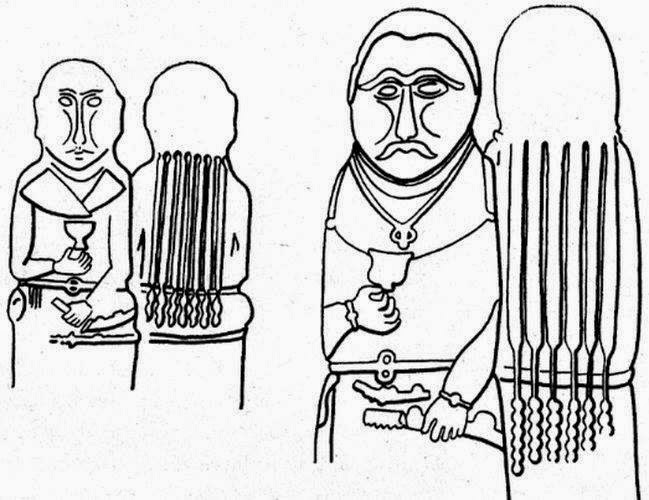
A drawing of Taşbaba (Tashbaba-Stonefather)

Turkish Taşbaba with his oath cup, dagger and long hair.
These "stonefathers" are used on graves, represents the brave fearless Turkish warrior or leader.

You can see it everywhere , from the Altai , Central Asia, to Europe....
from the Scythian Turks period (even earlier) till 15th c...

Ancestor of the gravestones....


Kars Province; 19th c AD;  Turkish Gravestones


Delilah gets Samson to tell her the secret of his strength: 
"My hair has never been cut," he says. "From the time that I was born, ..."
I wonder where the myth of Samson and Delilah comes from... ;)


Under Attila (reigned 434-453 CE) the Huns became the most powerful, and most feared, military force in Europe. After Attila's death, however, his sons fought each other for supremacy, squandered their resources, and the empire which Attila had built fell apart by 469 CE

According to the Roman historian Priscus of Panium, the men of the army had cut their long hair and slashed their cheeks, so that the greatest of all warriors should be mourned not with tears or the wailing of women but with the blood of men. (is a expression of mourning in Turkish culture)

The Huns are descended of the Scythians and were the same people as the Xiongnu and they are Turkish of nation. Most of the scholars don't mention the word Turk on purpose!


ilgili:


THE TURKS
_____________
_____________


3 Ocak 2015 Cumartesi

ETRÜSKLER - TÜRKLER


Sarcophagus of the Spouses, c. 520 B.C.E., 
Etruscan, painted terracotta,
3 feet 9-1/2 inches x 6 feet 7 inches, 
found in the Banditaccia necropolis, 
Cerveteri (Museo Nazionale di Villa Giulia in Rome)


 Etrüsk Aplu 
Apollo Etrüsklerde Apulu / Aplu , Hititlerde Apulinus'tur.
Apollo kelimesinin Yunanca bir anlamı yoktur .


 Etrüsk Artimi 
Yunan tanrı panteonundaki Artemis bir Amazondur. 
Amazonlar İskit,Saka, Kimmer soyundandır. 
Artemis kelimesinin Yunanca bir anlamı yoktur .


KIPÇAK TAŞNİNE

VE
SAMSON VE DALİLAH
SAMSON GÜCÜNÜ SAÇLARINDAN ALIR, KESİLİNCE GÜCÜNÜ KAYBEDER
EFSANESİ.....
TANIDIK GELDİ Mİ , TÜRK KÜLTÜRÜNDE YAS TUTMA ADETİDİR...


Eski Türkler'de saç bir kimlikti. Türkler uzun saçlarıyla o kadar bütünleşmiş ve ün yapmışlardı ki Türk dendiğinde uzun saçlı insanlar akla gelirdi. 

Selçuklular döneminden başlayarak geriye gidildiğinde Türklerin saçlarına ne kadar önem verdikleri daha da iyi anlaşılıyor. Mesela Çağrı Beyin kumandasında 1015 yılında Doğu Anadolu'dan gelen Selçuklu akıncılarıyla ilk kez karşılaşan Van Gölü civarındaki Ermeniler, Türk savaşçılarını sanki Brewehard filmindeki gibi tarif ediyordu: "Her şeyden evvel Türkmenlerin rüzgar gibi atlar üstünde bambaşka kıyafetleri, kadınlarinkine benzer uzun saçları, mızrakları ve yaylarıyla görünüşleri, böyle bir manzara ile ilk defa karşılaşan insanları telaşa düşürmüştü."


Prof. Dr. Faruk Sümer:" Oğuz Türklerinin saçları uzun ve  kesmezler. Hükümdarlar genelde saçlarını serbest bırakırken, savaşçılar ve diğer erkekler belik örerler. Oğuz erkekleri, saçlarının örgüleri çok olmasıyla tanınır. Peçeneklerin de saçları örülüydür. 9. yy yaşayan Horasan Türkleri'nin de saçları uzundu. Harzemşahlar'ın da saçları uzundu fakat hacca giderken kısaltıyorlar. Uygur metinlerinde de alplerin saçları aslan yelelerine benzetiliyor. Uygur hükümdarı ise saçlarını topuz şeklinde toplamakta ve topuzun üstünde, beş sınıf halkı temsil eden, beş dilimli taç giymekteydi."

Rus kaynaklarında da, 'sarışın' olmalarıyla tanınan Kuman Türk erkeklerinin saçlarının uzun olduğu ve örgü yaptıkları bildiriliyor. Hatta Kuman erkekleri, saçlarına üç model veriyormuş. Birinci model: Yan yana üç saç örgüsü; üç eşit uzunlukta ve kalınlıkta. İkinci model: Şakağın iki tarafından ve ensenin ortasından bir tutam olarak örülüyor ve üç örgü aşağıda birleşiyor. Üçüncü model: Bir tek uzun saç. Saçlarının bakımlı ve taranmış olmasıyla ün yapan Kuman erkekleri en çok birinci ve üçüncü modelleri tercih ediyordu. Uygurlar'da saçlar omuzları örten kalın örgüler halinde örülmüş dağınık haldeydi. Bazen da iki düğüm atılır ve kulakların önünden ve şakaklardan aşağı sarkıtılırdı. Fakat Uygur erkeklerinin favorisi arkaya doğru taranmış ve ortadan ikiye ayrılmış modellerdi.

Hun erkekleri ise diğerlerine göre daha hızlıydı. Ortaya çıkardıkları bir model o dönemde moda akımı haline gelmişti. Bizans tarihçisi Prokopios Avrupa Hunları'nı anlatan yazısında Hun Tarzı olarak adlandırılan bu modeli "Saçlarını ön taraftan geriye şakaklara kadar keser ve arka kısımlarını uzatırlardı" şeklinde tarif ediyor. Avarlar ve Bulgarlarda da bu tip yaygınmış. Çin yıllıkları ise, Asya Hunlarının da saçlarının uzun olduğunu fakat tepeden ördüklerini yazıyor.


Tanınmış sinolog O. Franke, saç örgüsünün yalnız Türklere mahsus olduğunu söylüyor. Güney Rusya bozkırında bulunan Türk kavimlere ait taş heykellerin ekserisinde başın arka tarafından aşağı doğru sarkmış üç saç örgüsü bunu doğruluyor. Fakat Göktürkler saçlarını örgü yapmayıp genelde serbest bırakırlardı. Ön taraf kirpiklere kadar uzatılır. Uzun saçlarını sol taraftan sırta atarlardı. Göktürk erkekleri de diğerleri gibi görünüşüne çok büyük önem veriyordu. Aynanın her erkeğe gerekli olduğu düşünülür ve aynanın tabiatüstü bir güce sahip olduğu varsayılırdı. Bir askerin ölümünden sonra da ayna, sahibinin yanında kalmalıydı. Arkeolojik kazılarda birçok mezarda diğer bazı eşyalarla birlikte, üzerinde sahiplerinin özel işaretlerini taşıyan ya da Göktürk alfabesiyle adının kazındığı aynalar çıkıyor. Manas Destanı'nda Yakup Han'ın karısından şikayet ederken saçını taramamasından söz etmesi ise Türklerin saçlarına verdikleri önemin bir başka göstergesi.

Türkler için saçlar o kadar önemliydi ki esarete düştüklerinde bile saçlarını dilleri ve gelenekleri gibi koruma gayretindeydiler. Işbara Hakan'ın 585 tarihinde Çin İmparatoruna gönderdiği mektupta yazılanlar da bunu ispatlıyor. Mektupta şöyle deniyordu: "Size bağlı kalacak, haraç verecek, kıymetli atlar hediye edeceğim. Fakat dilimizi değiştiremem, dalgalanan saçlarımızı sizinkine benzetemem, halkıma Çinli elbisesi giydiremem, Çin adetlerini almama imkan yoktur. Çünkü bu bakımlardan milletim, fevkalade hassastır, adeta çarpan tek bir kalp gibidir."  (alıntıdır)


Attis, Adonis, Osiris, Tammuz, Dumuzi vb. Tanrılar aynı zamanda "Çoban Tanrılar" idi. Bunların Göksel Karşılıkları Orion Takımyıldızıdır. Arkaik dönemlerden bu yana Çoban ve gökyüzündeki Venüs arketipi olan genç kızların Aşkı anlatılır durur..Tammuz İştar, Dumuzi-İnanna gibi. Venüsün Orion Takımyıldızındaki konumu hemen hemen Bahar dönemindedir ve yeni bir yılı yani Baharı başlatır.. N.Bilgili.


ETRÜSK MÖ.6.yy-4.yy  - Paradan önce kullanılan çubuk-bar / Etrüsk ABC'sinde Q damgası (kh- OQ - OK olarak okunur)
Orhun alfabesindeki İç-Çi-Ç - Kazayağı Tamgası

Tudun Tarkan, Türk Şahı, 7.yy-8.yy / Kulaklı Ejder-Kurt, Kün-Ay ve Kazayağı
7

ETRÜSK CHİMERA BROŞ MÖ.525-500

ETRÜSK CHİMERA

SAKA/İSKİT - KAZAKİSTAN